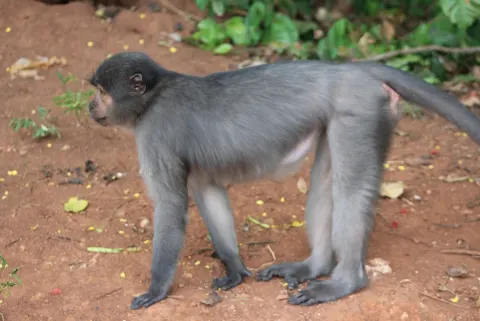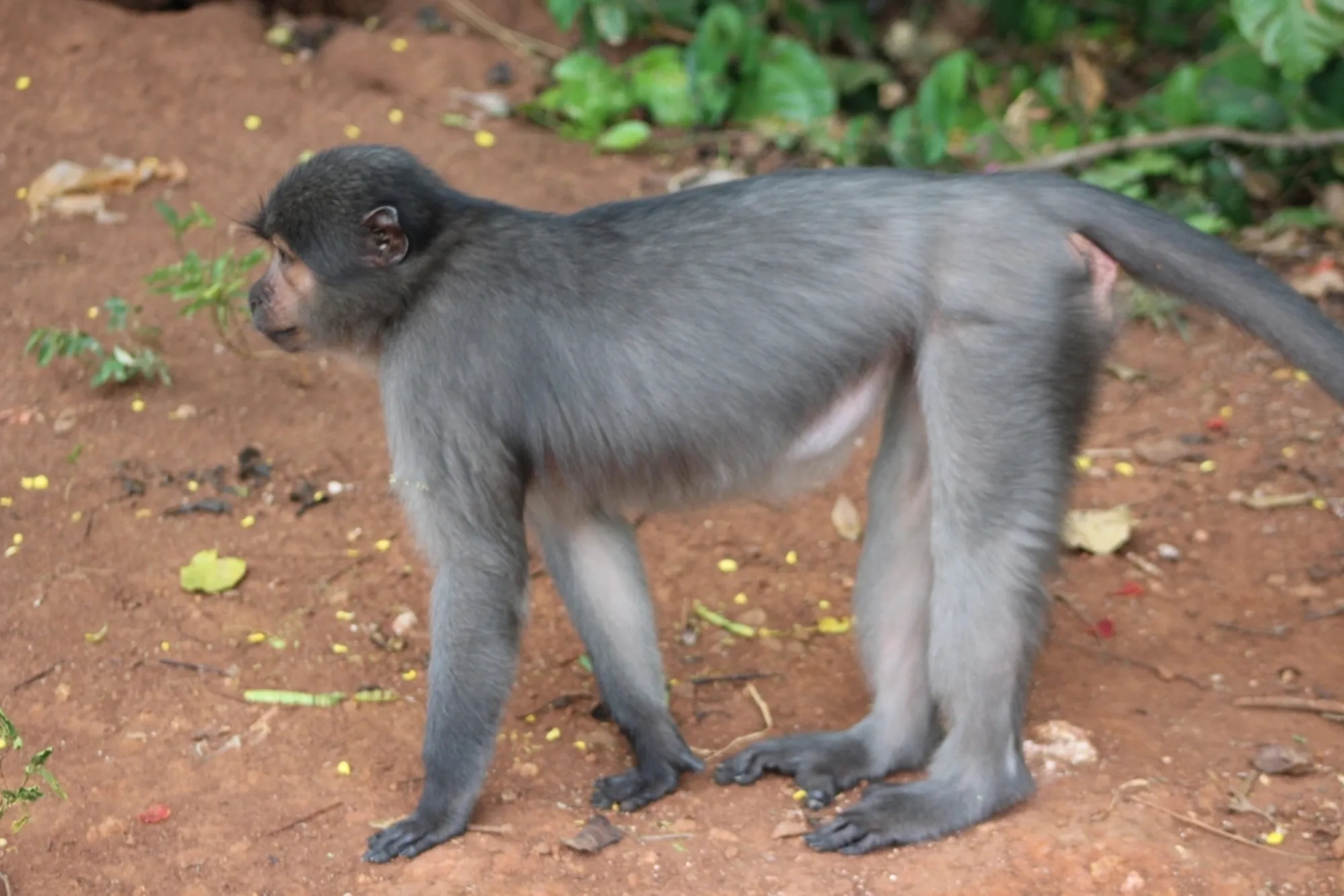
Sooty Mangabey
Cercocebus atys
Grey fur, a pale chest and stomach, and a greyish-pink face help distinguish the Sooty Mangabey, an Old World monkey of tropical West Africa. Darker fur frames its forehead and ears, while males are typically larger than females. It lives in forests from Senegal along the coast to Ivory Coast, with records also from Guinea, Guinea-Bissau, Liberia and Sierra Leone. Its habitats range from old-growth and secondary forest to dry, flooded, swamp, mangrove and gallery forests, and it also uses farmland.
Sooty mangabeys spend around 75% of their time on the ground and usually live and forage in groups of 70 to 120, with several males and females. Nuts and seeds make up more than 55% of their diet, alongside fruit and invertebrates. They have been seen scavenging coula and panda nuts left behind after chimpanzees and red river hogs opened them. Active during the day, they travel and display in the morning, often groom or play around late morning and early afternoon, and play or feed later in the afternoon. Their calls include grunts and twitters during foraging and distinct alarms for different kinds of predator. Females typically carry their young for around 160 to 170 days, and mothers have been observed defending infants against attacks by unfamiliar males.
Predators include humans and chimpanzees, as well as Gaboon vipers, crowned eagles and leopards. Their numbers are believed to be falling as forests are cleared or degraded for agriculture, firewood and timber. Hunting for meat is another threat, with animals killed in some areas faster than their populations can replace them.
Written from the English Wikipedia article Sooty mangabey (CC BY-SA 4.0).
- Records
- 2
- Countries
- 2
No atlas park has a record of the Sooty Mangabey in or around it yet.
These are open occurrence records, so they show where people looked for and recorded the Sooty Mangabey as much as where it lives. Cells are up to 25 km across, and every location is generalised to its cell.
Generalised encounter areas, not exact locations. Each shape is a grid cell coloured by how likely the species is there.
- Very likelyLiberia25 km zone · medium confidence · 1 record · updated 80 days ago
- LikelyCôte d’Ivoire25 km zone · medium confidence · 1 record · updated 80 days ago
Conservation status not assessed here yet, so every location is generalised to its grid cell.