White Rhinoceros
Ceratotherium simum
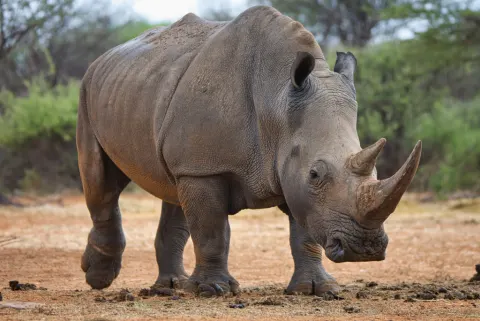
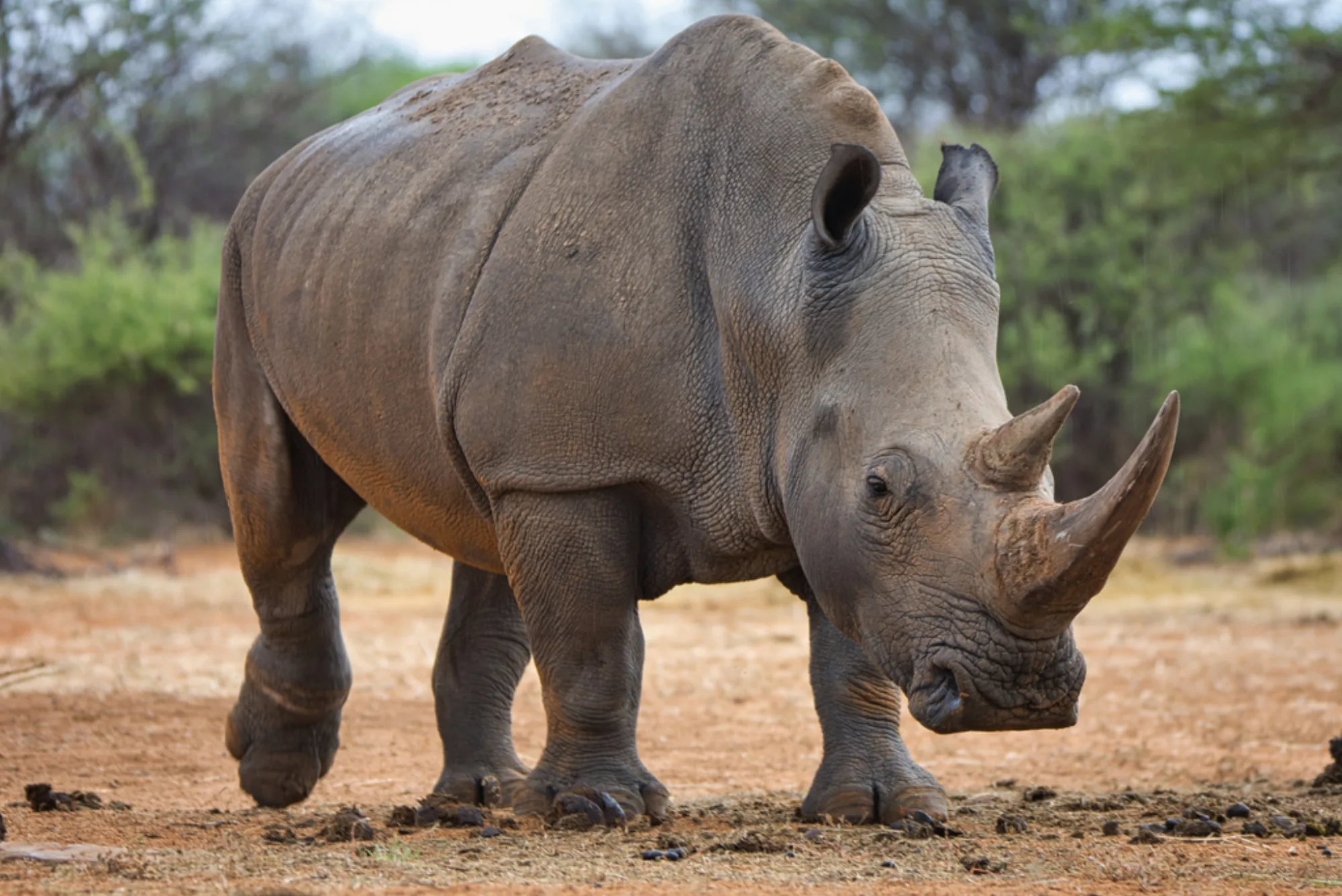
A broad, straight grazing mouth gives the White Rhinoceros its other name, the square-lipped rhinoceros. The largest living rhino has a massive body, a large head, a hump behind its neck and two horns arranged one behind the other. Its colour ranges from yellowish-brown to slate grey, and its ears can move independently to catch sounds, although it relies most on smell. Despite its bulk, it is quick and agile, reaching 50 km/h.
White rhinos inhabit grassland and savannah, with South Africa a stronghold for the southern subspecies. Smaller populations have been reintroduced to Eswatini, Uganda, Zimbabwe, Botswana and Namibia; others have been introduced to Kenya and Zambia. The northern subspecies formerly ranged across parts of East and Central Africa, and only two were confirmed remaining in 2018, both in captivity at Ol Pejeta. White rhinos graze on grass, favouring the shortest growth, and spend about half the day eating. They wallow in mud to cool down and can go four or five days without water in dry conditions. Herds can contain up to 14 animals, usually mostly females, while most adult males live alone. Dominant males mark their territories with dung and urine, and rhinos use calls to recognise one another and communicate over long distances. After a 16-month pregnancy, a female gives birth to a single calf, which she defends vigorously when threatened.
Habitat loss and poaching threaten white rhinos, with demand for horn driven by traditional medicine and jewellery. Historically, uncontrolled hunting was the major cause of their decline. Geotagged photographs can also help poachers locate rhinos, including at popular tourist attractions.
Written from the English Wikipedia article White rhinoceros (CC BY-SA 4.0).
- Records
- 33
- Countries
- 1
- Atlas places
- 3
These are open occurrence records, so they show where people looked for and recorded the White Rhinoceros as much as where it lives. Cells are up to 25 km across, and every location is generalised to its cell.
Generalised encounter areas, not exact locations. Each shape is a grid cell coloured by how likely the species is there.
- Very likelyKenya25 km zone · medium confidence · 33 records · updated 80 days ago
Conservation status not assessed here yet, so every location is generalised to its grid cell.