Desert Horned Viper
Cerastes cerastes
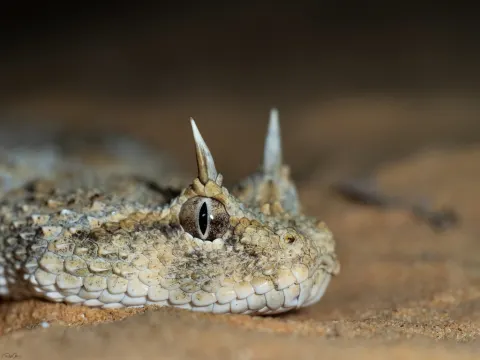
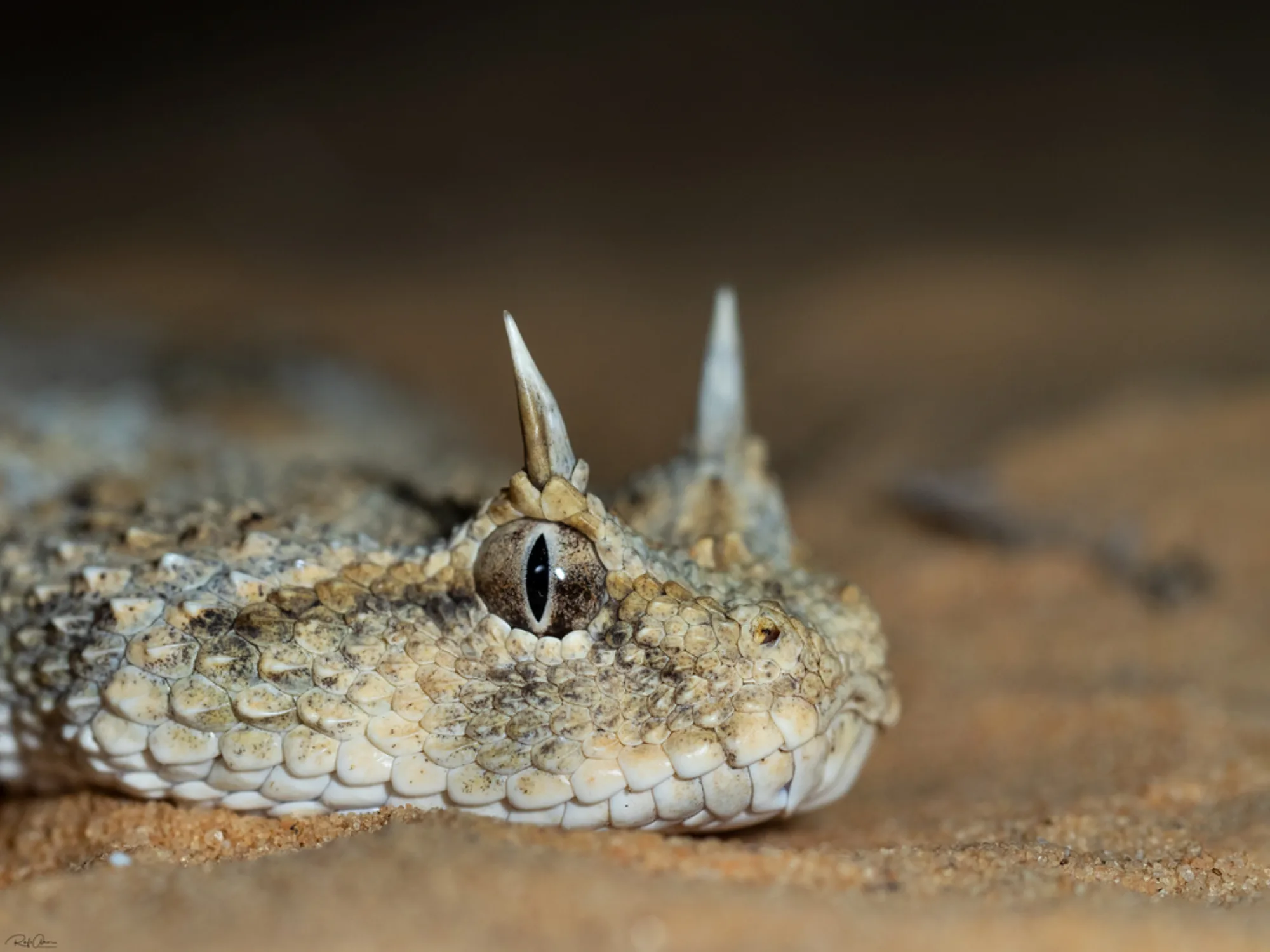
A pair of small horns above the eyes gives the Desert Horned Viper its distinctive look, though some individuals have reduced horns or none at all. Its prominent eyes sit at the sides of the head, and dark blotches run along a body that can be pale grey or yellowish, with pink, red or pale brown tones. This ground colour usually matches the surrounding sand or soil, while the belly is white and the thin tail may have a black tip. Adults average 30 to 60 cm in total length, with females larger than males.
The snake lives in North African deserts, the Levant and parts of the Arabian Peninsula, including areas of Egypt, Libya, Sudan, Iraq and Saudi Arabia. It favours dry, sandy ground with scattered rock outcrops, avoids coarse sand and sometimes turns up around oases. It has been found as high as 1,500 metres and prefers cooler places where annual temperatures average 20 °C or less.
Sidewinding leaves impressions of its body in the sand or soil. Usually placid, it may curl into a C shape and rub its coils together with a rasping sound when threatened. It hunts mainly by ambush, hidden in sand beside rocks or beneath vegetation, although it may also cover long distances after dark while looking for prey. Lizards, especially geckos, small rodents and birds make up its diet. Females lay 8 to 23 eggs under rocks or in abandoned rodent burrows; the eggs hatch after 50 to 80 days. Hatchlings measure 12 to 15 cm in total length, including the tail.
Written from the English Wikipedia article Cerastes cerastes (CC BY-SA 4.0).
- Records
- 46
- Countries
- 6
No atlas park has a record of the Desert Horned Viper in or around it yet.
These are open occurrence records, so they show where people looked for and recorded the Desert Horned Viper as much as where it lives. Cells are up to 25 km across, and every location is generalised to its cell.
Generalised encounter areas, not exact locations. Each shape is a grid cell coloured by how likely the species is there.
- Very likelyAlgeria25 km zone · medium confidence · 28 records · updated 80 days ago
- Very likelyIsrael25 km zone · medium confidence · 5 records · updated 80 days ago
- Very likelyYemen25 km zone · medium confidence · 4 records · updated 80 days ago
- LikelyMorocco25 km zone · medium confidence · 5 records · updated 80 days ago
- LikelyEgypt25 km zone · medium confidence · 4 records · updated 80 days ago
- PossibleWestern Sahara25 km zone · low confidence · 0 records · updated 80 days ago
Conservation status not assessed here yet, so every location is generalised to its grid cell.