Commerson's Dolphin
Cephalorhynchus commersonii
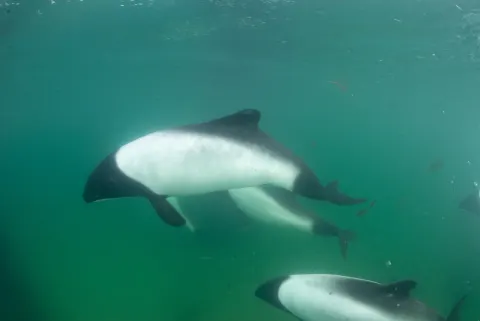
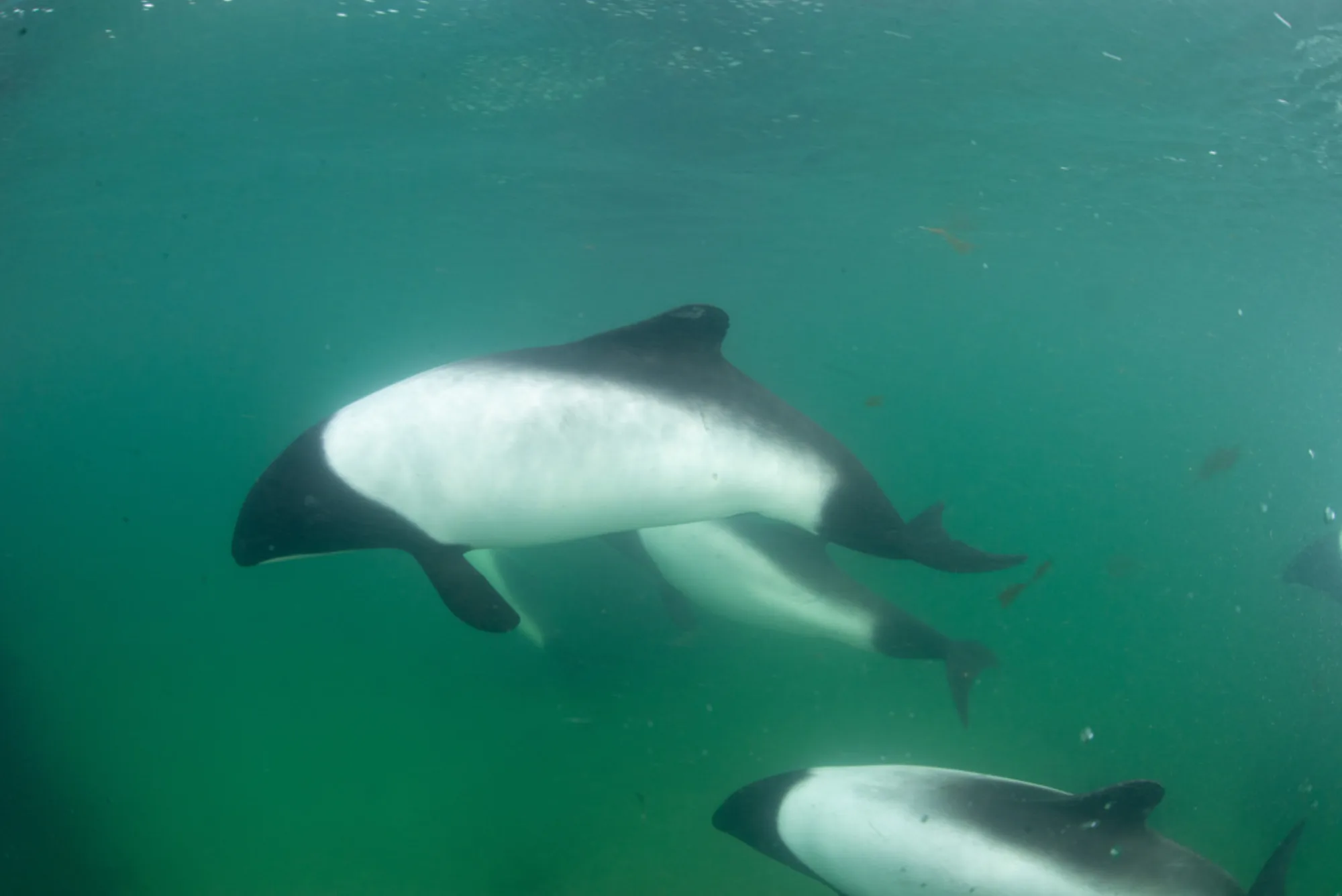
Small, stocky and boldly patterned, Commerson's Dolphin grows to around 1.5 m and can look like a porpoise. Around southern South America, it has a black head, dorsal fin and tail, contrasting sharply with a white throat and body. Dolphins near the Kerguelen Islands are generally larger, with softer-edged patches of dark and light grey and a white underside.
The two populations live far apart, and both are locally common. In South America, the dolphin occurs close to shore in Argentine inlets, including Puerto Deseado, as well as in the Strait of Magellan, off Tierra del Fuego and close to the Falkland Islands. Around the Kerguelen Islands in the southern Indian Ocean, it favours shallow water. It also uses estuaries, especially during the breeding season, and has been recorded entering the Santa Cruz River to feed at low tide.
At the surface, these active dolphins often swim fast and leap clear of the water. They twist and spin, surf breaking waves close to shore, ride at the bows of boats and follow fast-moving vessels. Their diet includes coastal and open-water fish and squid, while dolphins around South America also eat crustaceans. Females can breed from 6 to 9 years old, and males mature at about the same age. Calves are born in spring and summer after a gestation of 11 months. Living close to shore brings a significant hazard: dolphins are commonly killed accidentally in gillnets. Some Argentine and Chilean fishermen also killed them for crab bait in the 1970s and 1980s, though this practice has since been curtailed.
Written from the English Wikipedia article Commerson's dolphin (CC BY-SA 4.0).
- Records
- 592
- Countries
- 4
No atlas park has a record of the Commerson's Dolphin in or around it yet.
These are open occurrence records, so they show where people looked for and recorded the Commerson's Dolphin as much as where it lives. Cells are up to 25 km across, and every location is generalised to its cell.
Generalised encounter areas, not exact locations. Each shape is a grid cell coloured by how likely the species is there.
- Very likelyFrench Southern Territories25 km zone · high confidence · 525 records · updated 80 days ago
- Very likelyArgentina25 km zone · medium confidence · 64 records · updated 80 days ago
- LikelyFalkland Islands25 km zone · medium confidence · 3 records · updated 80 days ago
- LikelyChile25 km zone · low confidence · 0 records · updated 80 days ago
Conservation status not assessed here yet, so every location is generalised to its grid cell.