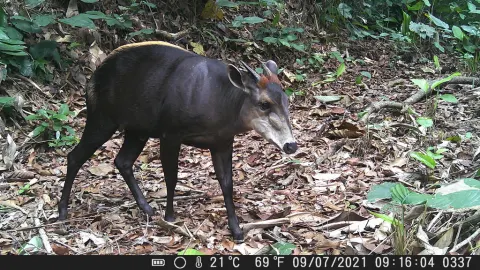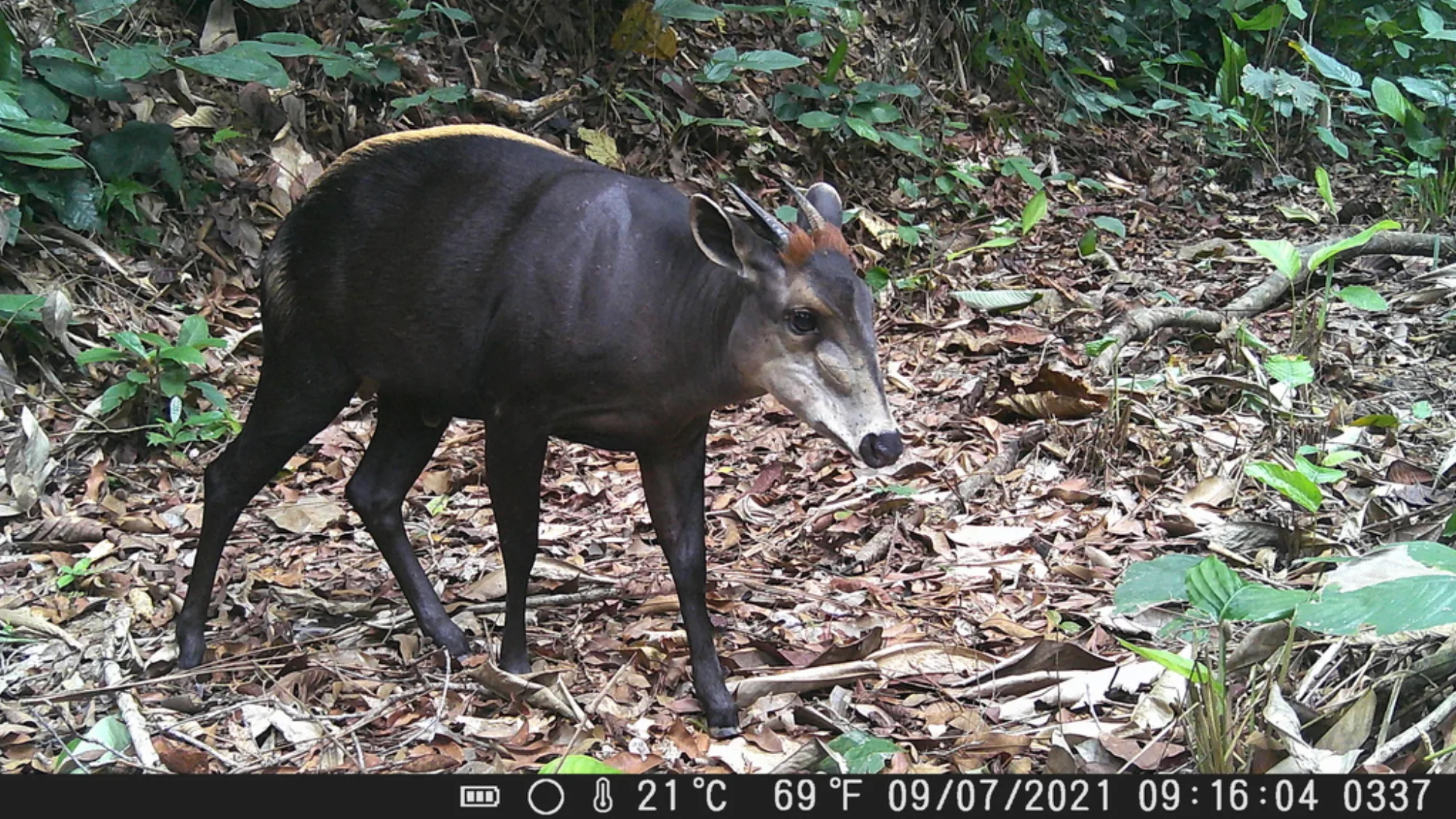
Yellow-backed Duiker
Cephalophus silvicultor
Shy and quick to flee, the Yellow-backed Duiker is a forest antelope with a rounded back that rises towards the rump. A patch of yellow hair on its rump gives it its name, and the hairs stand up when the animal feels threatened. Between its short horns sits an orange crest. Its head and body measure 115 to 145 cm, and it weighs about 60 to 80 kg; females are often slightly larger than males.
Its range lies mainly in Central and Western Africa, from Senegal and Gambia east to the Democratic Republic of the Congo and western Uganda, and south into Rwanda, Burundi and most of Zambia. It lives chiefly in forests, including rain, montane, riparian and semi-deciduous forests, but also uses open bush, isolated patches of forest and savanna clearings. Its body shape helps it move quickly through thick vegetation and dive into undergrowth for cover. Easily startled, it may run almost blindly when frightened or pursued. Active both day and night, it usually lives alone or in pairs, with small herds rarely seen.
Fruit makes up most of its diet, though it also selects shoots, roots, leaves and buds, and occasionally kills and eats small animals such as birds. Breeding can take place throughout the year, and many breed twice annually. A calf stays hidden for its first week, then weans between 3 and 5 months after birth. Hunting poses a major threat: duikers provide food and income, and a yellow-backed duiker can freeze in torchlight, making it easy to approach at night. The species may already have disappeared locally from the Oban Sector of Nigeria's Cross River National Park.
Written from the English Wikipedia article Yellow-backed duiker (CC BY-SA 4.0).
- Records
- 0
- Countries
- 2
No atlas park has a record of the Yellow-backed Duiker in or around it yet.
These are open occurrence records, so they show where people looked for and recorded the Yellow-backed Duiker as much as where it lives. Cells are up to 25 km across, and every location is generalised to its cell.
Generalised encounter areas, not exact locations. Each shape is a grid cell coloured by how likely the species is there.
- Very likelyLiberia25 km zone · low confidence · 0 records · updated 81 days ago
- UncommonCongo - Kinshasa25 km zone · low confidence · 0 records · updated 81 days ago
Conservation status not assessed here yet, so every location is generalised to its grid cell.