Red-flanked Duiker
Cephalophus rufilatus
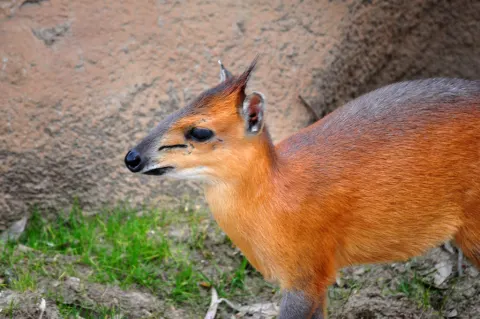
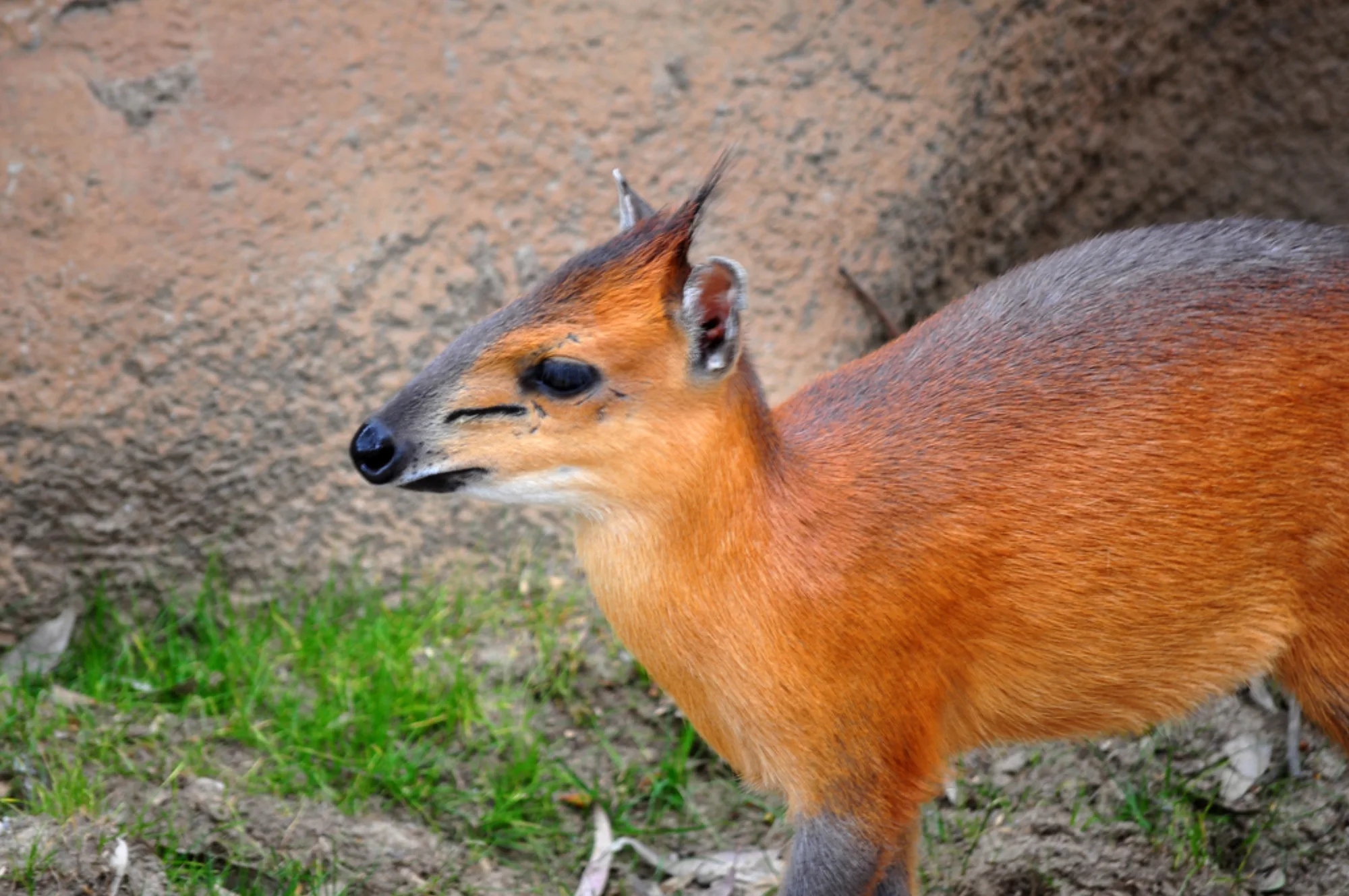
Small and alert, the Red-flanked Duiker stands about 34 to 37 centimetres tall and weighs around 12 to 14 kilograms. Its blackish-grey back blends into reddish-brown on the neck and flanks, while the legs are bluish-grey and the underbelly is white. Small white marks on the ears and snout, a dark stripe down the face and a tuft of black hair between the horns add to its distinctive appearance. Males have short horns that point backwards, while females often have none or have shorter ones.
Across West and Central Africa, its range stretches from Senegal and the Gambia to Sudan and the Nile Valley. Look for its habitat in open savannah woodland and at forest edges, as well as river basins with elephant grass or dense shrubs. Mainly solitary and territorial, it may share a small territory with another duiker for a few months before moving on. Early morning and the period just before dusk are its busiest times, and a startled animal will duck its head and plunge into thick vegetation. It browses on leaves, flowers, fallen fruit and twigs, also eating seeds and sometimes shoots.
Females usually have one young each year, with births during the dry months or around the onset of the wet season. The newborn quickly finds cover in vegetation, emerging when its mother returns to feed it. Leopards, crowned eagles and African rock pythons hunt duikers, but people probably kill more than these predators combined. Although logging and conversion to more open savannah and farmland have expanded its range, heavy hunting pressure is driving an overall decline in numbers.
Written from the English Wikipedia article Red-flanked duiker (CC BY-SA 4.0).
- Records
- 77
- Countries
- 7
No atlas park has a record of the Red-flanked Duiker in or around it yet.
These are open occurrence records, so they show where people looked for and recorded the Red-flanked Duiker as much as where it lives. Cells are up to 25 km across, and every location is generalised to its cell.
Generalised encounter areas, not exact locations. Each shape is a grid cell coloured by how likely the species is there.
- Very likelyBurkina Faso25 km zone · medium confidence · 47 records · updated 80 days ago
- Very likelyBenin25 km zone · medium confidence · 11 records · updated 80 days ago
- Very likelyCentral African Republic25 km zone · medium confidence · 11 records · updated 80 days ago
- Very likelyUnited States25 km zone · medium confidence · 4 records · updated 80 days ago
- LikelyCameroon25 km zone · medium confidence · 2 records · updated 80 days ago
- LikelySenegal25 km zone · medium confidence · 2 records · updated 80 days ago
- RareCongo - Kinshasa25 km zone · low confidence · 0 records · updated 80 days ago
Conservation status not assessed here yet, so every location is generalised to its grid cell.