Black Sea Bass
Centropristis striata
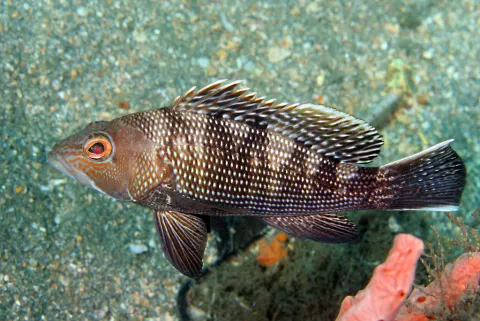
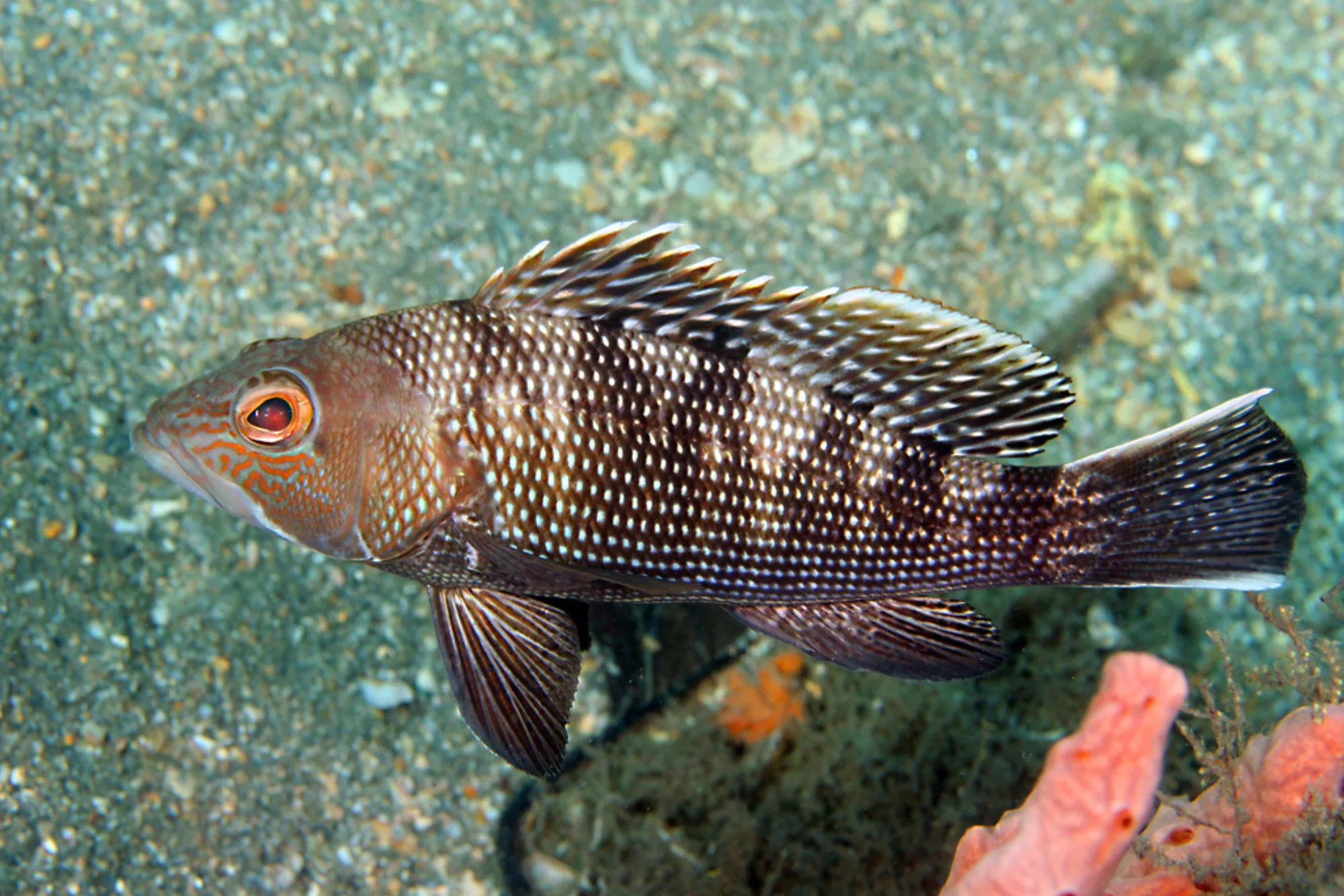
Along North America's western Atlantic coast, the Black Sea Bass (Centropristis striata) ranges from Nova Scotia south to the Florida Keys, then west through the Gulf of Mexico to Louisiana. This marine fish has an elongated body, a large mouth and a back that can be smoky grey, dusky brown or blue-black, becoming paler underneath. Pale blue or white spots on its scales make stripes along its back and sides, while white spots and bands mark its dorsal fin. Its sides can also look mottled or show alternating dark and light bars. During the breeding season, males develop a hump on the head, with bright blue and green colouring at the nape and around the eyes; females remain duller and paler.
Look for this fish near rock jetties and rocky ground in shallow water, although it also occurs offshore at depths down to 130 metres. It spends much of its time close to the bottom, gathering around rock piles, wrecks and artificial structures. A resting fish may point either upwards or downwards, and it can raise and spread its usually folded dorsal fin as a warning to another of its kind. Young fish stay in sheltered estuaries around structures, wrecks and shell-covered ground. Black Sea Bass hunt a wide range of prey, including crabs, shrimps, worms, small fish and bivalves.
Spawning takes place from January to July, and larger females can produce 500,000 eggs. Monkfish, bluefish and dusky sharks are among the larger fish that prey on Black Sea Bass. People also catch them commercially and for recreation, using trawls, hook and line, pots and traps; fishing is managed with measures that include catch limits and a closed season.
Written from the English Wikipedia article Black sea bass (CC BY-SA 4.0).
- Records
- 2,868
- Countries
- 2
No atlas park has a record of the Black Sea Bass in or around it yet.
These are open occurrence records, so they show where people looked for and recorded the Black Sea Bass as much as where it lives. Cells are up to 25 km across, and every location is generalised to its cell.
Generalised encounter areas, not exact locations. Each shape is a grid cell coloured by how likely the species is there.
- Very likelyUnited States25 km zone · medium confidence · 2864 records · updated 80 days ago
- PossibleCanada25 km zone · medium confidence · 4 records · updated 80 days ago
Conservation status not assessed here yet, so every location is generalised to its grid cell.