Snook
Centropomus undecimalis
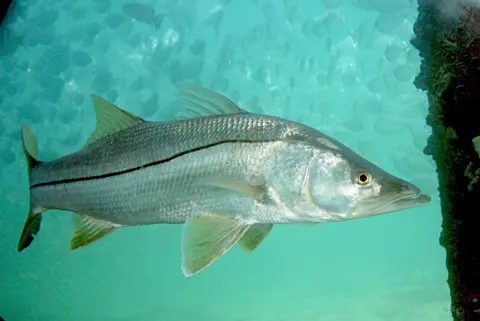
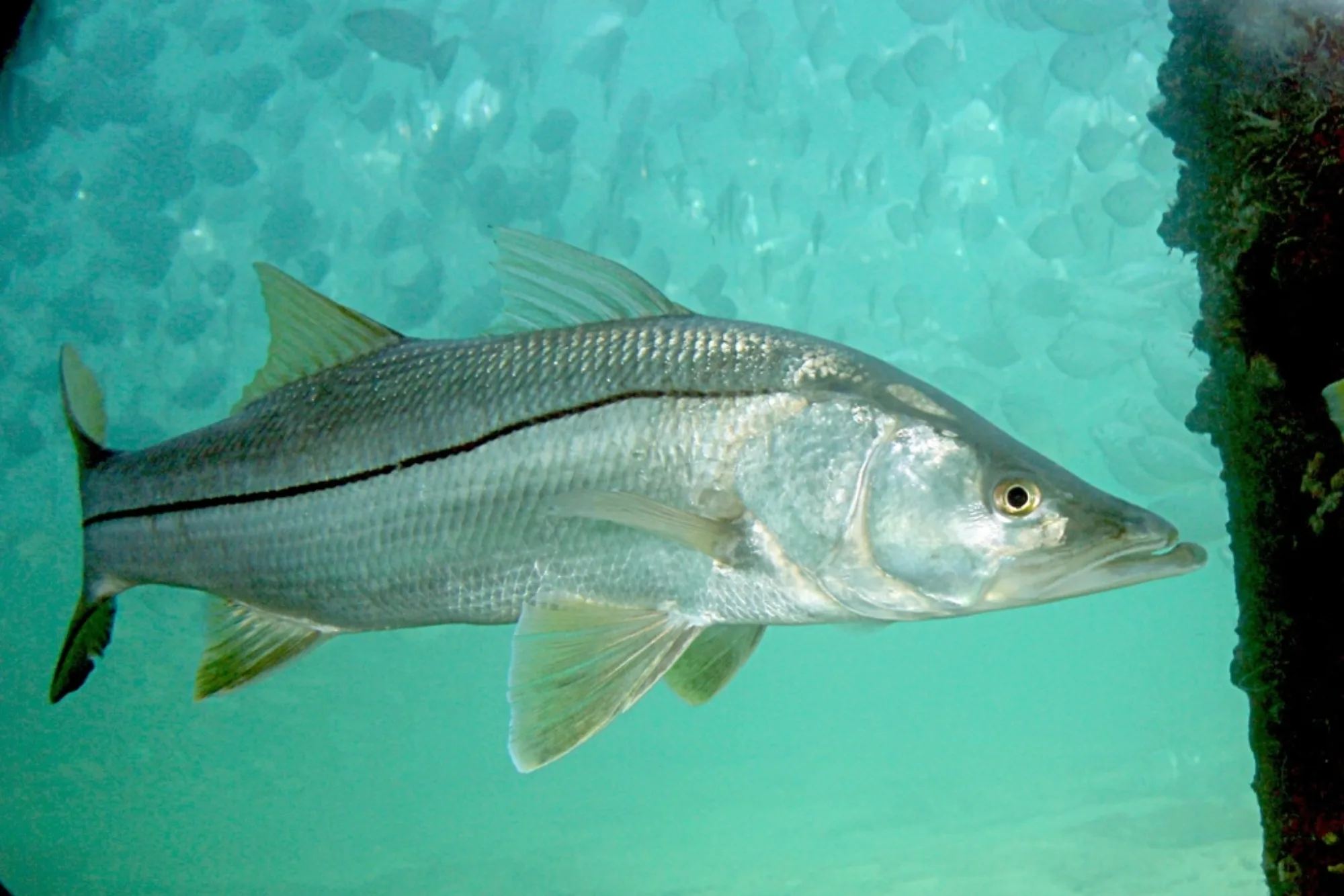
A dark stripe running along its side makes the Snook (Centropomus undecimalis) recognisable against its otherwise subdued colouring. Its pelvic and tail fins can be bright yellow, especially around spawning time. Commonly 50 cm long, this fish can reach 140 cm, making it one of the largest snooks.
Snook range through tropical waters of the western Atlantic, reaching from North Carolina south to Brazil and occurring in both the Caribbean Sea and the Gulf of Mexico. They inhabit estuaries, lagoons and shallow coastal waters down to 20 m, and often enter fresh water. Young fish favour less salty water and are often found in coastal wetland ponds, networks of islands and creeks within estuaries. The species can also thrive in saltier water, adapting to a range of habitats as it grows. An opportunistic predator, the Snook eats mainly smaller fish and crustaceans, including shrimp and occasionally crabs. Larger snook take larger prey, and adults sometimes eat juveniles, usually in winter when the two are close together in estuaries.
Spawning takes place from April to October, with a peak in July and August, typically in salty near-shore waters. Afterwards, juveniles move into nearby brackish estuaries, returning to saltier open water as adults to join the breeding population. Cold poses a serious threat: Snook stop feeding when water cools to 14.2 °C, and can die at 12.5 °C. A cold snap in January 2010 was followed by a 41.88% decline in nominal abundance in southwest Florida compared with the previous year. Snook are also caught commercially and pursued as game fish. Following the 2010 cold kill, recreational harvest was closed in Florida's Gulf of Mexico and Atlantic waters, with the Gulf harvest reopening in September 2013.
Written from the English Wikipedia article Common snook (CC BY-SA 4.0).
- Records
- 28,204
- Countries
- 11
- Atlas places
- 2
These are open occurrence records, so they show where people looked for and recorded the Snook as much as where it lives. Cells are up to 25 km across, and every location is generalised to its cell.
Generalised encounter areas, not exact locations. Each shape is a grid cell coloured by how likely the species is there.
- Very likelyColombia25 km zone · high confidence · 26171 records · updated 80 days ago
- Very likelyUnited States25 km zone · high confidence · 1854 records · updated 80 days ago
- Very likelyMexico25 km zone · medium confidence · 84 records · updated 80 days ago
- Very likelyBrazil25 km zone · medium confidence · 70 records · updated 80 days ago
- LikelyCosta Rica25 km zone · medium confidence · 18 records · updated 80 days ago
- PossibleCuraçao25 km zone · medium confidence · 3 records · updated 80 days ago
- PossibleHonduras25 km zone · medium confidence · 3 records · updated 80 days ago
- UncommonFrench Guiana25 km zone · medium confidence · 1 record · updated 80 days ago
- RareCaribbean Netherlands25 km zone · low confidence · 0 records · updated 80 days ago
- RareGuadeloupe25 km zone · low confidence · 0 records · updated 80 days ago
Conservation status not assessed here yet, so every location is generalised to its grid cell.