Sage Grouse
Centrocercus urophasianus
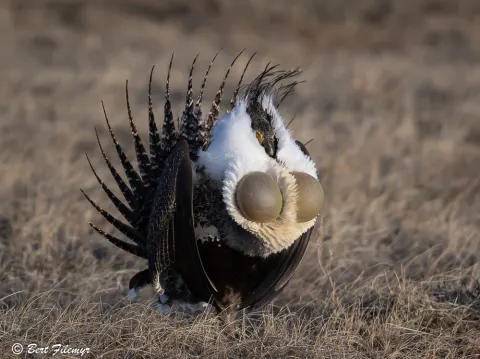
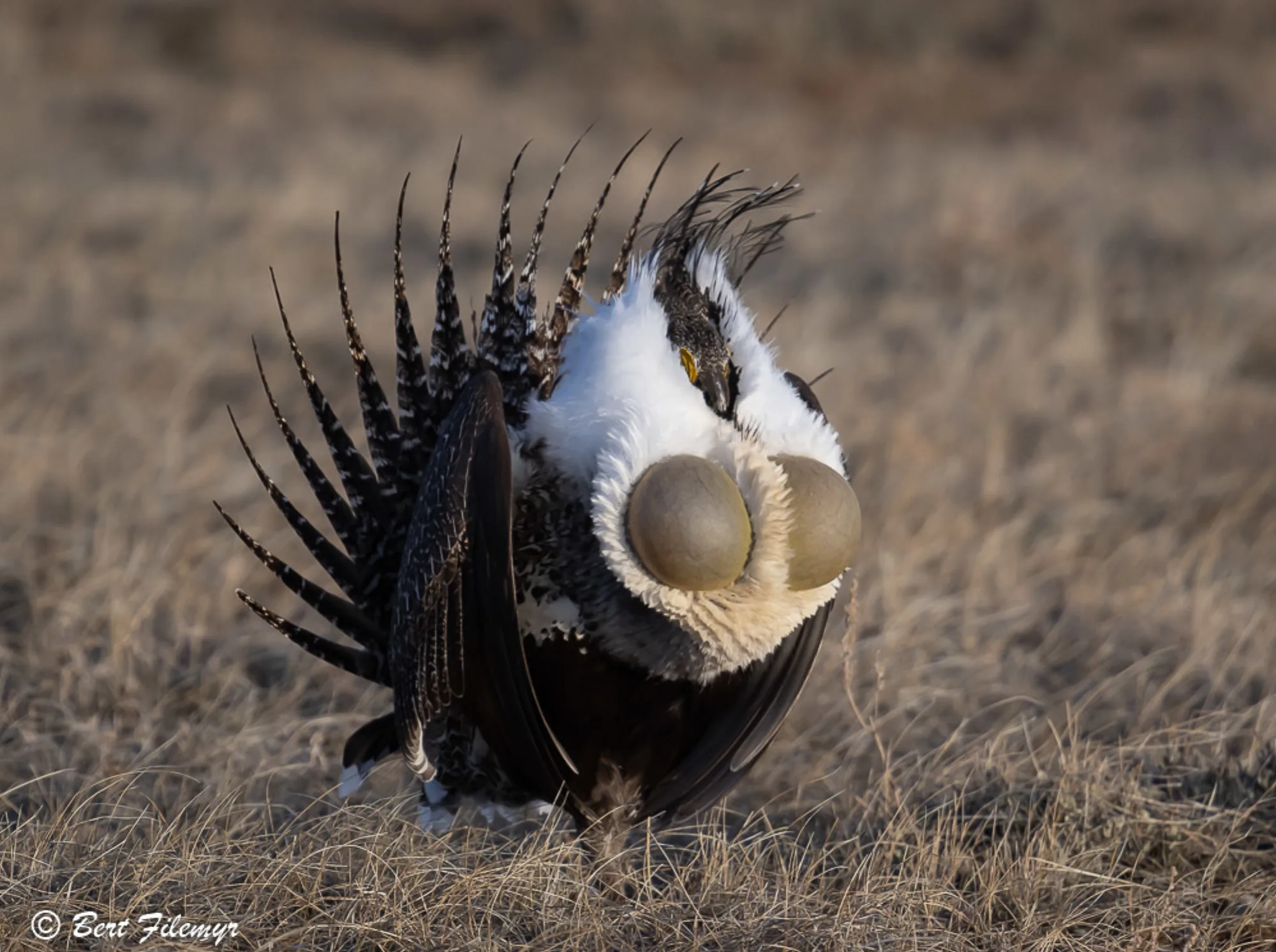
Across the sagebrush country of western North America, the Sage Grouse stands out as the continent's largest grouse. Adults have long, pointed tails and feathered legs; males are greyish above, with white breasts, black bellies and yellow patches over their eyes. Females are smaller and mottled grey-brown, with light brown throats and dark bellies. Its range extends across the western United States into the southern parts of Alberta and Saskatchewan, with birds usually living in sagebrush grassland, sometimes among juniper. Meadows surrounded by sagebrush can provide feeding grounds, while desert shrub habitat is also used.
Most birds stay in their breeding areas year-round, although some move to lower ground in winter. In Idaho, they have travelled as far as 160 km to avoid deep snow. Each spring, males gather at display grounds known as leks, where they strut in the early morning and evening while females watch. Leks can be found in open places, including meadows, exposed knolls and patches of sparse sagebrush. Hens make ground nests beneath sagebrush or grass, usually near the display grounds, and lay six to eight eggs. Chicks feed themselves and can fly by two weeks of age, though their movements remain limited at first.
Sage Grouse forage on the ground, eating sagebrush throughout the year as well as other plants and insects. Young chicks eat mostly insects, especially ants and beetles, before shifting towards plants. Habitat loss has driven declines across the bird's range, with residential building and energy development contributing to the loss. Inadequate vegetation cover can also leave nests and young exposed to predators.
Written from the English Wikipedia article Greater sage-grouse (CC BY-SA 4.0).
- Records
- 13,067
- Countries
- 1
- Atlas places
- 2
These are open occurrence records, so they show where people looked for and recorded the Sage Grouse as much as where it lives. Cells are up to 25 km across, and every location is generalised to its cell.
Generalised encounter areas, not exact locations. Each shape is a grid cell coloured by how likely the species is there.
- Very likelyUnited States25 km zone · medium confidence · 13067 records · updated 80 days ago
Conservation status not assessed here yet, so every location is generalised to its grid cell.