Giant Barb
Catlocarpio siamensis
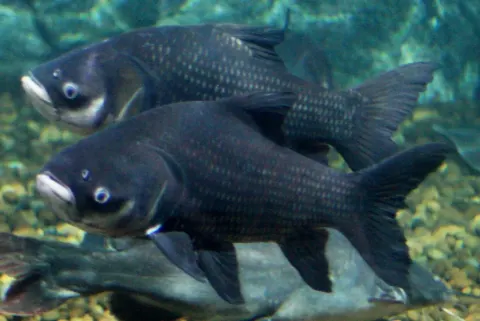
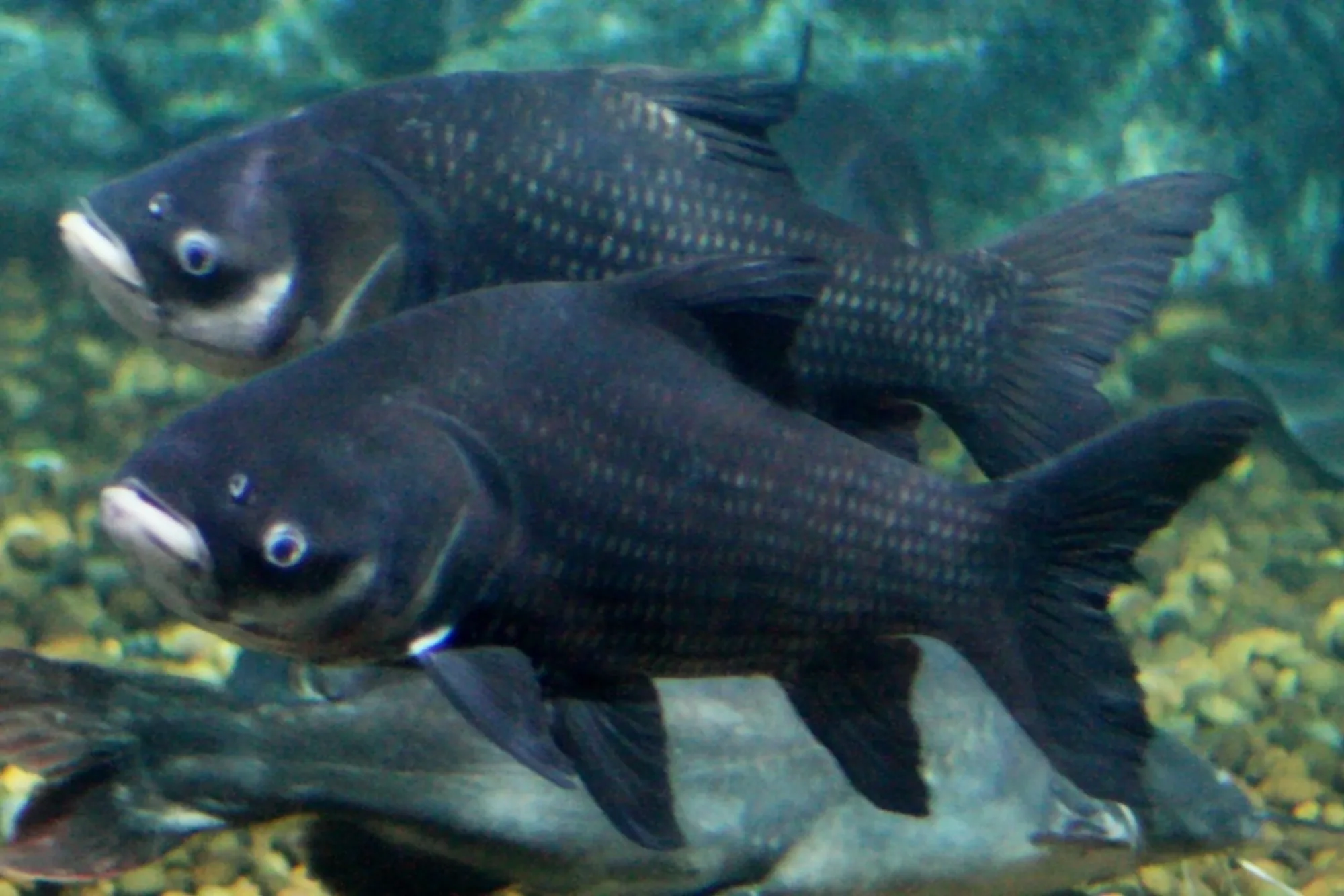
Found only within the river systems of the Mekong, Mae Klong, and Chao Phraya, the Giant Barb is the biggest member of the carp family in the world. This massive freshwater fish has a notably large head relative to its body and lacks any barbels. While historical reports suggest they could once reach lengths of 3 m and weights of 300 kg, modern specimens are much smaller. Today, the maximum length is typically around 1.8 m, and a recent record-breaking catch in Thailand weighed 105 kg. These fish are slow-moving and generally travel in pairs throughout their Indochinese range.
Their lifestyle is migratory, as they move between different areas to find food or suitable conditions for breeding depending on the time of year. You might spot them in deep pools along the margins of major rivers, though they also move into flooded forests, floodplains, and smaller canals during certain seasons. Young fish are more common in swamps and small tributaries. Their diet is almost entirely vegetarian, consisting of phytoplankton, algae, and the fallen fruits of plants submerged by floodwaters. They rarely, if ever, consume other animals.
Despite their size, these giants face severe pressure from human activity. Populations have plummeted due to the destruction of their natural habitats, specifically through pollution and the construction of dams. Overfishing has also taken a heavy toll. For instance, Cambodia recorded a catch of 200 tonnes in 1964, but that number dropped to just 10 fish by the year 2000. While they are now being raised in breeding centers and ponds for their economic value, very few individuals in the wild manage to survive long enough to reach full maturity.
Written from the English Wikipedia article Giant barb (CC BY-SA 4.0).
- Records
- 0
- Countries
- 1
- Atlas places
- 0
These are open occurrence records, so they show where people looked for and recorded the Giant Barb as much as where it lives. Cells are up to 25 km across, and every location is generalised to its cell.
Generalised encounter areas, not exact locations. Each shape is a grid cell coloured by how likely the species is there.
- Very likelyThailand50 km zone · low confidence · 0 records · updated 4 days ago