Chacoan Peccary
Catagonus wagneri
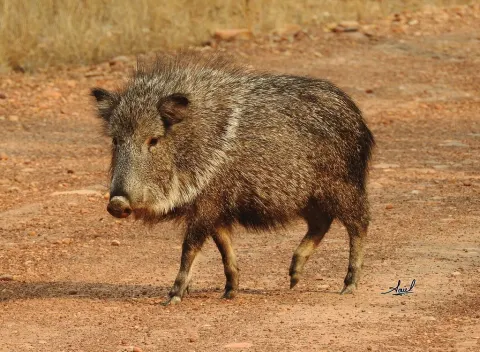
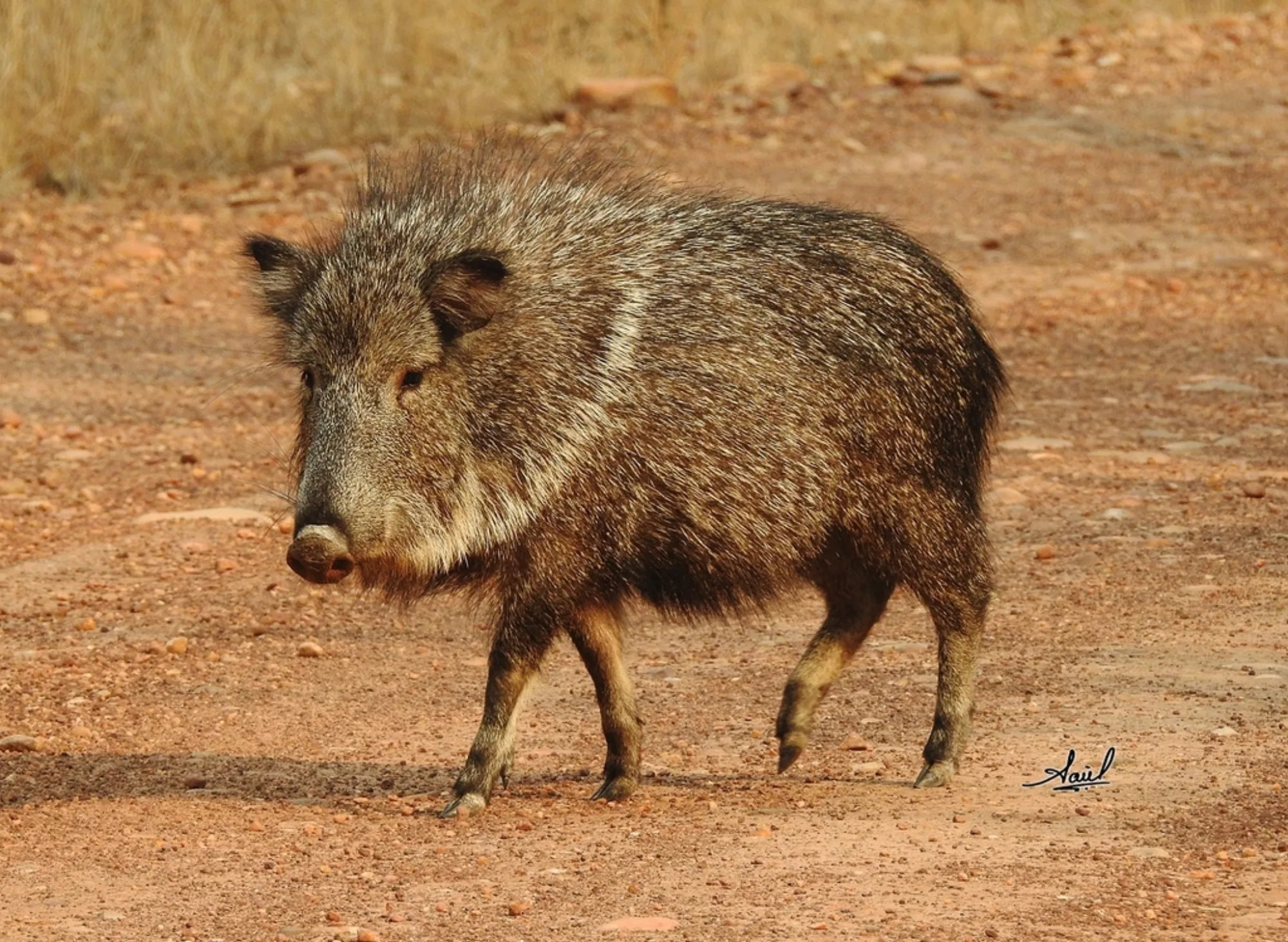
Pig-like in shape, the Chacoan Peccary has a tough, leathery snout and bristly hair ranging from brown to almost grey. A dark stripe crosses its back, while white fur marks its shoulders and surrounds its mouth. Compared with other peccaries, it has longer ears, a longer snout and a longer tail. Its home is the Gran Chaco, a hot, dry region spanning parts of Paraguay, Bolivia and Argentina, where thorny scrub and low-growing succulents surround scattered giant trees. Its small feet help it move among the spiny plants.
These social mammals travel in herds of up to 20 and are active by day, especially in the morning. They communicate with sounds ranging from grunts to teeth chattering, and may form a defensive wall when threatened. They mark trees and shrubs by rubbing against them, bathe frequently in mud or dust, and use particular places as dung stations. Cacti are a major part of their diet: a peccary can roll them on the ground to rub off the spines, or pull the spines off with its teeth and spit them out. Fallen cactus flowers and acacia pods are also on the menu, along with occasional bromeliad roots; salt licks provide minerals.
Most births take place from September to December, though litters have been found in almost every part of the year. A female may separate from the herd for the birth and rejoin it afterwards; her newborn can run within a few hours. Herd numbers are falling as habitat is lost and fragmented, with land being turned into large ranches. Hunting continues, and an unidentified disease has affected herds in recent years.
Written from the English Wikipedia article Chacoan peccary (CC BY-SA 4.0).
- Records
- 7
- Countries
- 1
No atlas park has a record of the Chacoan Peccary in or around it yet.
These are open occurrence records, so they show where people looked for and recorded the Chacoan Peccary as much as where it lives. Cells are up to 25 km across, and every location is generalised to its cell.
Generalised encounter areas, not exact locations. Each shape is a grid cell coloured by how likely the species is there.
- Very likelyParaguay25 km zone · medium confidence · 7 records · updated 80 days ago
Conservation status not assessed here yet, so every location is generalised to its grid cell.