Southern Cassowary
Casuarius casuarius
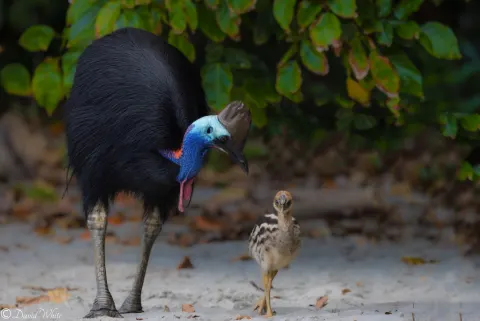
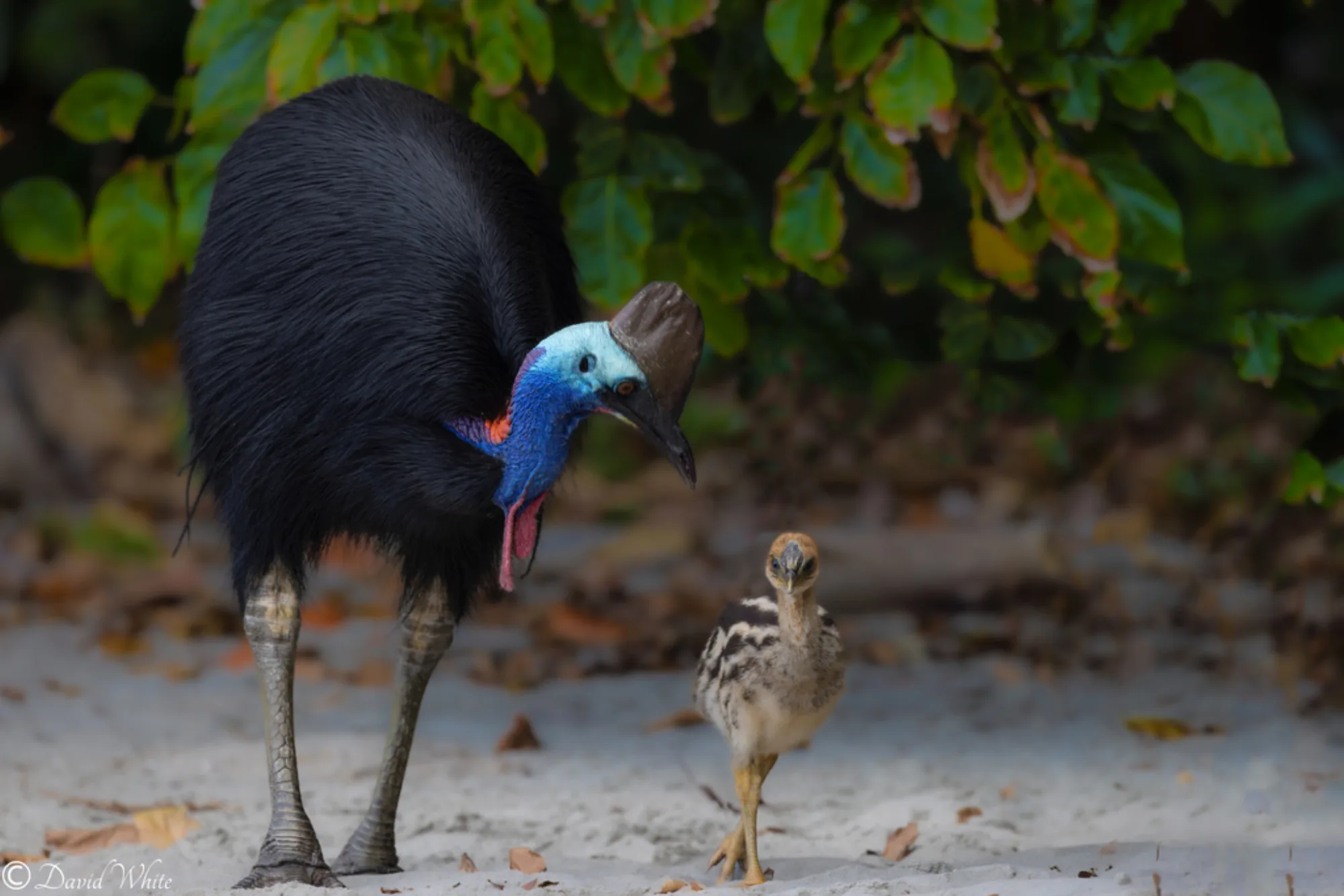
Tall, flightless and mostly black, the Southern Cassowary carries a brown, horn-like casque above its blue face. Adults have stiff, bristly feathers, a long neck with red colouring, and two red wattles hanging at the throat. Females are generally larger and brighter than males, while young birds start out with soft, striped plumage before developing brown feathers that darken as they grow. The bird typically stands 1.5 to 1.8 m tall, can run at up to 50 km/h and is a strong swimmer.
Southern Cassowaries live across northeastern Australia, Papua New Guinea and Indonesia, mainly in tropical rainforest, though they also use nearby savannah forests and mangroves. On the forest floor, they search for seeds and fallen fruit, including some that other animals cannot safely digest. Their diet also includes fungi, insects, snails, small vertebrates and carrion. Usually solitary, they pair during the breeding season, which falls in late winter or spring but varies considerably. The male builds a ground nest from plant material, then tends the eggs and brings up the chicks on his own. Chicks can move and explore within hours of hatching, but depend on the male for survival and usually become independent at 9 to 12 months.
Habitat loss, including loss caused by logging, affects the species, while hunting is a threat in some areas. Feral animals eat cassowary eggs, and road-building and vehicle strikes also take a toll. Feeding cassowaries can draw them towards inhabited areas, making encounters with people and vehicle strikes more likely.
Written from the English Wikipedia article Southern cassowary (CC BY-SA 4.0).
- Records
- 7,190
- Countries
- 3
- Atlas places
- 1
These are open occurrence records, so they show where people looked for and recorded the Southern Cassowary as much as where it lives. Cells are up to 25 km across, and every location is generalised to its cell.
Generalised encounter areas, not exact locations. Each shape is a grid cell coloured by how likely the species is there.
- Very likelyAustralia25 km zone · high confidence · 7093 records · updated 80 days ago
- LikelyPapua New Guinea25 km zone · medium confidence · 64 records · updated 80 days ago
- PossibleIndonesia25 km zone · medium confidence · 33 records · updated 80 days ago
Conservation status not assessed here yet, so every location is generalised to its grid cell.