Dwarf Cassowary
Casuarius bennetti
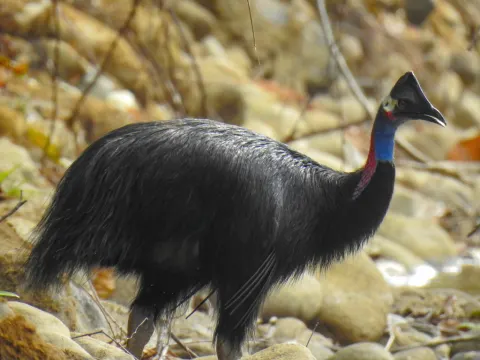
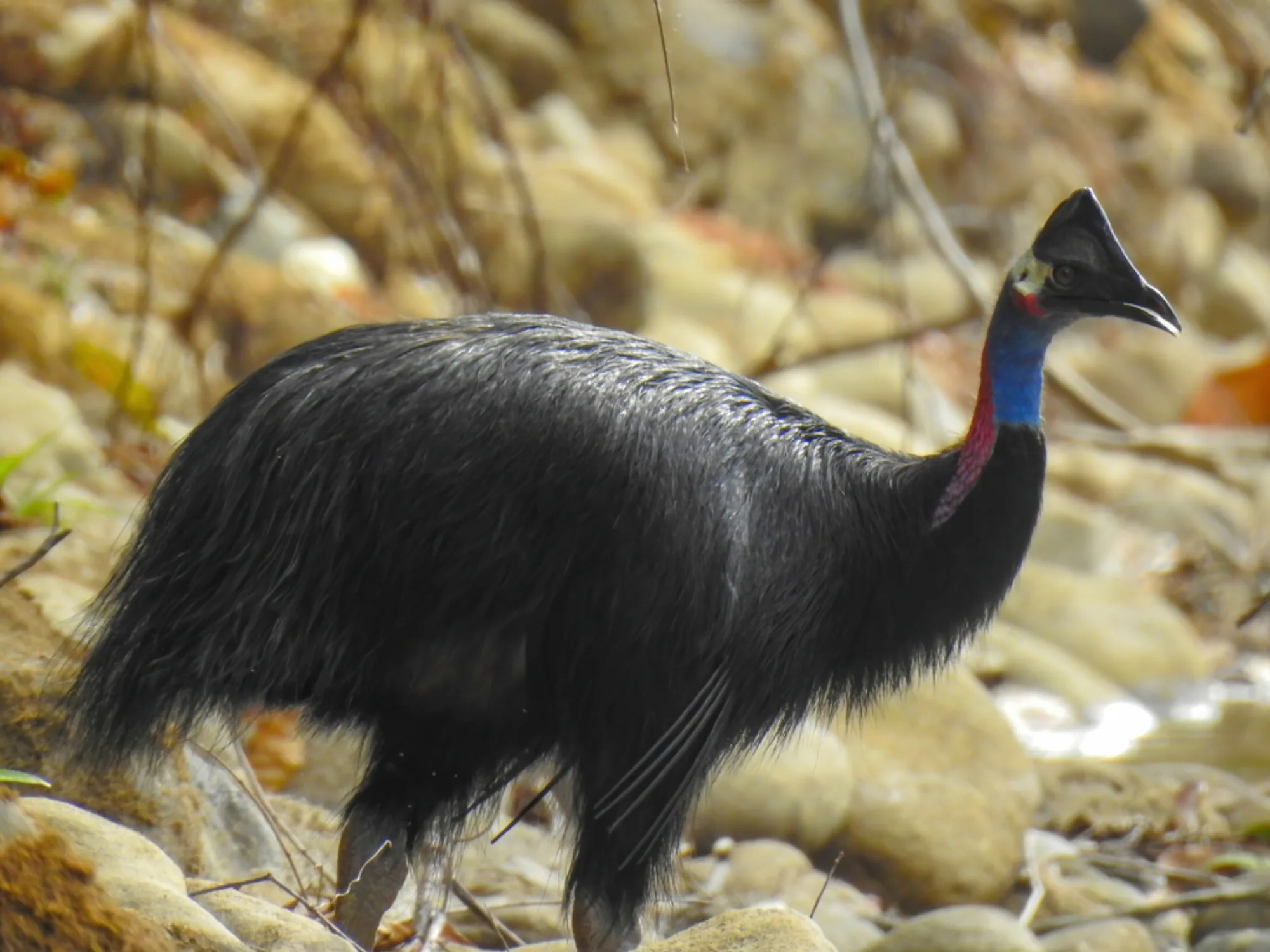
Smaller than its living cassowary relatives, the Dwarf Cassowary is still a large, flightless bird, standing 99 to 135 cm tall in total. It has stiff black feathers, a low triangular casque, pink cheeks and red patches on a blue neck. Its large, powerful feet carry inner claws that can reach 10 cm. Males and females look similar, although females are larger, with longer casques and brighter bare skin.
The bird lives in the mountain cloud forests and tropical rainforests of New Guinea, as well as on Yapen Island and islands of the Bismarck Archipelago, including New Britain and New Ireland. It occurs at elevations of around 3,300 m above sea level. Where it does not encounter the northern or southern cassowary, it may also forage in lowland or open forest. It usually searches for food alone or in small family groups, though larger gatherings can form around good feeding sites. It may migrate seasonally in part of its range, although it is sometimes thought to stay in one place.
Fallen fruit and fruit picked from shrubs form much of its diet, alongside invertebrates, small vertebrates and fungi. It uses its head crest to sift through leaf litter, uncovering food that can include insects, plant tissue, lizards and frogs. Breeding has been recorded in both wet and dry seasons. A nest is a shallow hollow on the ground, holding a clutch of 2 to 5 eggs. The male alone incubates the eggs for 49 to 52 days and raises the chicks. Habitat loss and degradation, hunting for food and capture for captivity have all put pressure on the species, although hunting pressure is substantially lower than in the past.
Written from the English Wikipedia article Dwarf cassowary (CC BY-SA 4.0).
- Records
- 71
- Countries
- 2
No atlas park has a record of the Dwarf Cassowary in or around it yet.
These are open occurrence records, so they show where people looked for and recorded the Dwarf Cassowary as much as where it lives. Cells are up to 25 km across, and every location is generalised to its cell.
Generalised encounter areas, not exact locations. Each shape is a grid cell coloured by how likely the species is there.
- Very likelyPapua New Guinea25 km zone · medium confidence · 64 records · updated 80 days ago
- LikelyIndonesia25 km zone · medium confidence · 7 records · updated 80 days ago
Conservation status not assessed here yet, so every location is generalised to its grid cell.