Eurasian Beaver
Castor fiber
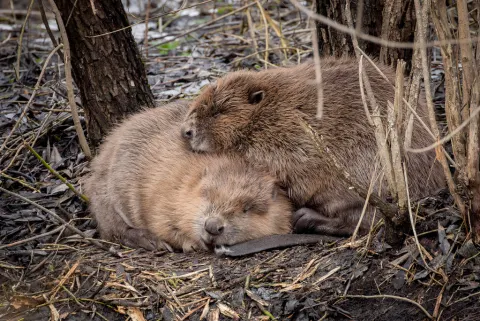
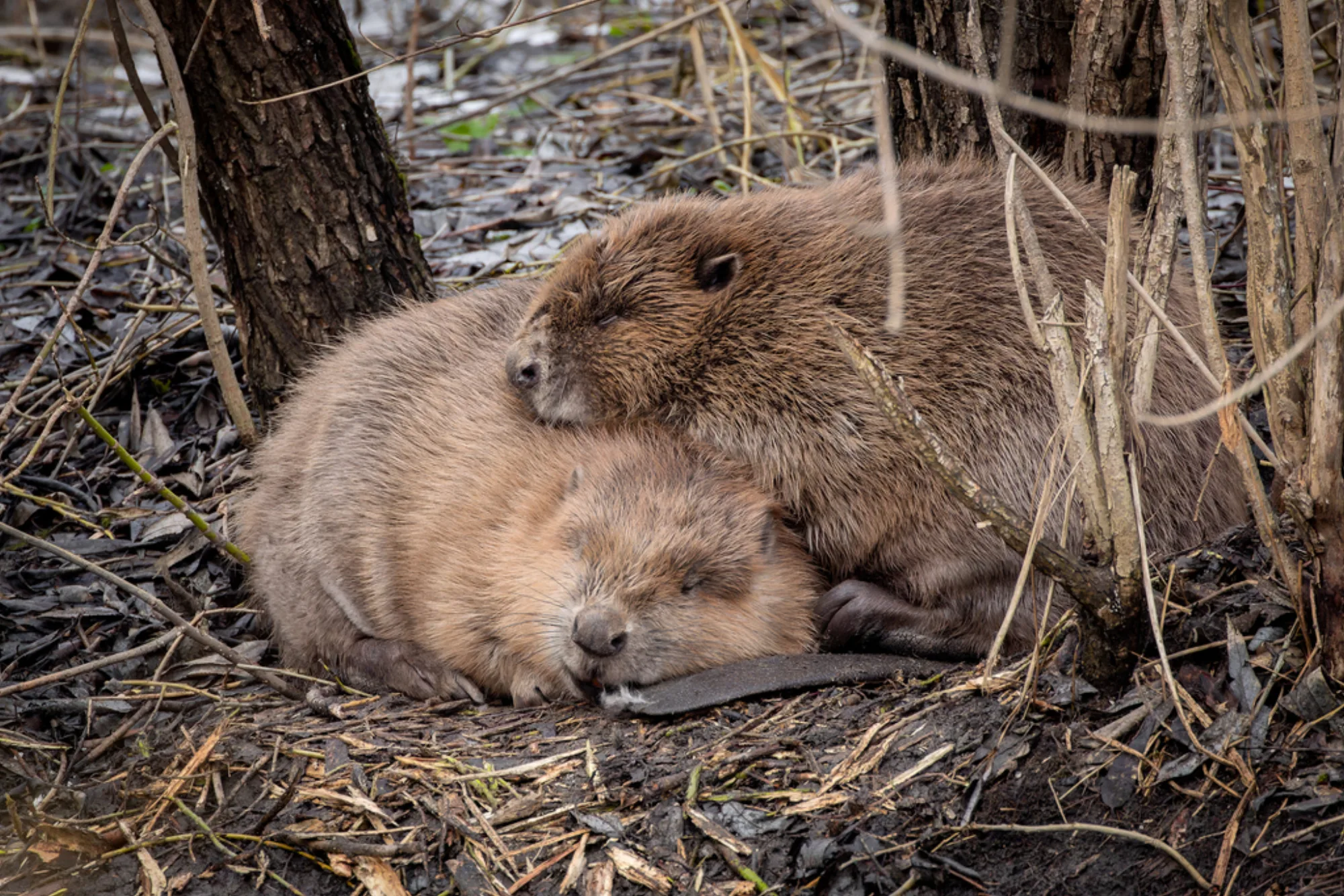
With its flat, scaly tail and large body, the Eurasian Beaver is one of the largest living rodents. Its fur varies in colour, from pale brown and reddish brown to blackish shades. An adult typically measures 80 to 100 cm from head to body, with a tail 25 to 50 cm long, and weighs around 11 to 30 kg. Once widespread across Europe and Asia, it was hunted for its fur and castoreum, a secretion valued for supposed medicinal properties. Hunting brought it close to extinction, but protection and reintroductions have helped it recover across much of its former range.
Today, beavers live across much of continental Europe and Scandinavia, as well as in Russia, China and Mongolia. In Britain, free-living populations occur in parts of Scotland and south-west England. Look for them around rivers and other waterways, where they cut waterside trees and shrubs and build dams. Their dams trap sediment and help create wetlands, providing habitat for animals including otters and water voles. Beavers eat water and riverbank plants, along with twigs, leaves, buds and the bark of trees such as willow, aspen and birch. In farmland they also eat crops.
Pairs stay together for several breeding seasons and have one litter each year. A litter averages three kits, though it can range from two to six. Most beavers do not breed until they are three years old. Despite the wider recovery, populations in Asia remain small, fragmented and under considerable threat.
Written from the English Wikipedia article Eurasian beaver (CC BY-SA 4.0).
- Records
- 234,977
- Countries
- 29
No atlas park has a record of the Eurasian Beaver in or around it yet.
These are open occurrence records, so they show where people looked for and recorded the Eurasian Beaver as much as where it lives. Cells are up to 25 km across, and every location is generalised to its cell.
Generalised encounter areas, not exact locations. Each shape is a grid cell coloured by how likely the species is there.
- Very likelySwitzerland25 km zone · high confidence · 150832 records · updated 86 days ago
- Very likelyUnited Kingdom25 km zone · high confidence · 37594 records · updated 86 days ago
- Very likelyFrance25 km zone · high confidence · 21672 records · updated 86 days ago
- Very likelyGermany25 km zone · high confidence · 12525 records · updated 86 days ago
- Very likelyNorway25 km zone · high confidence · 4438 records · updated 86 days ago
- Very likelyBelgium25 km zone · high confidence · 2606 records · updated 86 days ago
- Very likelyAustria25 km zone · high confidence · 2008 records · updated 86 days ago
- Very likelyLiechtenstein25 km zone · high confidence · 996 records · updated 86 days ago
- Very likelyRussia25 km zone · high confidence · 920 records · updated 86 days ago
- Very likelyEstonia25 km zone · high confidence · 276 records · updated 86 days ago
Conservation status not assessed here yet, so every location is generalised to its grid cell.