Philippine Tarsier
Carlito syrichta
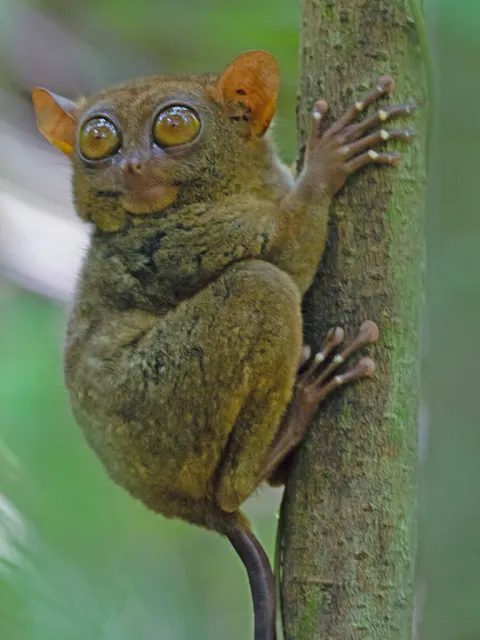
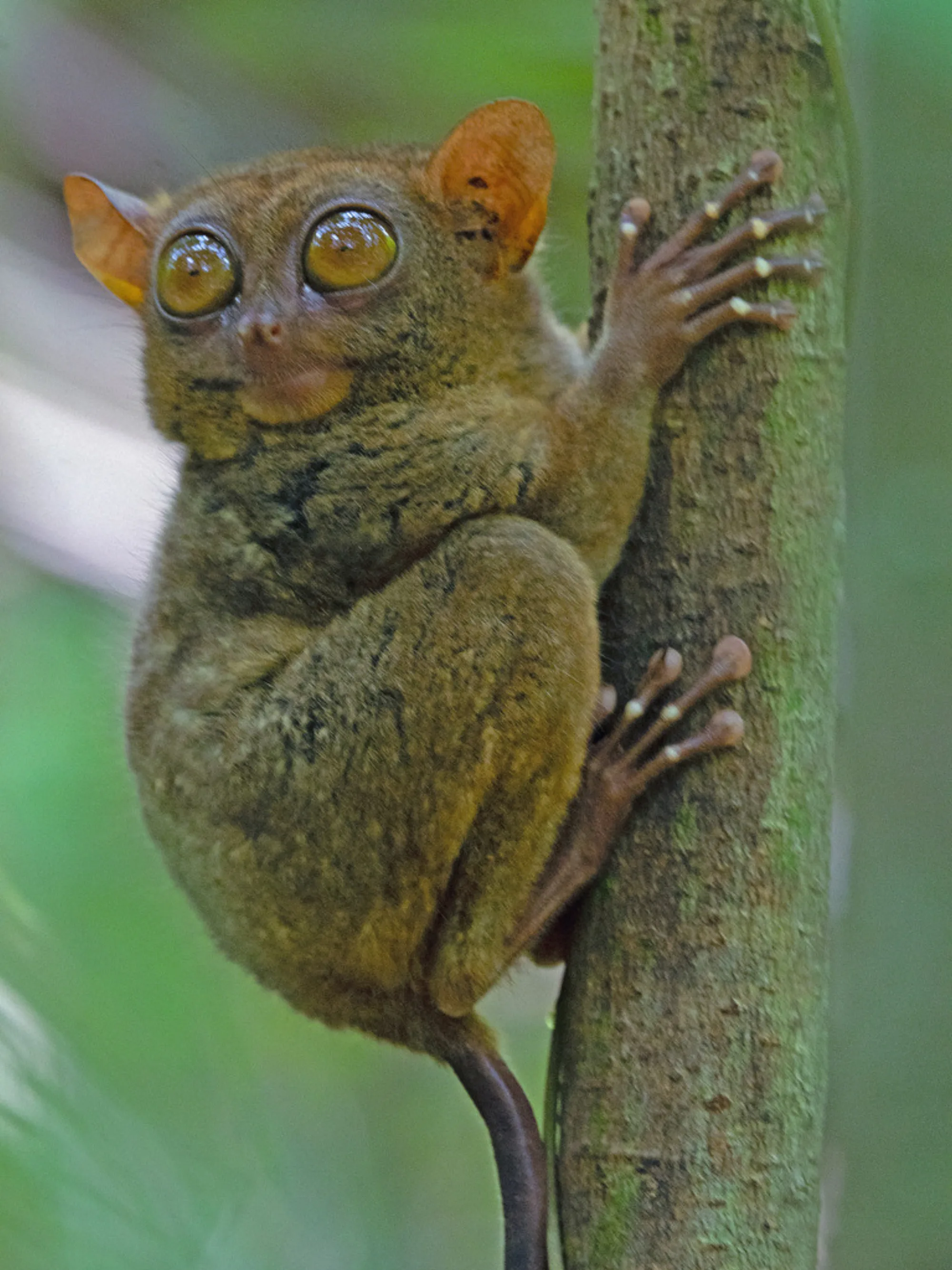
With enormous eyes and a round head, the Philippine Tarsier is a tiny primate that can be difficult to spot. An adult is roughly the size of a human fist, with thin, rough fur ranging from grey to dark brown. Its narrow tail has a tuft at the tip and is about twice as long as its body. Large, mobile ears pick up movement, while its eyes help it see at night. Found only in the Philippines, it lives mainly on Bohol, Samar, Leyte and Mindanao, as well as several smaller islands. It inhabits primary and secondary forest from sea level to 700 m, favouring dense, low vegetation and perches close to the ground.
Shy and mostly solitary, it sleeps by day in dark hollows near tree trunks and shrubs, then becomes active at night. It clings upright to trees and leaps between branches, sometimes jumping at least 3 m from tree to tree. Its prey includes live insects, especially crickets and grasshoppers, as well as spiders, small crustaceans, lizards and birds. After a gestation of about six months, a female gives birth to one young, already furry and with its eyes open. She carries her infant in her mouth, and it can cling to branches from birth. Forest loss threatens the species as land is converted for farming, housing and roads, while logging and cutting trees for firewood also encroach on its habitat. Tarsiers are also taken for the pet trade, despite surviving poorly away from their natural habitat. In captivity, camera flashes, handling and confinement can stress these shy animals.
Written from the English Wikipedia article Philippine tarsier (CC BY-SA 4.0).
- Records
- 30
- Countries
- 1
No atlas park has a record of the Philippine Tarsier in or around it yet.
These are open occurrence records, so they show where people looked for and recorded the Philippine Tarsier as much as where it lives. Cells are up to 25 km across, and every location is generalised to its cell.
Generalised encounter areas, not exact locations. Each shape is a grid cell coloured by how likely the species is there.
- Very likelyPhilippines25 km zone · medium confidence · 30 records · updated 80 days ago
Conservation status not assessed here yet, so every location is generalised to its grid cell.