Malabar Pufferfish
Carinotetraodon travancoricus
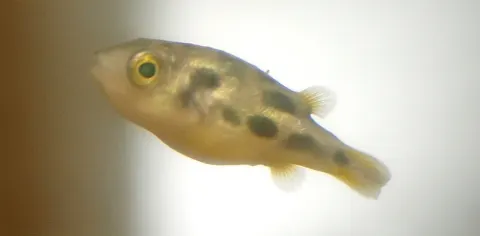
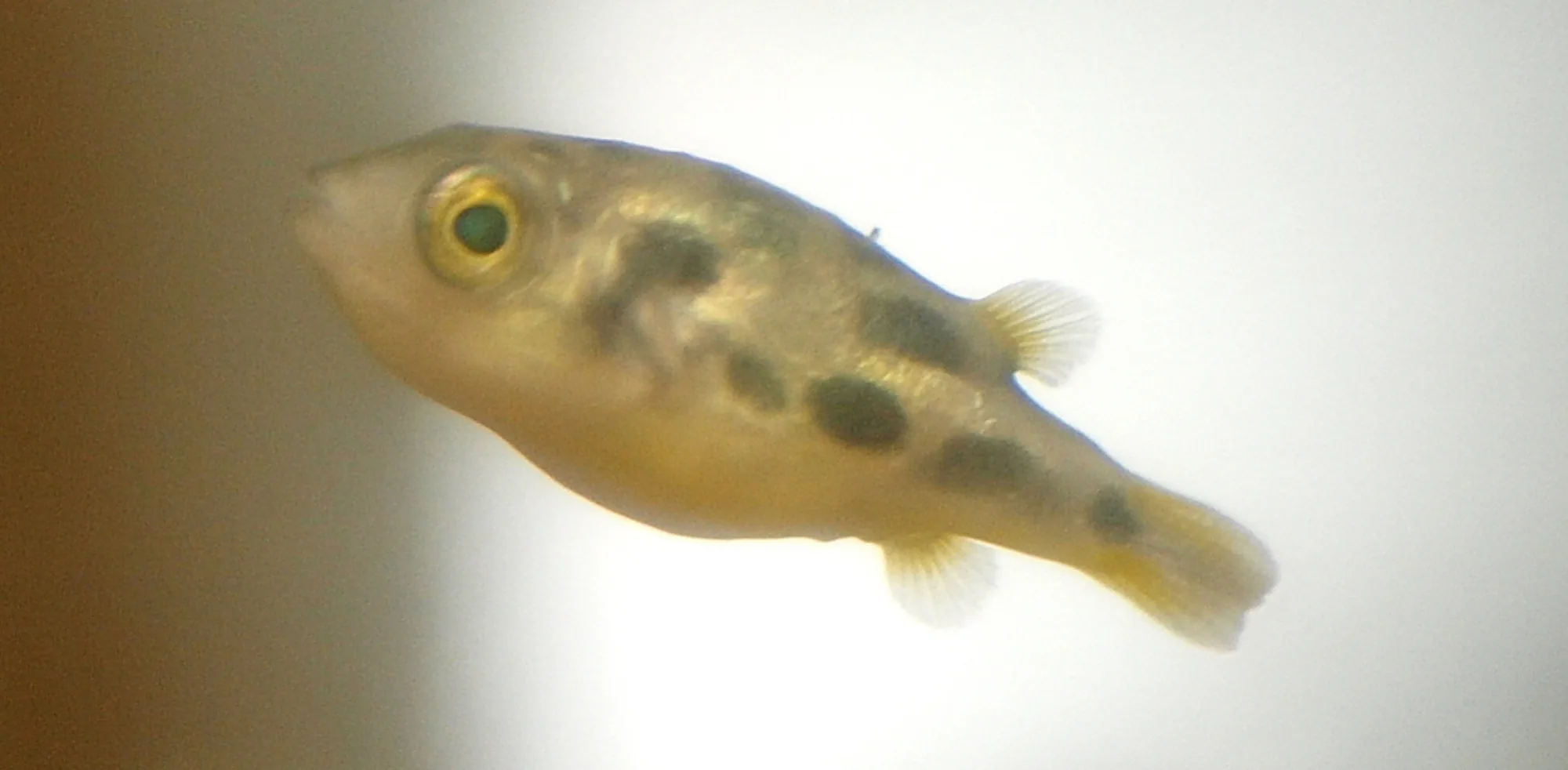
Small enough to be overlooked among underwater plants, the Malabar Pufferfish is a freshwater fish with a round, oblong body. It usually grows to less than 2.5 cm, although the largest documented fish reached 3.5 cm. Its greenish-yellow body carries dark green to brown-black patches, and the pattern varies considerably from fish to fish. Mature males tend to be brighter than females and can have a dark line along the belly and shimmering blue markings around the eyes. Females are generally rounder and larger, with white bellies and sometimes a yellow patch on the throat.
The fish occurs only in Kerala and southern Karnataka in southwestern India, where it lives in rivers, lakes and estuaries. It favours heavily vegetated water with bottoms of gravel and rock, or clay loam mixed with silt and sand. Records also come from ponds, ditches, irrigation channels and abandoned water bodies in paddy fields. A slow swimmer, it stays near the bottom and gathers in large shoals that can sometimes number hundreds of fish. It is found mainly from January to May and is rarely seen during the rainy season. Its varied diet includes water fleas, seed shrimp and the aquatic larvae of insects, with insect larvae a particular favourite. Breeding takes place through most of the year, with spawning peaking from May to August during the southwest monsoon. In aquariums, females may lay eggs among plants, and males return to guard them. Wild populations face habitat loss from damming and deforestation for agriculture, as well as wastewater pollution and heavy collection for the aquarium trade.
Written from the English Wikipedia article Dwarf pufferfish (CC BY-SA 4.0).
- Records
- 6
- Countries
- 1
No atlas park has a record of the Malabar Pufferfish in or around it yet.
These are open occurrence records, so they show where people looked for and recorded the Malabar Pufferfish as much as where it lives. Cells are up to 25 km across, and every location is generalised to its cell.
Generalised encounter areas, not exact locations. Each shape is a grid cell coloured by how likely the species is there.
- Very likelyIndia25 km zone · medium confidence · 6 records · updated 80 days ago
Conservation status not assessed here yet, so every location is generalised to its grid cell.