Pig-nosed Turtle
Carettochelys insculpta
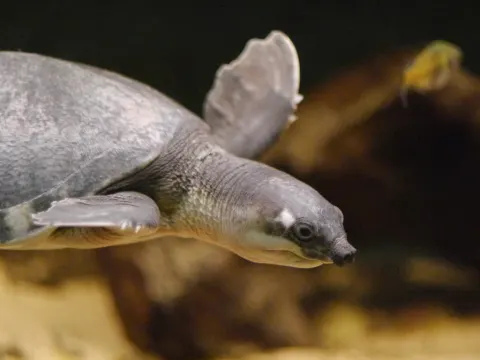
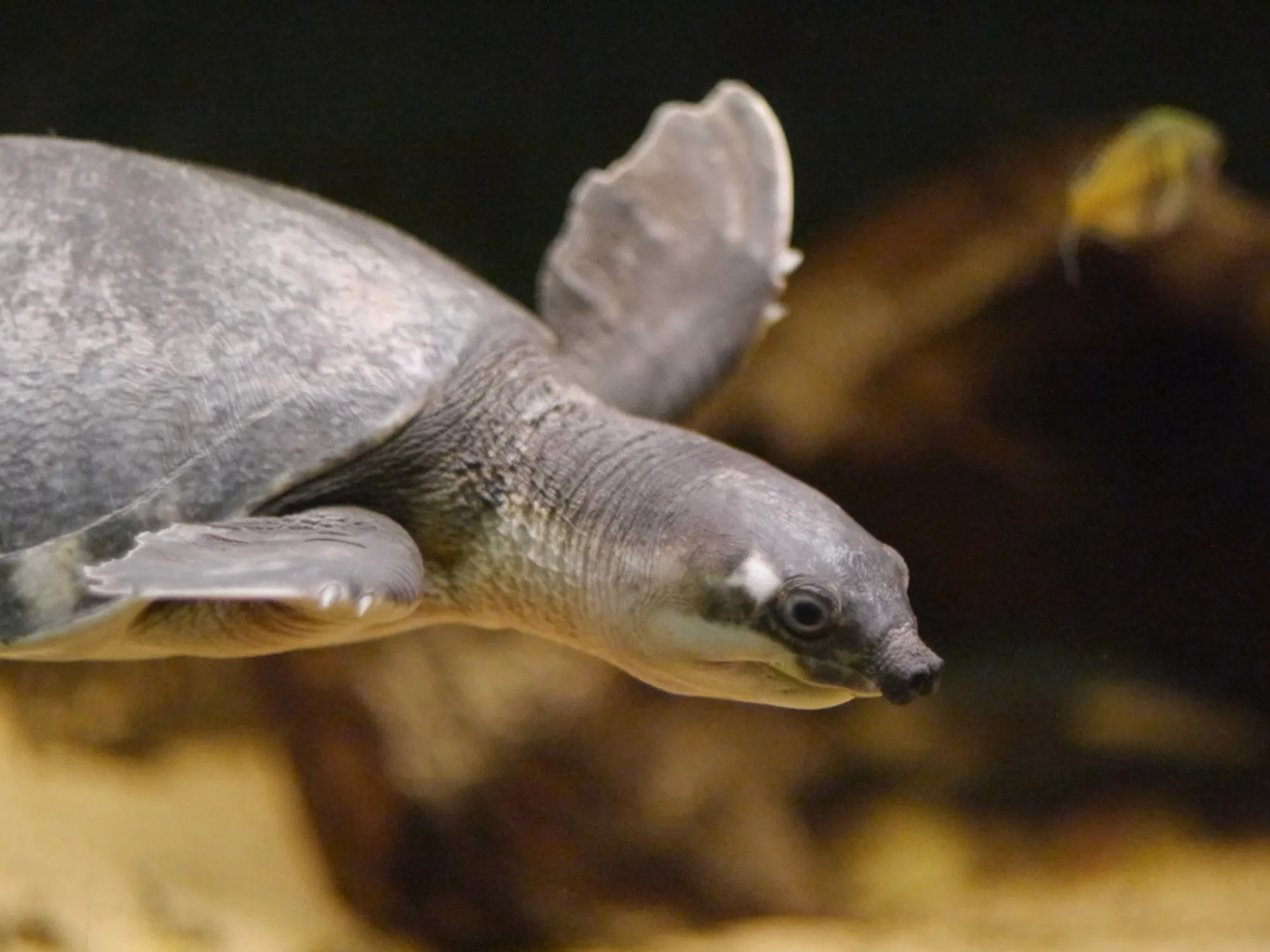
With a fleshy snout and nostrils at its tip, the Pig-nosed Turtle has a face that explains its name. Its flippers resemble those of a sea turtle, while its leathery upper shell is usually grey or olive and its underside cream-coloured. Adults can reach about 70 to 75 cm in shell length and weigh over 20 kg. It lives in freshwater streams, lagoons and rivers across the Northern Territory of Australia and southern New Guinea. In New Guinea, it is believed to inhabit all the larger southward-flowing rivers and some smaller ones.
The turtle is not entirely aquatic, although few wild studies have been made and much about its everyday behaviour remains unknown. During the cooler dry season, it appears to show some social structure around warm-water vents in certain river systems. Its varied diet includes fig flowers, fruit and leaves, along with crustaceans, molluscs and insects. Females lay their eggs on sandy riverbanks late in the dry season. Fully developed young remain inside their eggs until conditions suit emergence; flooding or a sudden fall in air pressure may trigger hatching. Turtles in a clutch hatch together, gaining safety in numbers and more help digging through the sand.
Illegal capture and trafficking pose a serious threat, including capture for the exotic pet trade. The species declined by more than 50% between 1981 and 2011, and large numbers have been seized from smugglers. In Papua New Guinea, the Piku Biodiversity Network helps local communities monitor turtles and set their own harvest targets, with the aim of sustaining the population.
Written from the English Wikipedia article Pig-nosed turtle (CC BY-SA 4.0).
- Records
- 141
- Countries
- 3
- Atlas places
- 1
These are open occurrence records, so they show where people looked for and recorded the Pig-nosed Turtle as much as where it lives. Cells are up to 25 km across, and every location is generalised to its cell.
Generalised encounter areas, not exact locations. Each shape is a grid cell coloured by how likely the species is there.
- Very likelyAustralia25 km zone · medium confidence · 123 records · updated 80 days ago
- LikelyPapua New Guinea25 km zone · medium confidence · 17 records · updated 80 days ago
- UncommonSingapore25 km zone · low confidence · 1 record · updated 80 days ago
Conservation status not assessed here yet, so every location is generalised to its grid cell.