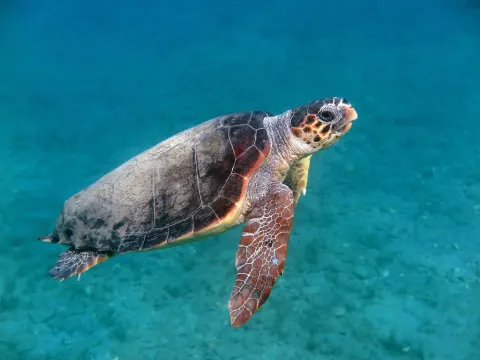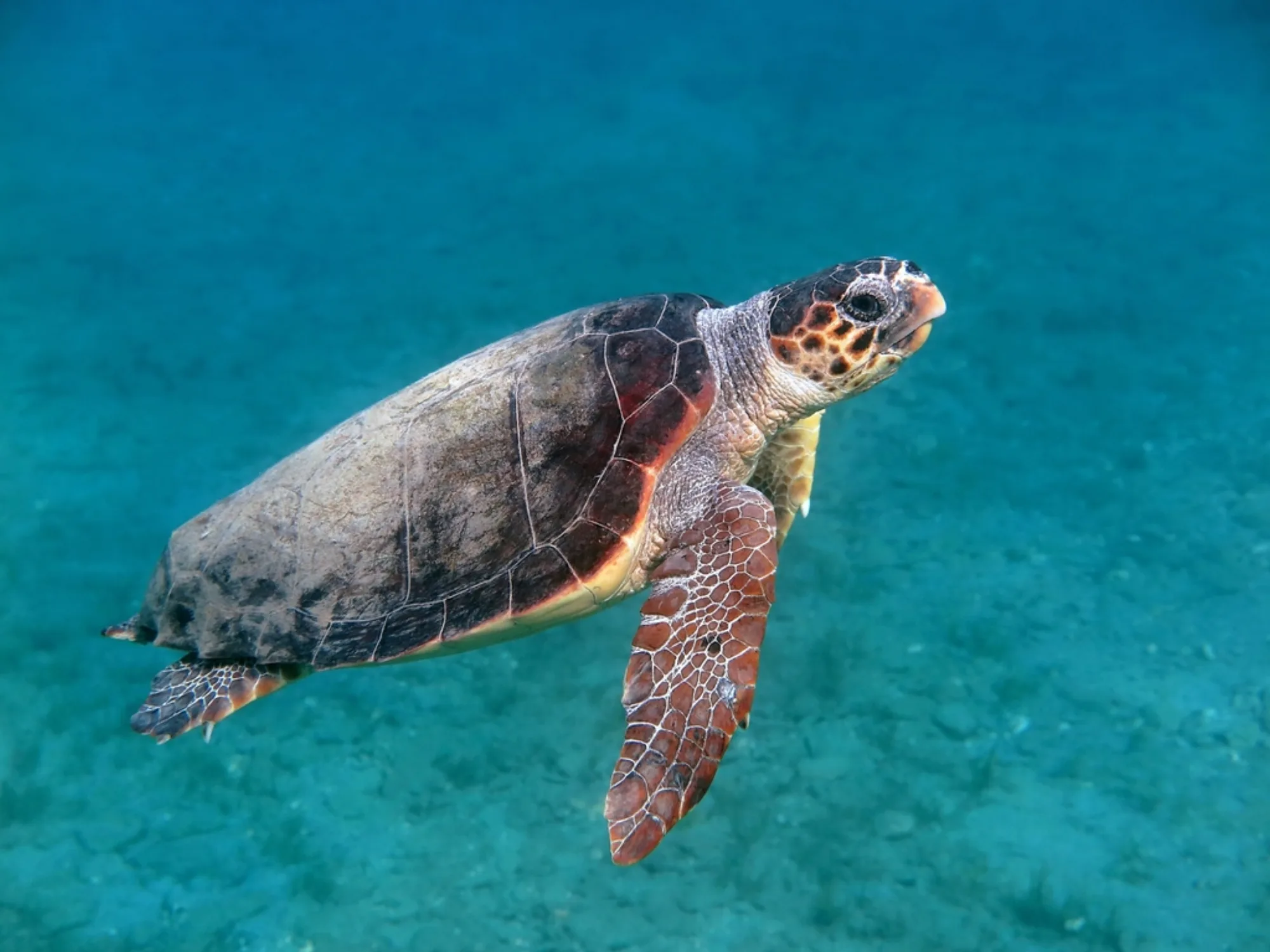
Loggerhead Turtle
Caretta caretta
Named for its large head, the Loggerhead Turtle is a marine reptile with a typically reddish-brown shell and skin ranging from yellow to brown. Fully grown, it averages around 90 cm in shell length and weighs approximately 135 kg. Its powerful jaws help it crush prey, while its shell provides protection, although it cannot pull its head or flippers inside.
Loggerheads inhabit the Atlantic, Pacific and Indian Oceans and the Mediterranean Sea, spending most of their lives in open water and shallow coastal areas. Hatchlings shelter among floating Sargassum algae, while juveniles and adults also use the continental shelf and coastal estuaries. Florida, Oman, eastern Australia and Japan are among their nesting areas, and Greece is a major nesting site in the Mediterranean. Loggerheads are most active during the day and divide their time between swimming and resting on the bottom. They eat mainly bottom-dwelling invertebrates, including whelks, conchs and horseshoe crabs, but also take jellyfish and squid during ocean migrations.
Females come ashore briefly to nest, laying their eggs at or close to their own birthplace. After covering the nest with sand, they return to the sea; hatchlings usually emerge at night and head towards the brighter horizon over the water. Females lay an average of four clutches before going two to three years without producing eggs. Coastal development removes nesting habitat, while artificial lights can draw hatchlings inland, exposing them to dehydration and predators. Fishing gear can entangle or trap turtles, causing injury or drowning, and swallowed plastic can cause starvation or suffocation. Eggs and young turtles face many predators, while large sharks can prey on adults.
Written from the English Wikipedia article Loggerhead sea turtle (CC BY-SA 4.0).
- Records
- 11,106
- Countries
- 13
No atlas park has a record of the Loggerhead Turtle in or around it yet.
These are open occurrence records, so they show where people looked for and recorded the Loggerhead Turtle as much as where it lives. Cells are up to 25 km across, and every location is generalised to its cell.
Generalised encounter areas, not exact locations. Each shape is a grid cell coloured by how likely the species is there.
- Very likelySpain25 km zone · medium confidence · 5757 records · updated 80 days ago
- Very likelyAlgeria25 km zone · medium confidence · 1286 records · updated 80 days ago
- Very likelyUnited States25 km zone · medium confidence · 1052 records · updated 80 days ago
- Very likelyTunisia25 km zone · medium confidence · 728 records · updated 80 days ago
- Very likelyAustralia25 km zone · medium confidence · 563 records · updated 80 days ago
- Very likelyItaly25 km zone · high confidence · 524 records · updated 80 days ago
- Very likelyGreece25 km zone · medium confidence · 290 records · updated 80 days ago
- Very likelyMalta25 km zone · medium confidence · 281 records · updated 80 days ago
- Very likelyFrance25 km zone · medium confidence · 223 records · updated 80 days ago
- Very likelyMorocco25 km zone · medium confidence · 158 records · updated 80 days ago
Conservation status not assessed here yet, so every location is generalised to its grid cell.