European Goldfinch
Carduelis carduelis
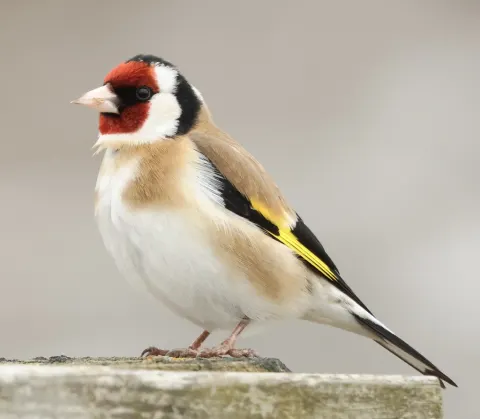
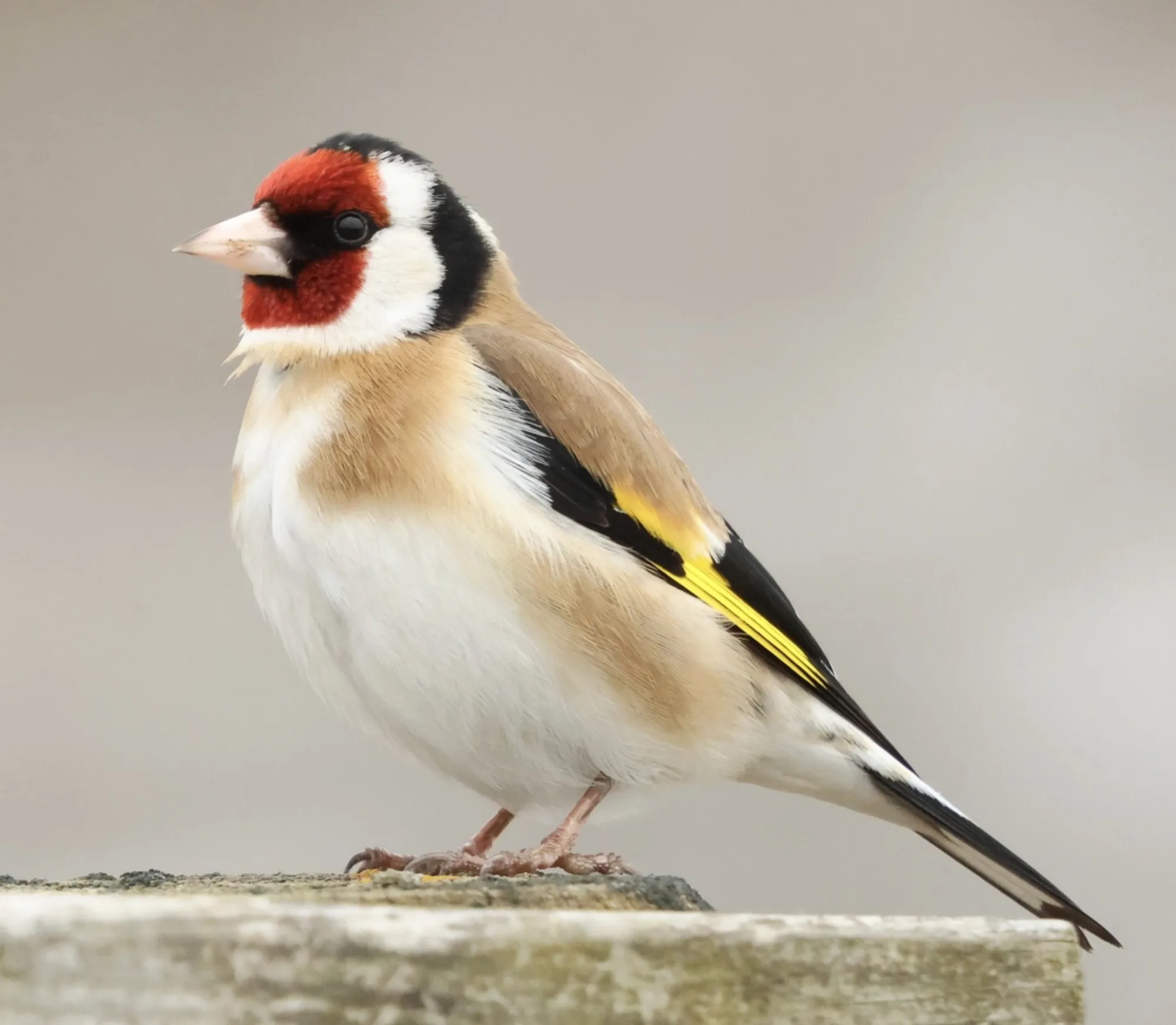
A flash of yellow across black wings helps identify the European Goldfinch, a small finch whose red face stands out against its black-and-white head. Its back is warm brown, while the underparts are white with buff patches on the breast and flanks. Males and females look much alike, though the male's darker red face marking extends just behind the eye. Young birds have plainer heads and greyer backs, but share the yellow wing stripe. Listen for a silvery twittering song, a mixture of trills and twitters.
The goldfinch favours open, partly wooded lowlands across a native range that includes Europe, North Africa and parts of central and western Asia. Birds in milder western areas generally stay year-round, while those from colder places migrate, and even western birds move locally to escape bad weather. Introduced populations also occur in places including Australia, New Zealand and the western Great Lakes region of the United States. Small seeds are its preferred food, including those of thistles, cornflowers and teasels. In winter, goldfinches visit feeders and gather in flocks of up to 40, sometimes more.
The female builds a compact nest, usually several metres above ground, concealed among leaves and twigs near the end of a branch. She uses moss and lichen, lines the cup with plant down and fastens it to twigs with spider silk. Both parents feed the chicks, initially with seeds and insects, and typically raise two broods a year. Trapping and the destruction of open-space habitat are threats that conservation efforts seek to limit.
Written from the English Wikipedia article European goldfinch (CC BY-SA 4.0).
- Records
- 1,398,319
- Countries
- 86
- Atlas places
- 2
These are open occurrence records, so they show where people looked for and recorded the European Goldfinch as much as where it lives. Cells are up to 25 km across, and every location is generalised to its cell.
Generalised encounter areas, not exact locations. Each shape is a grid cell coloured by how likely the species is there.
- Very likelyUnited Kingdom25 km zone · high confidence · 573860 records · updated 86 days ago
- Very likelySpain25 km zone · high confidence · 213031 records · updated 86 days ago
- Very likelyNorway25 km zone · high confidence · 97434 records · updated 86 days ago
- Very likelyPortugal25 km zone · high confidence · 77124 records · updated 86 days ago
- Very likelyFrance25 km zone · high confidence · 77088 records · updated 86 days ago
- Very likelyAustralia25 km zone · high confidence · 42072 records · updated 86 days ago
- Very likelyNew Zealand25 km zone · high confidence · 39126 records · updated 86 days ago
- Very likelyBelgium25 km zone · high confidence · 38859 records · updated 86 days ago
- Very likelyCzechia25 km zone · high confidence · 17520 records · updated 86 days ago
- Very likelyFinland25 km zone · high confidence · 16866 records · updated 86 days ago
Conservation status not assessed here yet, so every location is generalised to its grid cell.