Northern Cardinal
Cardinalis cardinalis
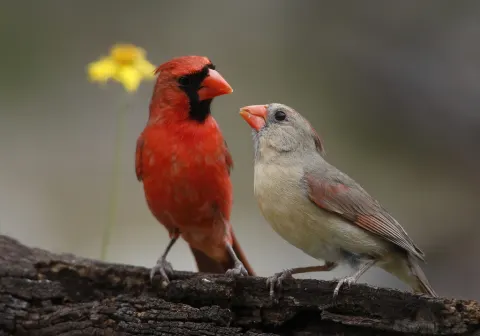
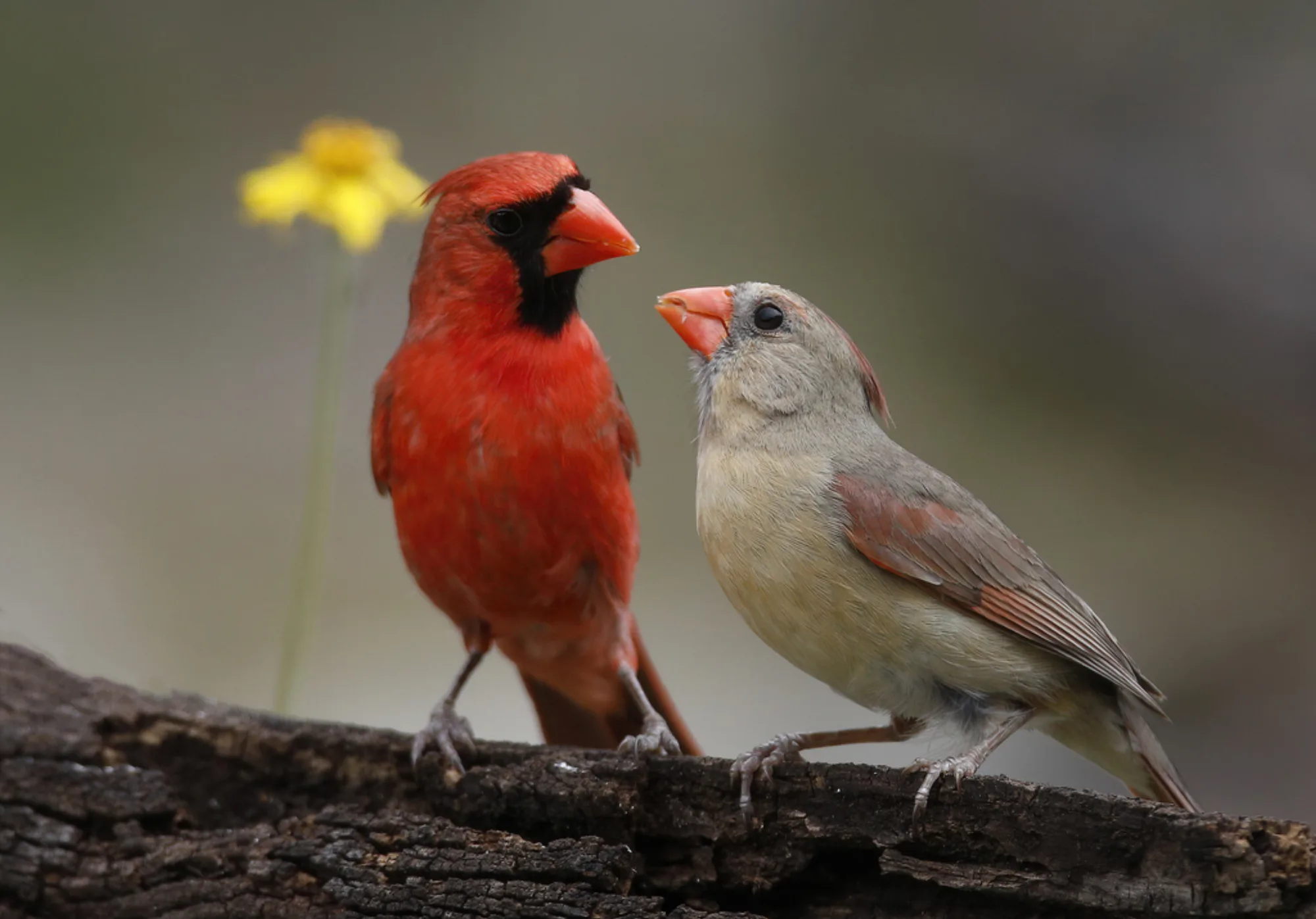
A raised crest and a strong coral-coloured beak help identify the Northern Cardinal, a mid-sized songbird. The male is crimson red, with darker wings and back and a black mask across his face. The female is mostly greyish brown, with a reddish tint on her crest, wings and tail, and a less distinct dark mask. Young birds resemble females in colour until they grow their adult feathers in autumn; their beaks are initially greyish black.
Look for cardinals across much of the eastern United States, in parts of southern Canada and south through Mexico to northern Belize and Guatemala. They have also been introduced to Bermuda and Hawaii. They inhabit gardens, shrublands, wetlands and woodlands, and in Massachusetts are especially numerous where dense cover meets open ground, including woodland edges and parks. Both sexes sing clear whistles, while the male also sings from a high perch to defend his territory and chases away other males. Pairs often travel together and generally remain together throughout the year.
Adults feed largely on seeds, grains and fruit, often hopping along the ground beneath trees or shrubs. They also eat insects and snails, while their young are fed almost entirely on insects. The female builds a concealed cup nest in a dense shrub or low tree, usually laying three or four eggs per clutch. Young leave the nest 10 or 11 days after hatching, and pairs can raise up to four broods a year. Hawks, falcons and owls prey on cardinals, while snakes, squirrels, crows and domestic cats are among the predators of eggs and chicks. Cowbirds have also been seen laying eggs in cardinal nests.
Written from the English Wikipedia article Northern cardinal (CC BY-SA 4.0).
- Records
- 9,733,508
- Countries
- 10
- Atlas places
- 1
These are open occurrence records, so they show where people looked for and recorded the Northern Cardinal as much as where it lives. Cells are up to 25 km across, and every location is generalised to its cell.
Generalised encounter areas, not exact locations. Each shape is a grid cell coloured by how likely the species is there.
- Very likelyUnited States25 km zone · high confidence · 8531495 records · updated 86 days ago
- Very likelyCanada25 km zone · high confidence · 1076520 records · updated 86 days ago
- Very likelyMexico25 km zone · high confidence · 109732 records · updated 86 days ago
- Very likelyBermuda25 km zone · high confidence · 10090 records · updated today
- Very likelyBelize25 km zone · high confidence · 5425 records · updated today
- PossibleGuatemala25 km zone · high confidence · 231 records · updated today
- RareSt. Pierre & Miquelon25 km zone · medium confidence · 8 records · updated today
- RareHonduras25 km zone · medium confidence · 3 records · updated today
- RareNorway25 km zone · medium confidence · 3 records · updated today
- RareBelgium25 km zone · medium confidence · 1 record · updated today
Conservation status not assessed here yet, so every location is generalised to its grid cell.