Great White Shark
Carcharodon carcharias
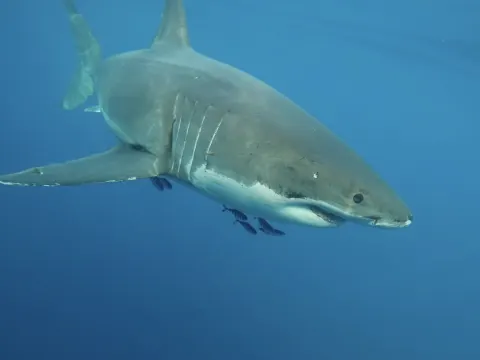
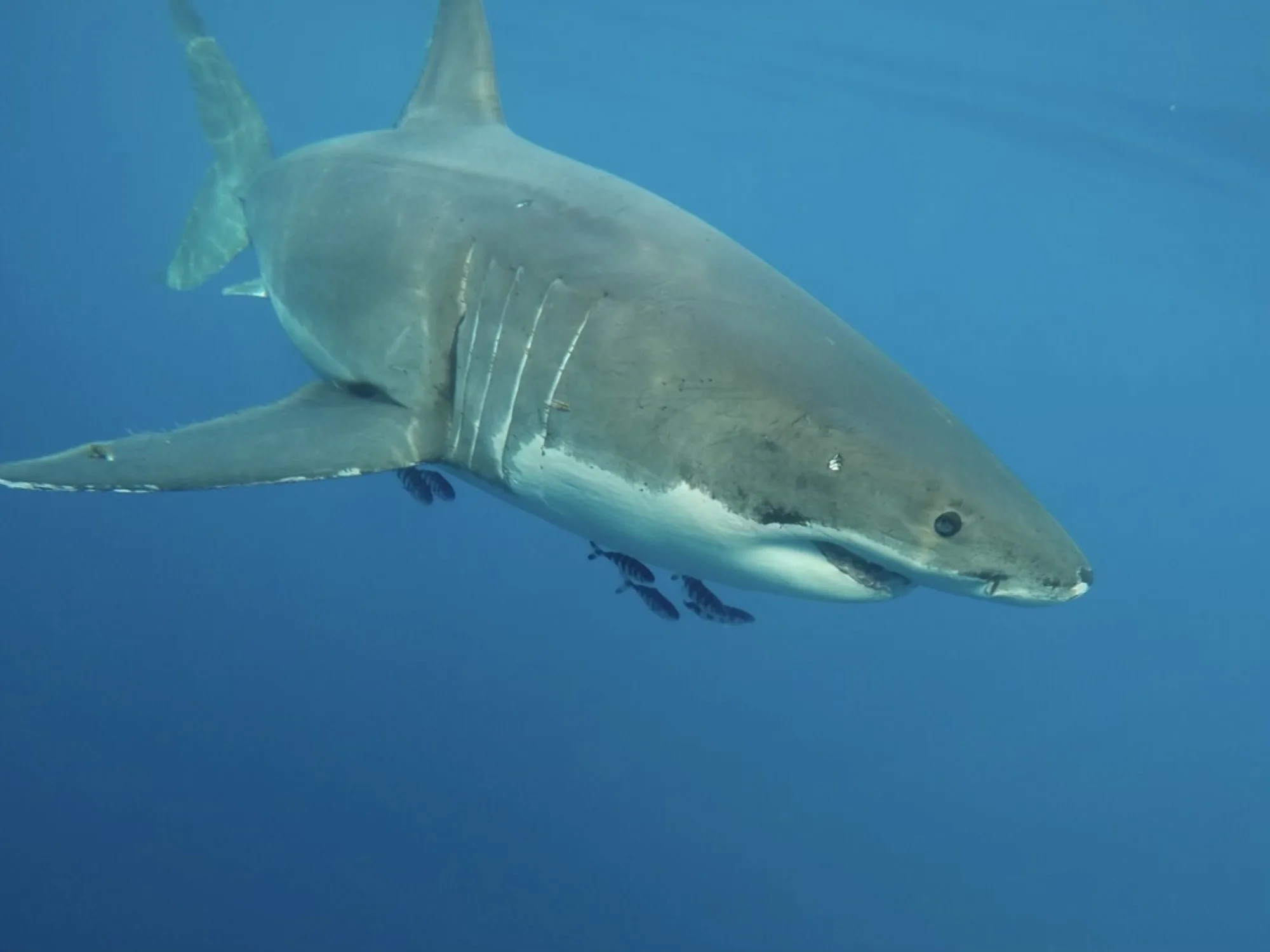
A stocky, torpedo-shaped body, pointed snout and dark upper surface give the Great White Shark its distinctive outline. Its underside is white, while the upper body is usually blue-grey or grey-brown; a large triangular dorsal fin rises from its back. Among the largest living sharks, it has rows of serrated teeth that are continually replaced.
White sharks range through tropical and temperate seas worldwide, from coastal waters to the open ocean. Major populations occur in the North Pacific, western North Atlantic, Mediterranean, southern Africa and Oceania. Along the coast, they use habitats including island groups, offshore reefs, banks and headlands. They usually stay near the surface, though they can dive as deep as 1,300 m. Travellers may see them at feeding gatherings such as the Farallon Islands off California, the Western Cape of South Africa and Australia's Neptune Islands, where viewing trips operate from boats or underwater cages.
Usually solitary, these sharks travel long distances as food supplies and temperatures change. They eat fish, squid and marine mammals such as seals and dolphins, and also scavenge whale carcasses. Off South Africa, a shark hunting Cape fur seals may burst partly or completely out of the water. Young sharks stay in shallower coastal water and take smaller prey, while pups hatch from eggs inside the female and are born live. Threats include being caught accidentally in commercial fishing, being targeted by recreational fishers and becoming tangled in beach protection nets. Orcas also prey on white sharks, which may leave an area when the whales arrive.
Written from the English Wikipedia article Great white shark (CC BY-SA 4.0).
- Records
- 11,560
- Countries
- 9
- Atlas places
- 5
These are open occurrence records, so they show where people looked for and recorded the Great White Shark as much as where it lives. Cells are up to 25 km across, and every location is generalised to its cell.
Generalised encounter areas, not exact locations. Each shape is a grid cell coloured by how likely the species is there.
- Very likelyAustralia25 km zone · high confidence · 9256 records · updated 80 days ago
- Very likelyUnited States25 km zone · high confidence · 2069 records · updated 80 days ago
- LikelySouth Africa25 km zone · medium confidence · 91 records · updated 80 days ago
- LikelyMexico25 km zone · medium confidence · 44 records · updated 80 days ago
- LikelyUnited Kingdom25 km zone · medium confidence · 41 records · updated 80 days ago
- PossibleNew Zealand25 km zone · medium confidence · 33 records · updated 80 days ago
- PossiblePortugal25 km zone · medium confidence · 9 records · updated 80 days ago
- PossibleUnnamed area25 km zone · medium confidence · 8 records · updated 80 days ago
- PossibleFrench Southern Territories25 km zone · medium confidence · 6 records · updated 80 days ago
- PossibleCanada25 km zone · medium confidence · 3 records · updated 80 days ago
Conservation status not assessed here yet, so every location is generalised to its grid cell.