Sand Shark
Carcharias taurus
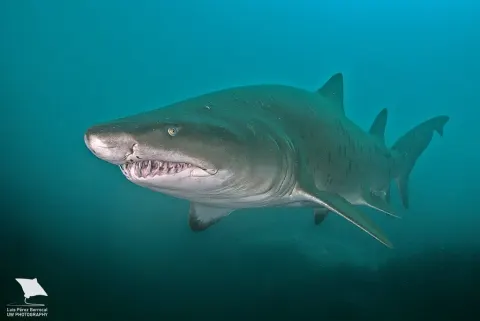
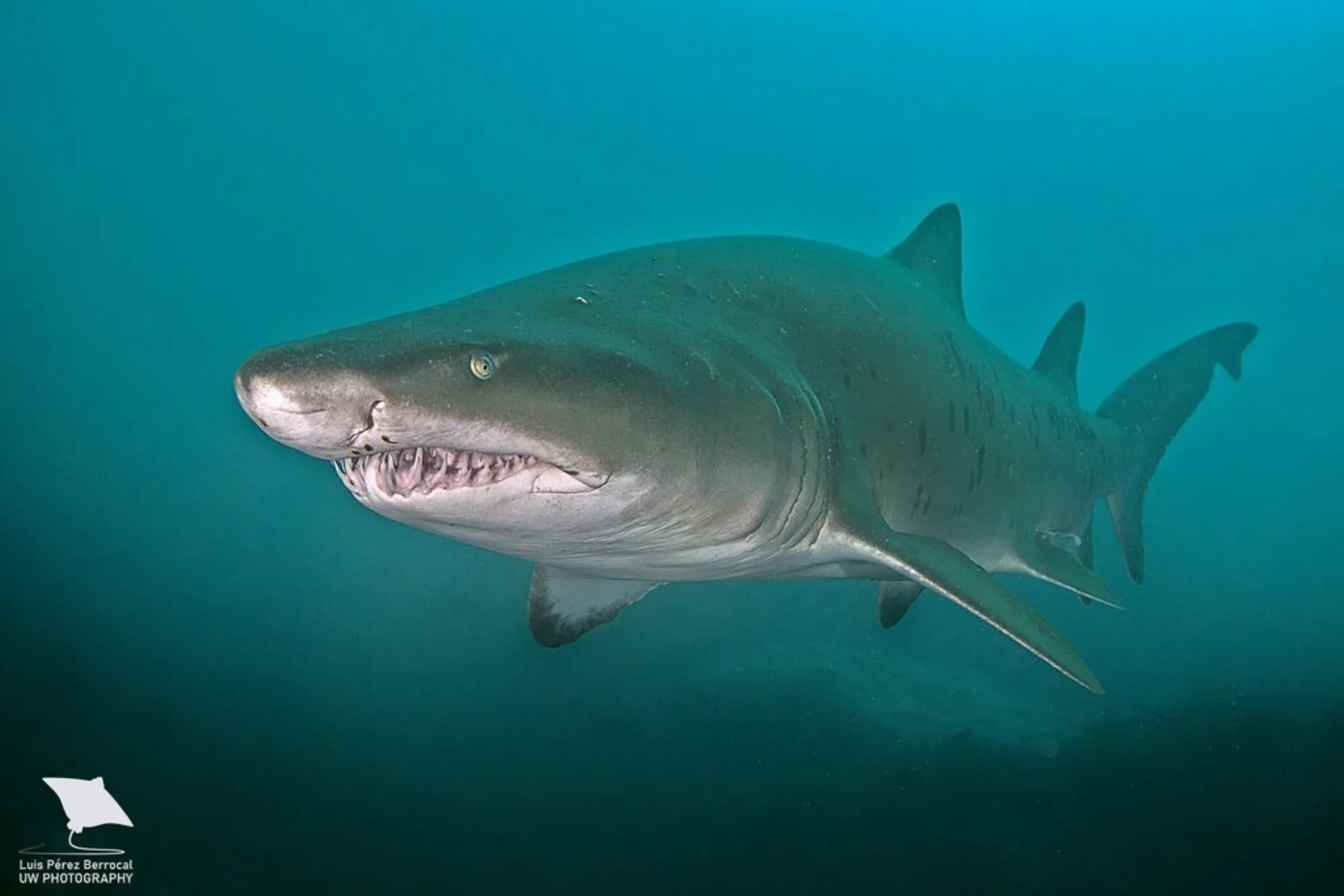
With its pointed head, bulky body and rows of sharp teeth visible as it swims, the Sand Shark (Carcharias taurus) can look formidable, yet it is relatively placid and slow-moving. Most adults measure around 2.2 to 2.5 m, with grey-brown backs, pale undersides and reddish-brown spots concentrated towards the rear. It lives in temperate and subtropical waters across the Atlantic, Pacific and Indian Oceans, including waters around Japan, Australia, southern Africa and the eastern coasts of the Americas. Its habitats range from sandy shores and estuaries to shallow bays and reefs, reaching depths of around 191 m. The species once lived in the Mediterranean, where the last sighting was in 2003; it is presumed gone from the region.
By day, divers may encounter these sharks hovering above sandy bottoms near rocks, caves and reefs. At night they leave their shelters to hunt, often travelling some distance along the ocean floor. They can gulp air at the surface, helping them hang almost motionless in the water, and have been seen hunting schools of fish in groups. Their varied prey includes bony fish, squid, crustaceans, skates and other sharks. Females breed only every second or third year, giving birth to no more than two pups at a time; before birth, the most developed embryos eat their smaller siblings.
That slow reproduction makes losses difficult to replace. Overfishing has contributed to population declines, with the sharks taken for food, fins and hides, while beach shark nets also catch and kill them. Pollution in estuaries along the eastern United States can harm young sharks, and fishing can reduce the food available to them.
Written from the English Wikipedia article Sand tiger shark (CC BY-SA 4.0).
- Records
- 1,677
- Countries
- 7
- Atlas places
- 3
These are open occurrence records, so they show where people looked for and recorded the Sand Shark as much as where it lives. Cells are up to 25 km across, and every location is generalised to its cell.
Generalised encounter areas, not exact locations. Each shape is a grid cell coloured by how likely the species is there.
- Very likelyAustralia25 km zone · high confidence · 1564 records · updated 80 days ago
- Very likelySouth Africa25 km zone · medium confidence · 63 records · updated 80 days ago
- Very likelyMexico25 km zone · medium confidence · 20 records · updated 80 days ago
- LikelyUnited States25 km zone · medium confidence · 30 records · updated 80 days ago
- UncommonBrazil25 km zone · low confidence · 0 records · updated 80 days ago
- UncommonGrenada25 km zone · low confidence · 0 records · updated 80 days ago
- RareJapan25 km zone · low confidence · 0 records · updated 80 days ago
Conservation status not assessed here yet, so every location is generalised to its grid cell.