Dusky Shark
Carcharhinus obscurus
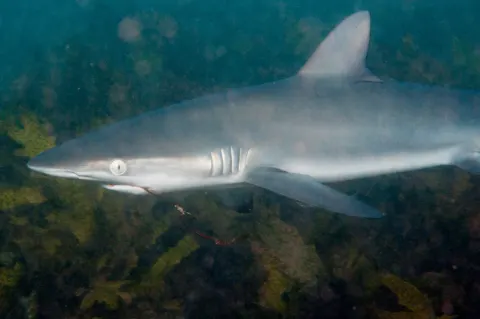
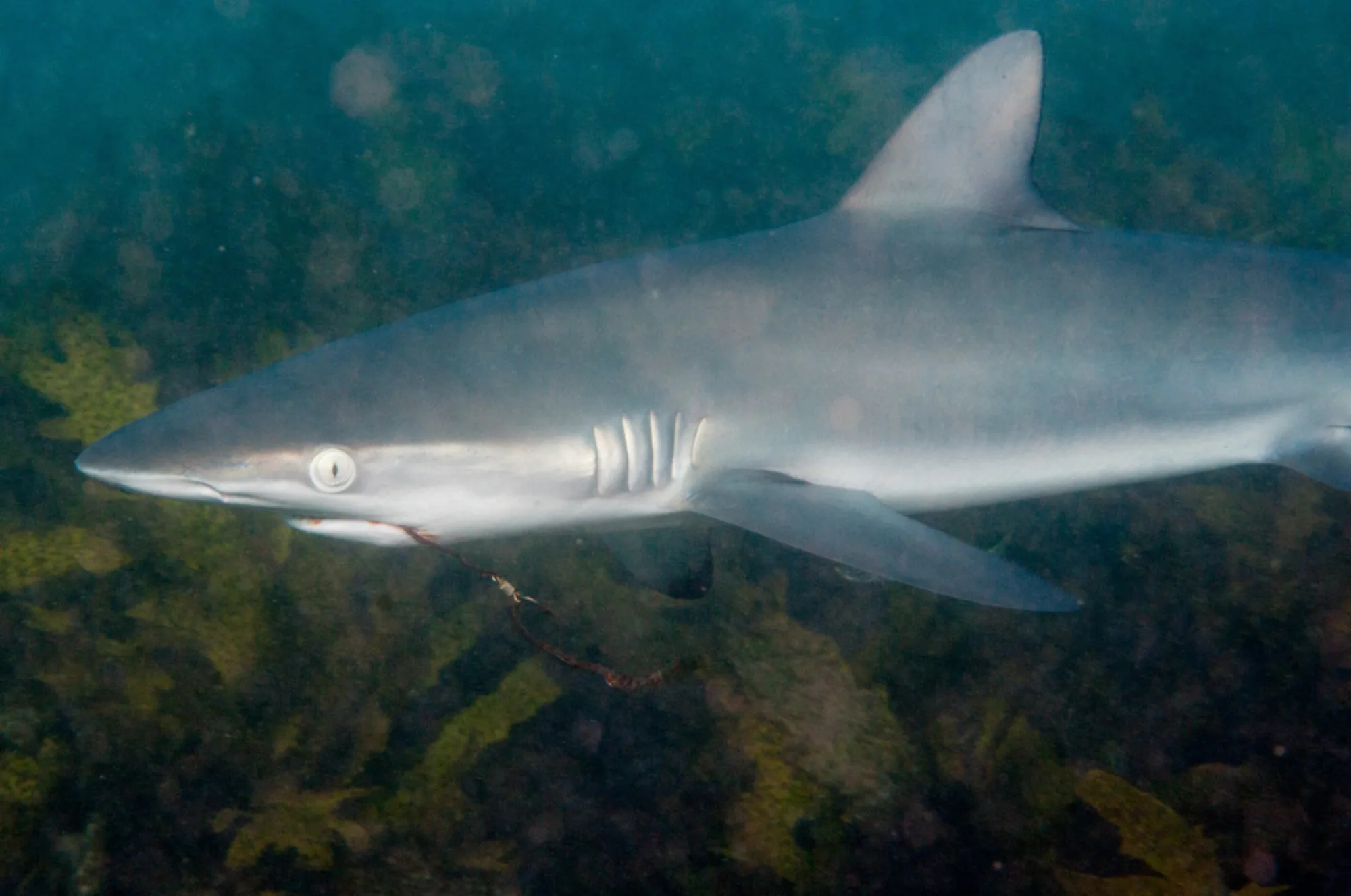
A slender, streamlined hunter, the Dusky Shark (Carcharhinus obscurus) can grow to more than 4 m long. Look for a short, rounded snout, long sickle-shaped side fins and faint markings on the fins. Its back ranges from bronze to bluish grey, while its underside is white, with a faint pale stripe along the sides. The fin tips are darker, particularly in young sharks.
Dusky Sharks inhabit tropical and warm-temperate seas around the world, although their range is discontinuous. They occur off places including South Africa, Madagascar, Japan, Australia and the Bahamas. They range from the surf zone across the continental shelf and into adjacent oceanic waters, favouring temperatures of 19 to 28 °C. These roaming sharks make seasonal migrations, generally travelling towards the poles in summer and back towards the equator in winter. Adults sometimes follow ships far from land, while young sharks can gather in large numbers where food is available.
The species hunts throughout the water column but favours feeding near the bottom. Adults eat a wide variety of prey, chiefly bony fish, sharks, rays and cephalopods, while young sharks feed mainly on small open-water prey such as sardines and squid. Females give birth in shallow coastal nurseries, including lagoons, where their pups find food and shelter. Pregnancy can last 22 to 24 months, and females have a year of rest between pregnancies; the sharks reach adulthood at around 20 years old. This slow life cycle leaves them especially susceptible to overfishing: they are caught for their fins and other products, taken as bycatch and entangled in beach protection nets.
Written from the English Wikipedia article Dusky shark (CC BY-SA 4.0).
- Records
- 3,813
- Countries
- 9
- Atlas places
- 2
These are open occurrence records, so they show where people looked for and recorded the Dusky Shark as much as where it lives. Cells are up to 25 km across, and every location is generalised to its cell.
Generalised encounter areas, not exact locations. Each shape is a grid cell coloured by how likely the species is there.
- Very likelyAustralia25 km zone · high confidence · 3394 records · updated 80 days ago
- Very likelyUnited Kingdom25 km zone · medium confidence · 322 records · updated 80 days ago
- LikelyFaroe Islands25 km zone · medium confidence · 54 records · updated 80 days ago
- LikelyUnited States25 km zone · medium confidence · 21 records · updated 80 days ago
- LikelyIndonesia25 km zone · medium confidence · 13 records · updated 80 days ago
- PossibleSouth Africa25 km zone · medium confidence · 6 records · updated 80 days ago
- PossibleMexico25 km zone · medium confidence · 3 records · updated 80 days ago
- UncommonGrenada25 km zone · low confidence · 0 records · updated 80 days ago
- RareIsrael25 km zone · low confidence · 0 records · updated 80 days ago
Conservation status not assessed here yet, so every location is generalised to its grid cell.