Blacktip Reef Shark
Carcharhinus melanopterus
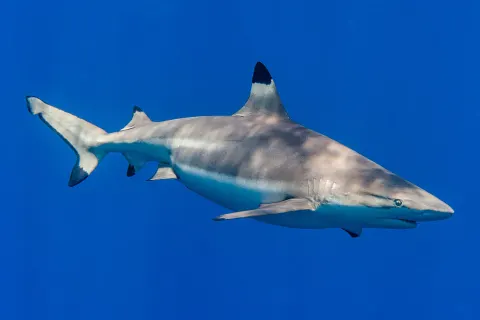
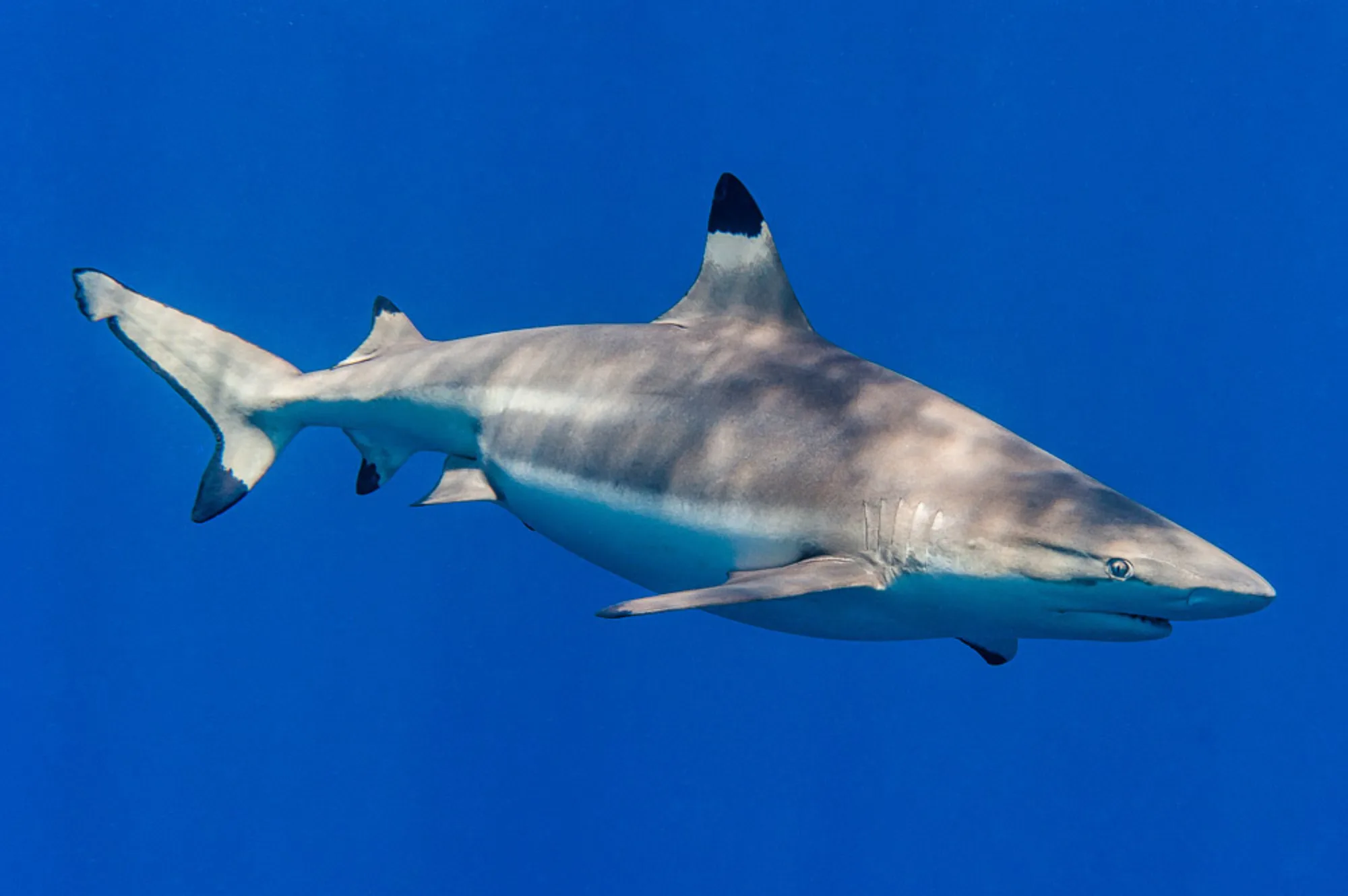
A dark fin breaking the surface can reveal a Blacktip Reef Shark swimming close to shore. This requiem shark has black tips on all its fins, with especially clear markings on its first dorsal fin and the lower part of its tail. Its upper body is pale greyish-brown, its underside is white, and a white band runs along its sides. Most are no more than 1.6 m long, and females are larger than males.
The species lives in tropical and subtropical coastal waters across the Indian and Pacific Oceans, from South Africa and the Red Sea eastwards to oceanic islands including Hawaii. It has also reached the eastern Mediterranean through the Suez Canal. Usually found in water only a few metres deep, it favours reef ledges and sandy flats, though it can enter brackish and fresh water. Fast and active, they may swim alone, in small groups or in larger gatherings, and individuals can remain in the same area for several years.
Small fish make up much of their diet, alongside prey such as squid, octopus, shrimp and crabs. In the Indian Ocean, groups have been seen driving schools of mullet towards shore to feed. Females give birth to two to five live young, with breeding cycles varying by location. Young sharks often gather in large groups in very shallow water over sand flats or in mangroves near shore. Generally timid and easily frightened away by swimmers, these sharks can nevertheless mistake a wading person's legs or feet for prey and bite them. They are caught in coastal fisheries for their meat, fins and liver oil, and overfishing has caused substantial local declines. Their low reproductive rate limits their ability to recover from depletion.
Written from the English Wikipedia article Blacktip reef shark (CC BY-SA 4.0).
- Records
- 199,472
- Countries
- 27
- Atlas places
- 1
These are open occurrence records, so they show where people looked for and recorded the Blacktip Reef Shark as much as where it lives. Cells are up to 25 km across, and every location is generalised to its cell.
Generalised encounter areas, not exact locations. Each shape is a grid cell coloured by how likely the species is there.
- Very likelyAustralia25 km zone · medium confidence · 198463 records · updated 80 days ago
- Very likelyU.S. Outlying Islands25 km zone · high confidence · 279 records · updated 80 days ago
- Very likelyFrench Polynesia25 km zone · medium confidence · 256 records · updated 80 days ago
- Very likelySeychelles25 km zone · high confidence · 160 records · updated 80 days ago
- Very likelyAmerican Samoa25 km zone · medium confidence · 39 records · updated 80 days ago
- Very likelyMicronesia25 km zone · medium confidence · 33 records · updated 80 days ago
- LikelyIndonesia25 km zone · medium confidence · 57 records · updated 80 days ago
- LikelyMaldives25 km zone · medium confidence · 56 records · updated 80 days ago
- LikelyMarshall Islands25 km zone · medium confidence · 24 records · updated 80 days ago
- LikelySolomon Islands25 km zone · medium confidence · 17 records · updated 80 days ago
Conservation status not assessed here yet, so every location is generalised to its grid cell.