Oceanic Whitetip Shark
Carcharhinus longimanus
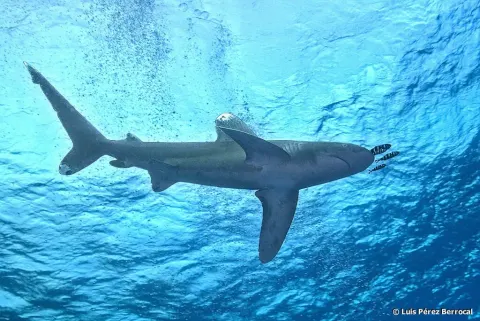
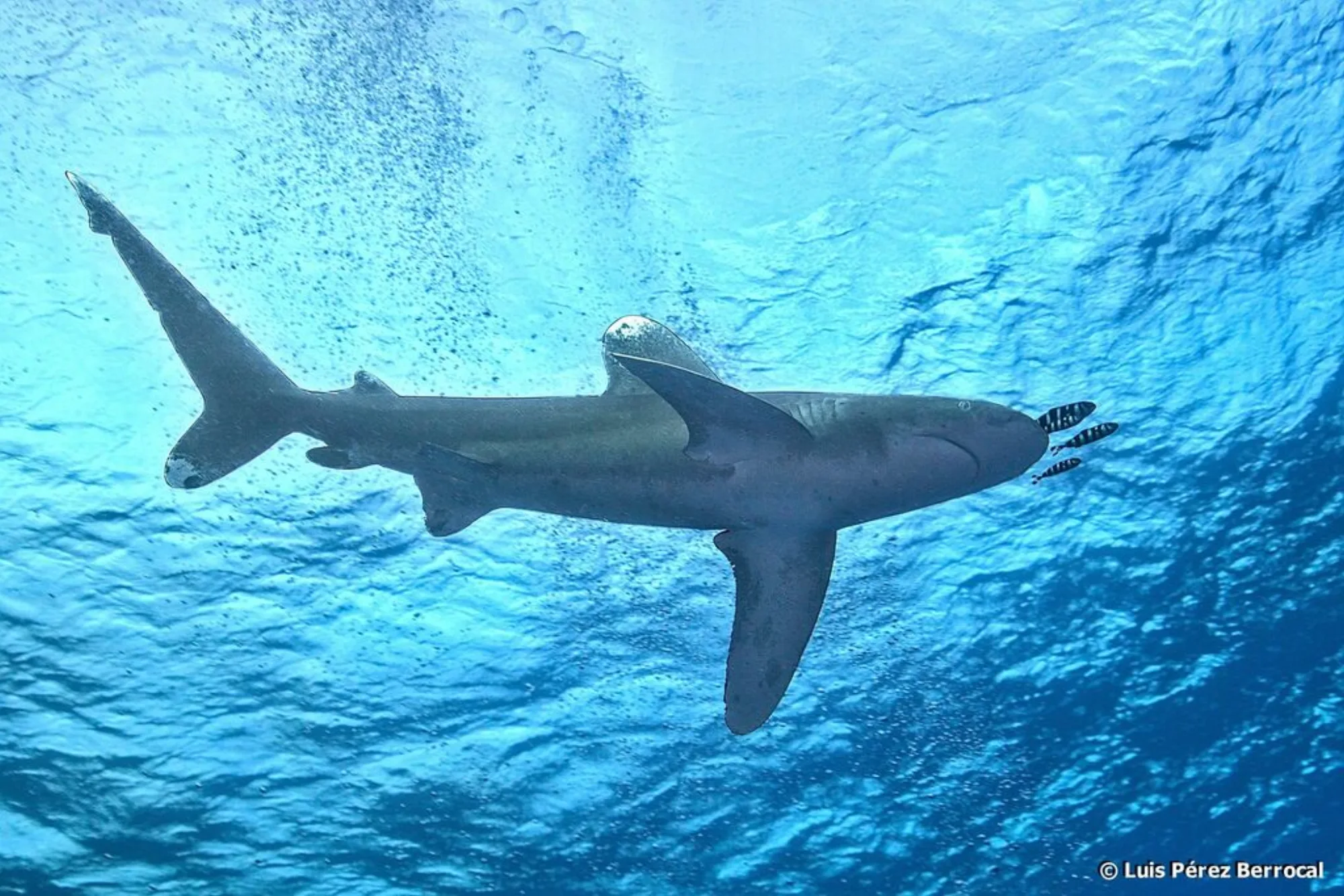
Long, rounded fins with white tips give the Oceanic Whitetip Shark a distinctive silhouette in open water. This large, stocky shark is grey-bronze above and white underneath, and its fins can also be mottled. Young sharks sometimes have black marks, while some individuals show a saddle-shaped patch between the two dorsal fins. They usually grow up to 3 m long and weigh up to 150 kg.
Oceanic whitetips range through tropical and warm temperate seas around the world, favouring deep water far offshore. They spend most of their time in the upper 150 m, although they sometimes come close to land around oceanic islands and narrow continental shelves. They prefer water above 20 °C and up to 28 °C, but can be found in cooler water. Usually solitary, they swim by day and night, often cruising slowly near the surface. When food is plentiful, they can gather in large numbers, as they do off Cat Island in the Bahamas from winter to spring. Their main prey includes squid and bony fish, though they also eat animals ranging from seabirds and sea turtles to marine mammal carcasses. They may follow pilot whales, which also feed on squid.
Females give birth to live young after carrying them for between nine months and a year. In the northwest Atlantic and southwest Indian Ocean, mating and births appear to take place in early summer. Fishing poses the main threat to oceanic whitetips, which are usually caught unintentionally and are used for their fins and meat. Their numbers appear to have fallen across every ocean region they inhabit, and pollution may pose another threat.
Written from the English Wikipedia article Oceanic whitetip shark (CC BY-SA 4.0).
- Records
- 193
- Countries
- 13
No atlas park has a record of the Oceanic Whitetip Shark in or around it yet.
These are open occurrence records, so they show where people looked for and recorded the Oceanic Whitetip Shark as much as where it lives. Cells are up to 25 km across, and every location is generalised to its cell.
Generalised encounter areas, not exact locations. Each shape is a grid cell coloured by how likely the species is there.
- Very likelyEgypt25 km zone · medium confidence · 56 records · updated 80 days ago
- Very likelyUnnamed area25 km zone · medium confidence · 44 records · updated 80 days ago
- Very likelyUnited Kingdom25 km zone · medium confidence · 23 records · updated 80 days ago
- Very likelySeychelles25 km zone · medium confidence · 19 records · updated 80 days ago
- Very likelyMauritania25 km zone · medium confidence · 18 records · updated 80 days ago
- Very likelyColombia25 km zone · medium confidence · 9 records · updated 80 days ago
- Very likelyGabon25 km zone · medium confidence · 7 records · updated 80 days ago
- Very likelyDenmark25 km zone · medium confidence · 3 records · updated 80 days ago
- LikelyFrance25 km zone · low confidence · 6 records · updated 80 days ago
- LikelyCôte d’Ivoire25 km zone · medium confidence · 3 records · updated 80 days ago
Conservation status not assessed here yet, so every location is generalised to its grid cell.