Blacktip Shark
Carcharhinus limbatus
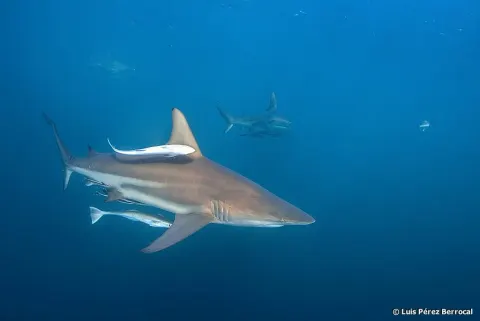
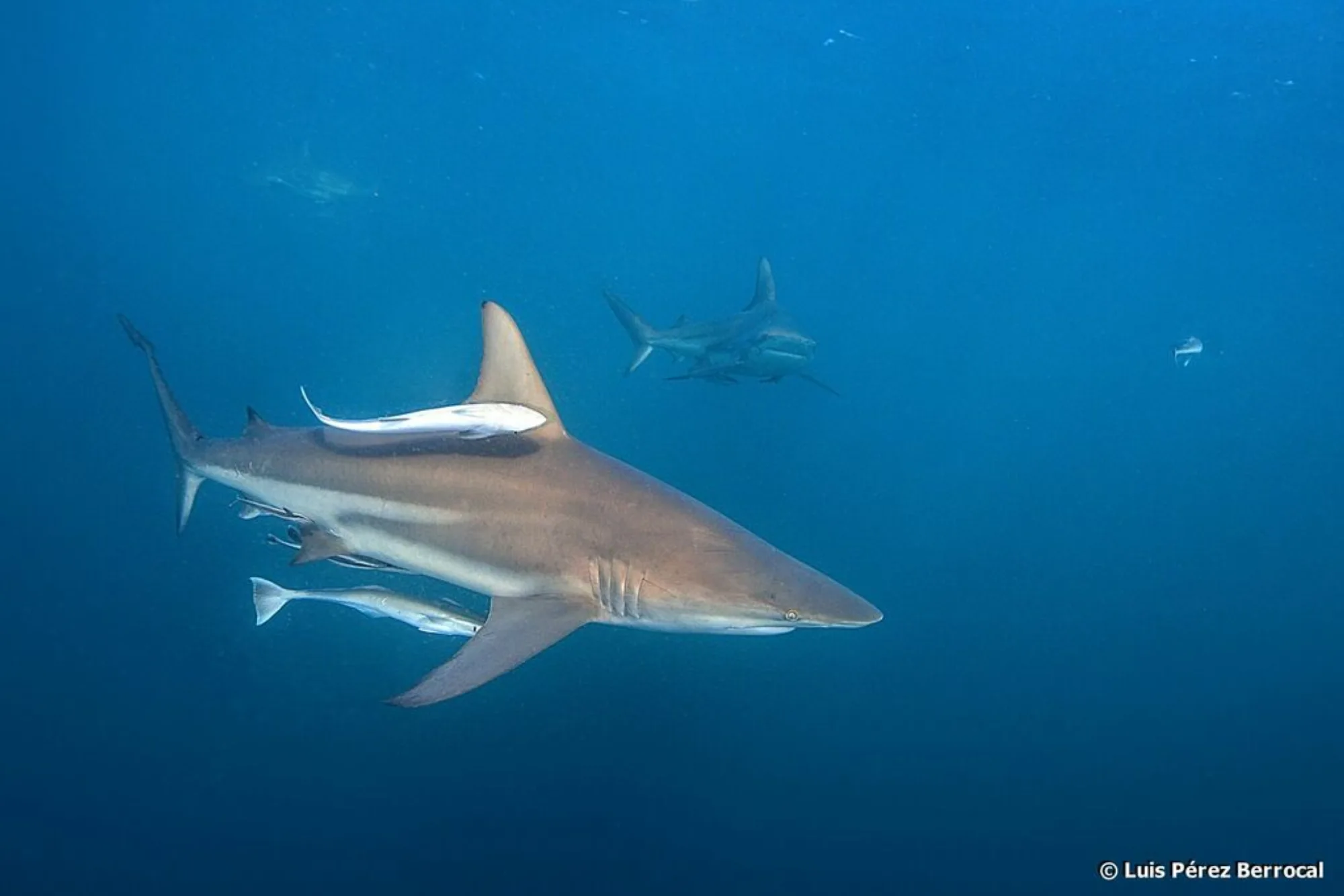
A pointed snout, streamlined body and dark fin markings help distinguish the Blacktip Shark (Carcharhinus limbatus), a requiem shark usually about 1.5 m long. Its upper body ranges from grey to brown, its underside is white, and a striking white stripe runs along each side. Most have black tips or edges on several fins, although some larger sharks have few or no markings. Found in tropical and subtropical waters worldwide, it favours muddy bays, island lagoons and drop-offs near coral reefs. It also enters estuaries and mangrove swamps, and most individuals live in water less than 30 m deep.
Blacktips are swift predators, often seen in groups of varying sizes. They sometimes burst from the water in spinning leaps after rushing through schools of small fish. Fish make up about 90% of their diet, but they also eat rays, skates, smaller sharks, crustaceans and cephalopods. Hunting is most active at dawn and dusk. Although generally wary of people, blacktips may show curiosity towards divers while keeping their distance, and can become aggressive when food is present.
Females usually give birth to four to seven pups every other year, using shallow coastal nurseries where food is plentiful and predators are fewer. The young stay in these nurseries until their first autumn, while adult females return to their own birth areas to give birth. Young sharks face threats from larger predators and starvation. Across much of its range, the Blacktip Shark is caught by commercial and recreational fisheries; its slow reproduction makes it sensitive to overfishing. Its meat, fins, skin and liver oil are all used.
Written from the English Wikipedia article Blacktip shark (CC BY-SA 4.0).
- Records
- 18,944
- Countries
- 20
- Atlas places
- 4
These are open occurrence records, so they show where people looked for and recorded the Blacktip Shark as much as where it lives. Cells are up to 25 km across, and every location is generalised to its cell.
Generalised encounter areas, not exact locations. Each shape is a grid cell coloured by how likely the species is there.
- Very likelyAustralia25 km zone · medium confidence · 18273 records · updated 80 days ago
- Very likelyUnited States25 km zone · high confidence · 254 records · updated 80 days ago
- Very likelyEcuador25 km zone · high confidence · 134 records · updated 80 days ago
- Very likelyUnited Kingdom25 km zone · medium confidence · 102 records · updated 80 days ago
- Very likelyMexico25 km zone · medium confidence · 52 records · updated 80 days ago
- Very likelyFaroe Islands25 km zone · medium confidence · 36 records · updated 80 days ago
- Very likelyMozambique25 km zone · medium confidence · 27 records · updated 80 days ago
- Very likelyJapan25 km zone · medium confidence · 12 records · updated 80 days ago
- Very likelySvalbard & Jan Mayen25 km zone · medium confidence · 11 records · updated 80 days ago
- Very likelyBelize25 km zone · medium confidence · 10 records · updated 80 days ago
Conservation status not assessed here yet, so every location is generalised to its grid cell.