Bull Shark
Carcharhinus leucas
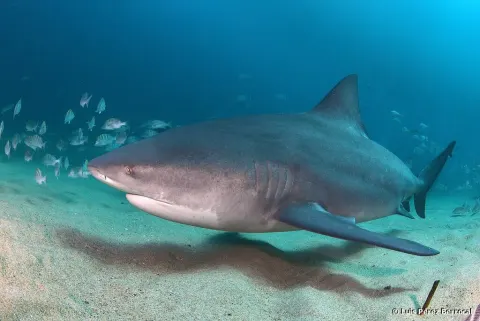
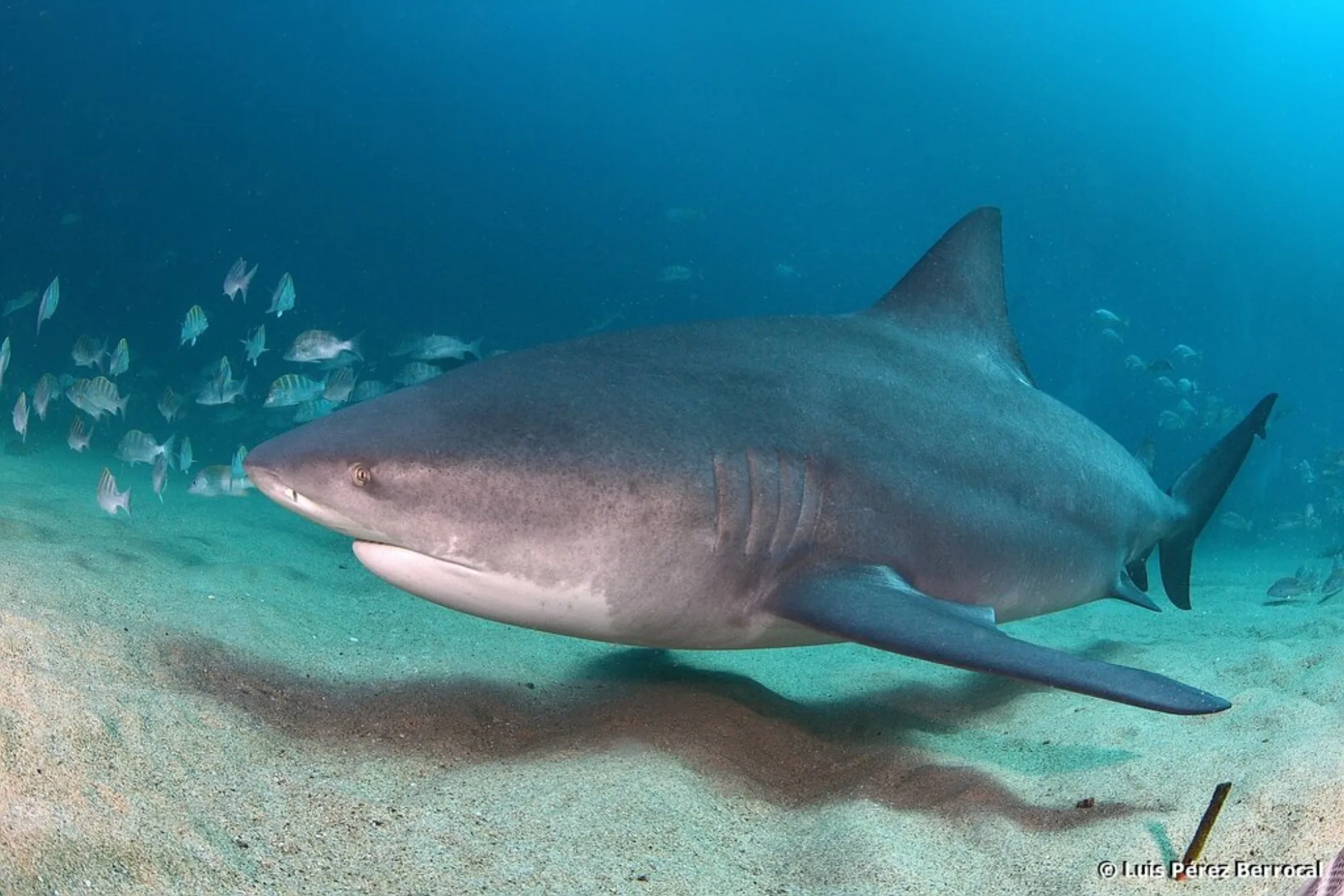
Stocky and broad-snouted, the Bull Shark (Carcharhinus leucas) is a large requiem shark with a grey back and white underside. Females are larger than males: adults average 2.4 m in length, compared with 2.25 m for males. Its name reflects its build and its aggressive, unpredictable behaviour.
Bull Sharks occur around the world in warm coastal waters, rivers and lakes, moving readily between salt and fresh water. They favour shallow water, usually swimming no deeper than 30 m, though they have been found at 150 m. In the Atlantic, their range stretches southwards from Massachusetts to Brazil and from Morocco to Angola; in the Pacific, it extends between Baja California and Ecuador. Some travel far inland: one reached the Amazon River at Iquitos in Peru, 4,000 km upriver. Estuaries, river mouths and coastal lagoons are among the places where young sharks find shelter.
Usually a solitary hunter, the Bull Shark sometimes pairs with another to make catching prey easier. It hunts in murky water and feeds mainly on bony fish, small sharks and stingrays, but also takes animals ranging from turtles and birds to dolphins. After a 12-month pregnancy, a female can give birth to 1 to 13 live, free-swimming young, which she does not rear. Fishing nets, fishing for oil, skin and meat, and pollution threaten the species. Sharks are also culled near beaches to reduce the risk of attacks on people, while larger sharks and crocodiles can prey on them.
Written from the English Wikipedia article Bull shark (CC BY-SA 4.0).
- Records
- 76,679
- Countries
- 14
- Atlas places
- 4
These are open occurrence records, so they show where people looked for and recorded the Bull Shark as much as where it lives. Cells are up to 25 km across, and every location is generalised to its cell.
Generalised encounter areas, not exact locations. Each shape is a grid cell coloured by how likely the species is there.
- Very likelyAustralia25 km zone · high confidence · 75139 records · updated 80 days ago
- Very likelyUnited States25 km zone · high confidence · 1185 records · updated 80 days ago
- LikelyMozambique25 km zone · medium confidence · 163 records · updated 80 days ago
- LikelyMexico25 km zone · medium confidence · 105 records · updated 80 days ago
- LikelyUnited Kingdom25 km zone · medium confidence · 23 records · updated 80 days ago
- PossibleSouth Africa25 km zone · medium confidence · 24 records · updated 80 days ago
- PossibleFiji25 km zone · medium confidence · 21 records · updated 80 days ago
- PossiblePanama25 km zone · medium confidence · 11 records · updated 80 days ago
- PossibleBahamas25 km zone · medium confidence · 5 records · updated 80 days ago
- PossibleMyanmar (Burma)25 km zone · medium confidence · 3 records · updated 80 days ago
Conservation status not assessed here yet, so every location is generalised to its grid cell.