Galapagos Shark
Carcharhinus galapagensis
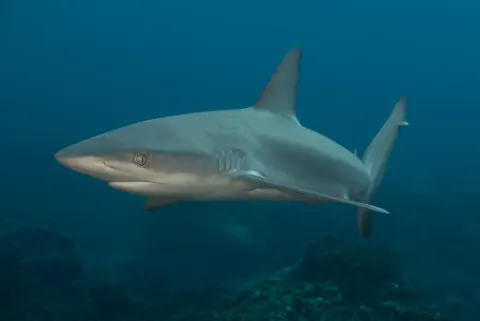
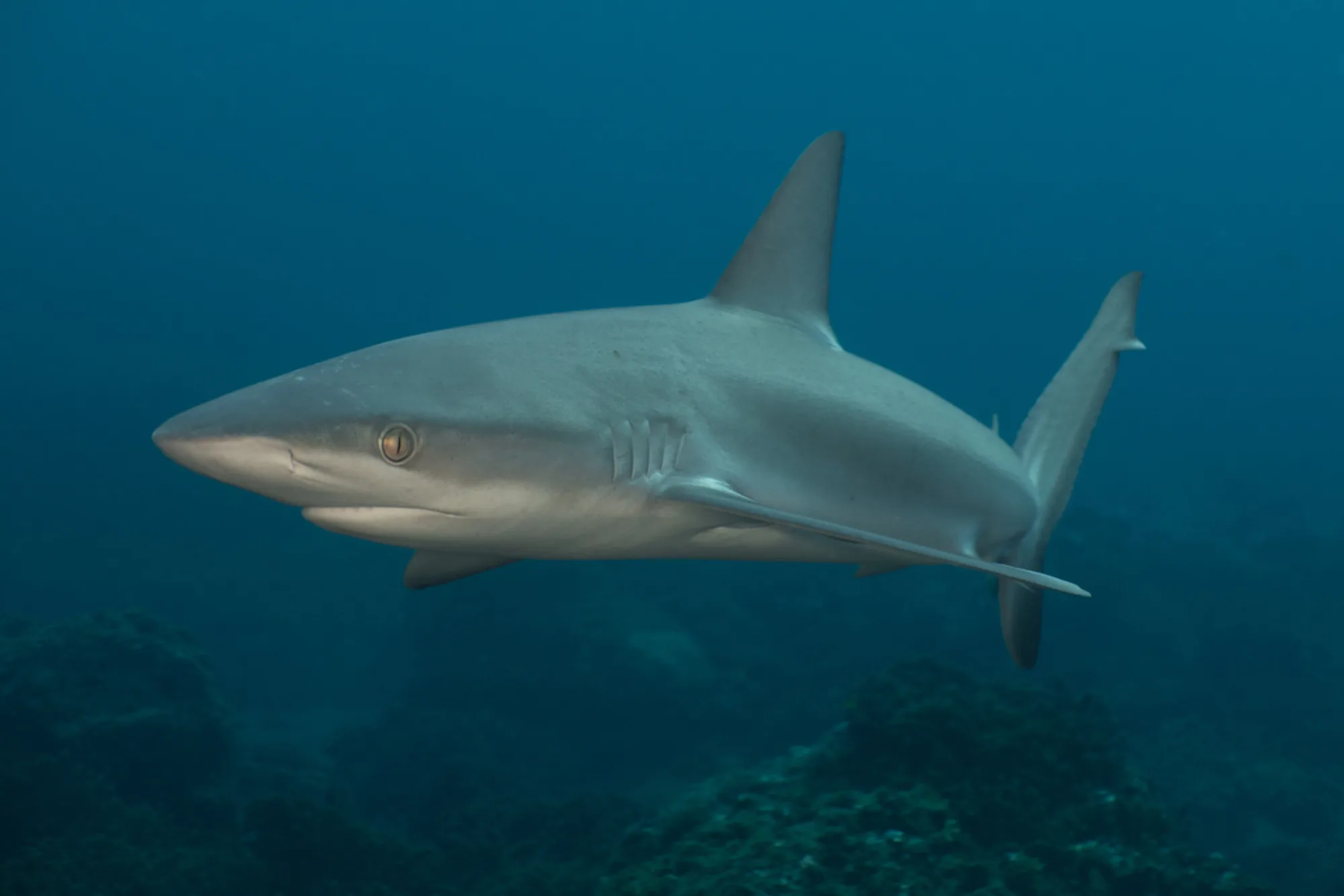
A tall dorsal fin with a slightly rounded tip helps identify the Galapagos Shark, though it can be difficult to distinguish from the dusky and grey reef sharks. This large, streamlined shark commonly reaches 3.0 m in length. It is brownish grey above and white below, with a faint pale stripe along its sides and darker edges to its fins.
Found mainly around tropical oceanic islands, it favours clear water, rugged reefs and strong currents near the coast. It also gathers around rocky islets and seamounts, and can cross open water between islands. Its range includes the Galapagos and Hawaiian Islands, Bermuda, Cape Verde and the Kermadec Islands. Juveniles rarely go deeper than 25 m, while adults have been reported at depths of 180 m. Divers visit Wolf and Darwin in the northern Galapagos to see these sharks in open water, where they gather alongside scalloped hammerheads. Galapagos Sharks can approach swimmers closely and show interest in hands or swim fins.
An active predator, it often gathers in large groups and feeds mainly on bottom-dwelling bony fish and octopuses. Larger sharks eat a wider range of prey, including smaller sharks and rays, and have been seen attacking sea lions and marine iguanas. Females give birth to 4 to 16 pups every 2 to 3 years, and the young stay in shallow water, away from larger adults that may prey on them. Commercial fisheries catch the species across much of its range, and its slow reproduction limits its ability to recover from population losses. It may have disappeared from sites around Central America, while its fragmented distribution could put other regional populations at risk.
Written from the English Wikipedia article Galapagos shark (CC BY-SA 4.0).
- Records
- 1,343
- Countries
- 13
- Atlas places
- 1
These are open occurrence records, so they show where people looked for and recorded the Galapagos Shark as much as where it lives. Cells are up to 25 km across, and every location is generalised to its cell.
Generalised encounter areas, not exact locations. Each shape is a grid cell coloured by how likely the species is there.
- Very likelyAustralia25 km zone · high confidence · 732 records · updated 80 days ago
- Very likelyUnited States25 km zone · high confidence · 540 records · updated 80 days ago
- LikelyEcuador25 km zone · medium confidence · 24 records · updated 80 days ago
- LikelyUnited Kingdom25 km zone · medium confidence · 15 records · updated 80 days ago
- LikelySvalbard & Jan Mayen25 km zone · medium confidence · 9 records · updated 80 days ago
- LikelyFaroe Islands25 km zone · medium confidence · 6 records · updated 80 days ago
- PossibleSt. Helena25 km zone · medium confidence · 5 records · updated 80 days ago
- PossibleMexico25 km zone · medium confidence · 4 records · updated 80 days ago
- PossibleFrance25 km zone · medium confidence · 3 records · updated 80 days ago
- PossibleNorfolk Island25 km zone · medium confidence · 3 records · updated 80 days ago
Conservation status not assessed here yet, so every location is generalised to its grid cell.