Silky Shark
Carcharhinus falciformis
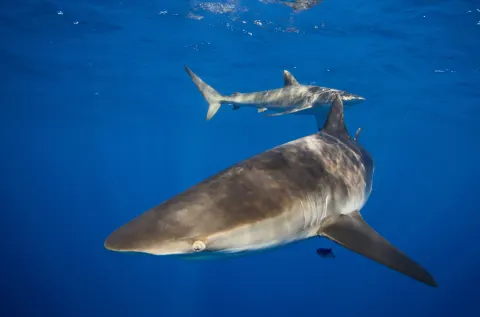
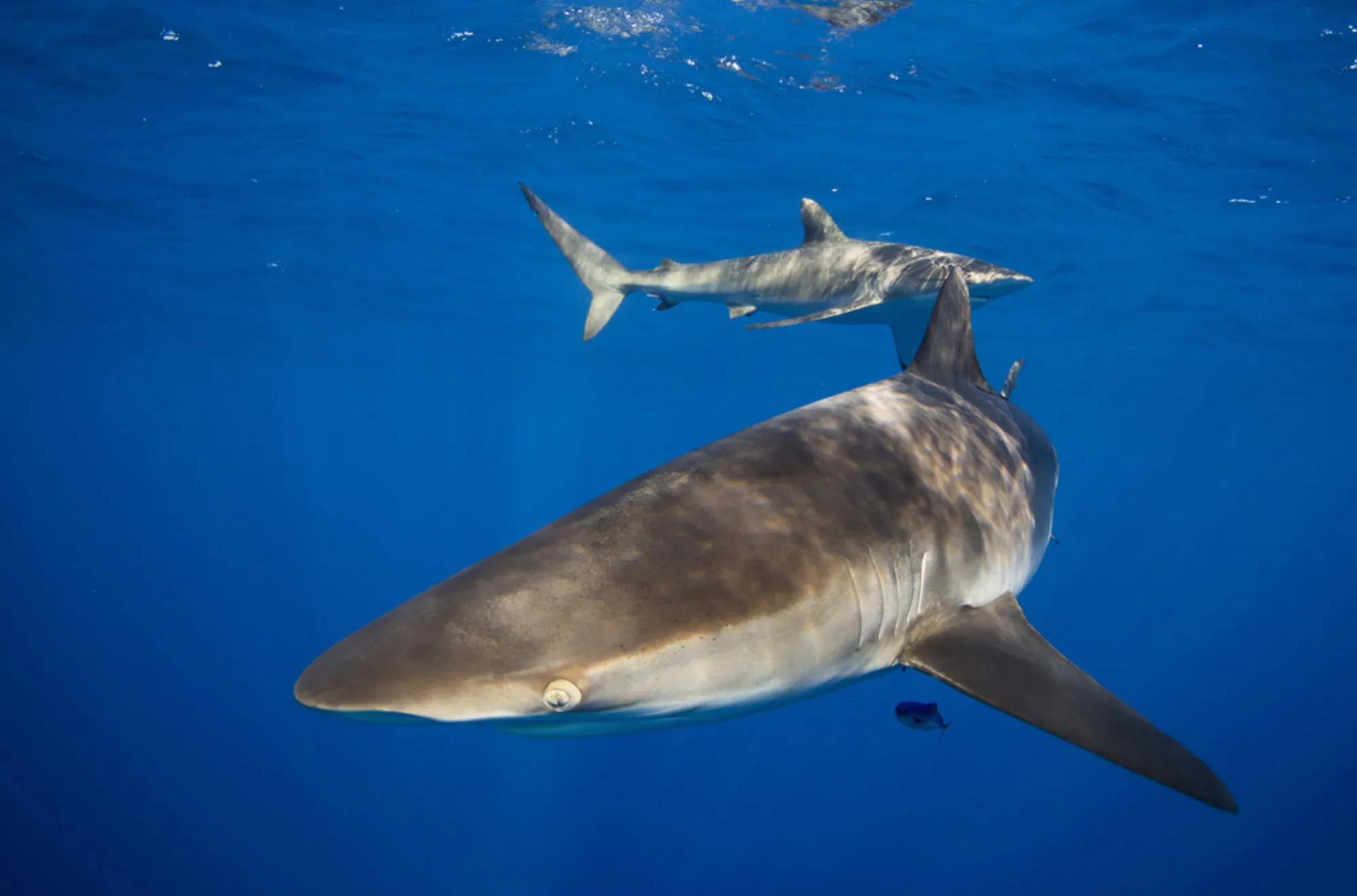
Named for its smooth skin, the Silky Shark (Carcharhinus falciformis) is a slender, streamlined requiem shark that typically reaches 2.5 m in length. Its back is a deep metallic bronze-grey, its underside white, and its long pectoral fins curve like sickles. The first dorsal fin is relatively small, while the second is tiny with a long rear tip. This highly mobile, migratory shark ranges through tropical waters worldwide, primarily in the open ocean. It favours the edges of continental and island shelves, often around islands and above deepwater reefs, and is most common from the surface to 200 m.
An active, inquisitive hunter, it may circle something that interests it, at times moving its head from one side to the other, before responding swiftly to changes nearby. Younger sharks can gather in large, loosely organised groups, and the species is often seen around floating objects. Silky Sharks eat mainly bony fish and cephalopods, often following schools of tuna. They can herd small fish into a tight mass at the surface, then charge through it with slashing attacks. Females give birth every year or every other year, with litters of up to 16 pups. The young spend their first months in protected nurseries among reefs at the outer edge of the continental shelf before moving into the open ocean.
Divers may find these curious sharks approaching closely and repeatedly, though contact with people is rare in their oceanic habitat. Fishing poses a serious threat: Silky Sharks are caught in commercial and artisanal fisheries and incidentally in tuna fisheries. Their fins are valuable, and their meat, skin, liver oil and jaws are also used. Evidence points to substantial worldwide declines, with their modest reproductive rate unable to sustain heavy exploitation.
Written from the English Wikipedia article Silky shark (CC BY-SA 4.0).
- Records
- 3,159
- Countries
- 24
No atlas park has a record of the Silky Shark in or around it yet.
These are open occurrence records, so they show where people looked for and recorded the Silky Shark as much as where it lives. Cells are up to 25 km across, and every location is generalised to its cell.
Generalised encounter areas, not exact locations. Each shape is a grid cell coloured by how likely the species is there.
- Very likelyUnnamed area25 km zone · high confidence · 1236 records · updated 80 days ago
- Very likelySeychelles25 km zone · medium confidence · 679 records · updated 80 days ago
- Very likelyUnited Kingdom25 km zone · medium confidence · 196 records · updated 80 days ago
- Very likelyGuinea25 km zone · medium confidence · 166 records · updated 80 days ago
- Very likelyGabon25 km zone · medium confidence · 141 records · updated 80 days ago
- Very likelyBritish Indian Ocean Territory25 km zone · medium confidence · 129 records · updated 80 days ago
- Very likelyMexico25 km zone · medium confidence · 125 records · updated 80 days ago
- Very likelyColombia25 km zone · medium confidence · 112 records · updated 80 days ago
- Very likelyFaroe Islands25 km zone · medium confidence · 74 records · updated 80 days ago
- Very likelyMozambique25 km zone · medium confidence · 46 records · updated 80 days ago
Conservation status not assessed here yet, so every location is generalised to its grid cell.