Spinner Shark
Carcharhinus brevipinna
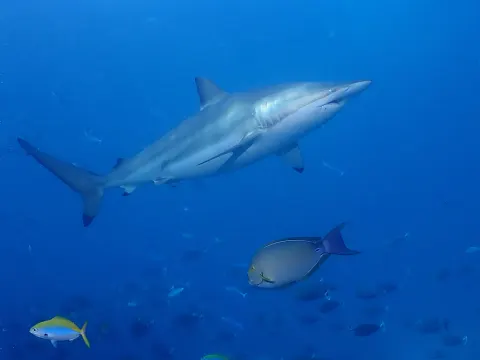
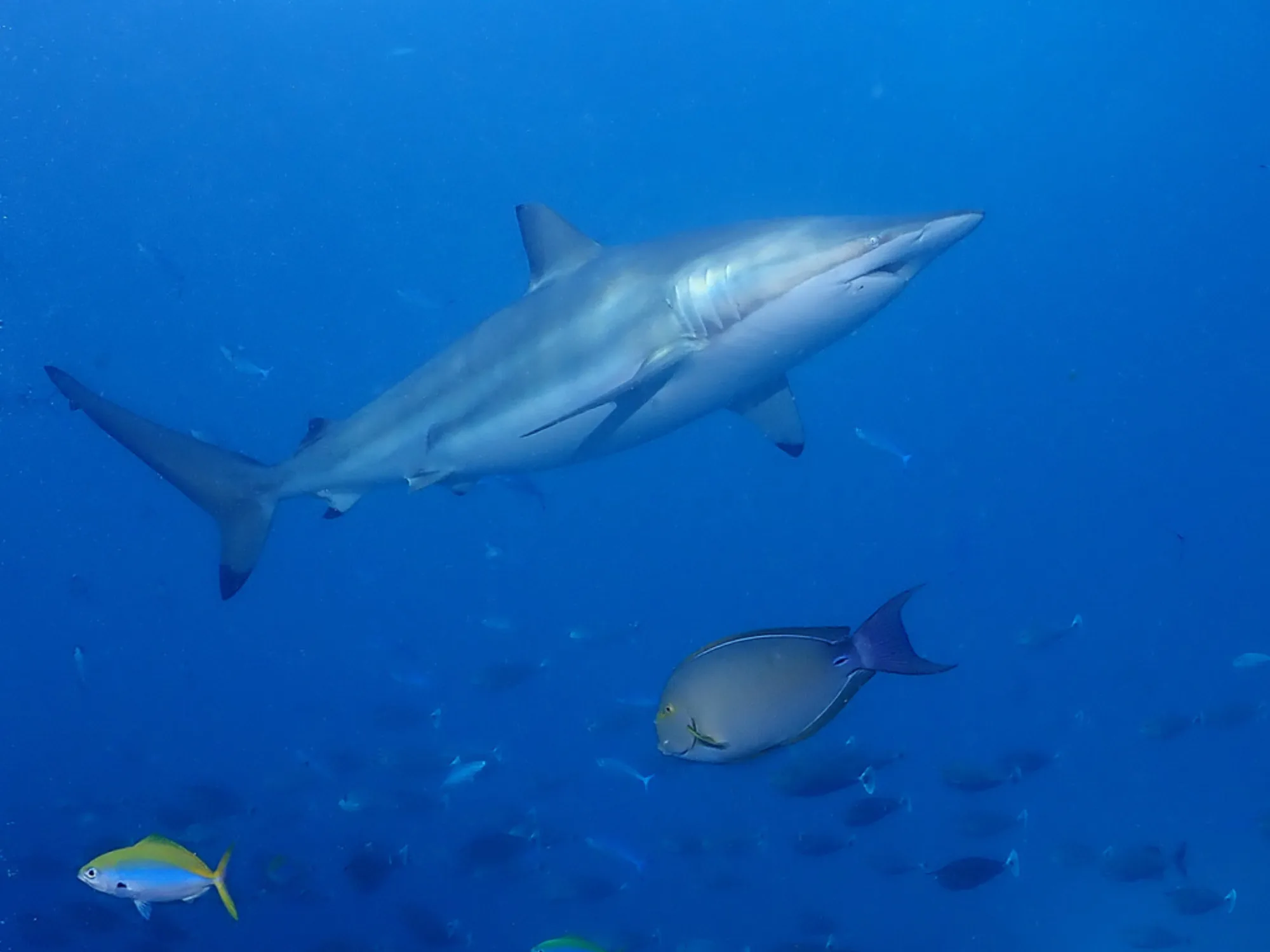
A sudden spiral through a school of fish can send the Spinner Shark clear of the water, a feeding habit that gives it its name. This swift, slender requiem shark has a long, pointed snout and can reach 3 m in length. Its upper body is grey, at times tinged bronze, while its underside is white and a faint pale band runs along each side. Larger individuals have black tips on several fins, while the fins of young sharks are unmarked. An adult can be told from the similar blacktip shark by the black tip on its anal fin and the more rearward position of its first dorsal fin.
Spinner sharks range through tropical and warm temperate seas, from coastal waters to well offshore, but are absent from the eastern Pacific. They prefer water shallower than 30 m, although they have been recorded down to 100 m. Young sharks sometimes enter bays and avoid brackish water. In the northwest Atlantic, the sharks move between warm inshore waters in spring and summer and deeper waters farther south in winter. Fast and sociable, they sometimes gather in large schools separated by age and sex. They feed mainly on small bony fish, including sardines, anchovies and mullets, as well as squid, cuttlefish and octopus. Groups may chase schools of prey at speed, with individual sharks spinning upwards through the fish and sometimes bursting into the air.
Females give birth to three to 20 pups every other year, using shallow coastal nursery areas where the young grow relatively quickly. Commercial fishers catch spinner sharks for products including leather, vitamins, food and fins for soup, while recreational fishers prize them as strong fighters. Their frequent use of coastal habitats also exposes them to habitat degradation.
Written from the English Wikipedia article Spinner shark (CC BY-SA 4.0).
- Records
- 310
- Countries
- 13
- Atlas places
- 1
These are open occurrence records, so they show where people looked for and recorded the Spinner Shark as much as where it lives. Cells are up to 25 km across, and every location is generalised to its cell.
Generalised encounter areas, not exact locations. Each shape is a grid cell coloured by how likely the species is there.
- Very likelyUnited States25 km zone · medium confidence · 228 records · updated 80 days ago
- Very likelyAustralia25 km zone · medium confidence · 24 records · updated 80 days ago
- Very likelyFaroe Islands25 km zone · medium confidence · 14 records · updated 80 days ago
- Very likelyBrazil25 km zone · medium confidence · 12 records · updated 80 days ago
- Very likelyMexico25 km zone · medium confidence · 7 records · updated 80 days ago
- LikelySouth Africa25 km zone · medium confidence · 9 records · updated 80 days ago
- LikelyIndonesia25 km zone · medium confidence · 7 records · updated 80 days ago
- LikelyJapan25 km zone · medium confidence · 3 records · updated 80 days ago
- LikelyPapua New Guinea25 km zone · medium confidence · 3 records · updated 80 days ago
- LikelyUnited Kingdom25 km zone · medium confidence · 3 records · updated 80 days ago
Conservation status not assessed here yet, so every location is generalised to its grid cell.