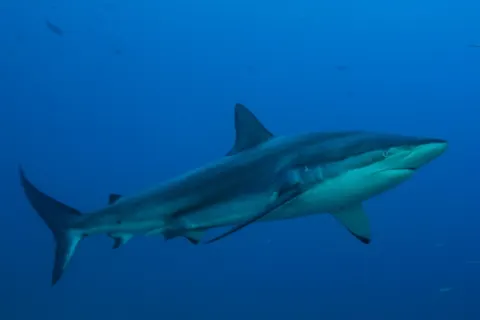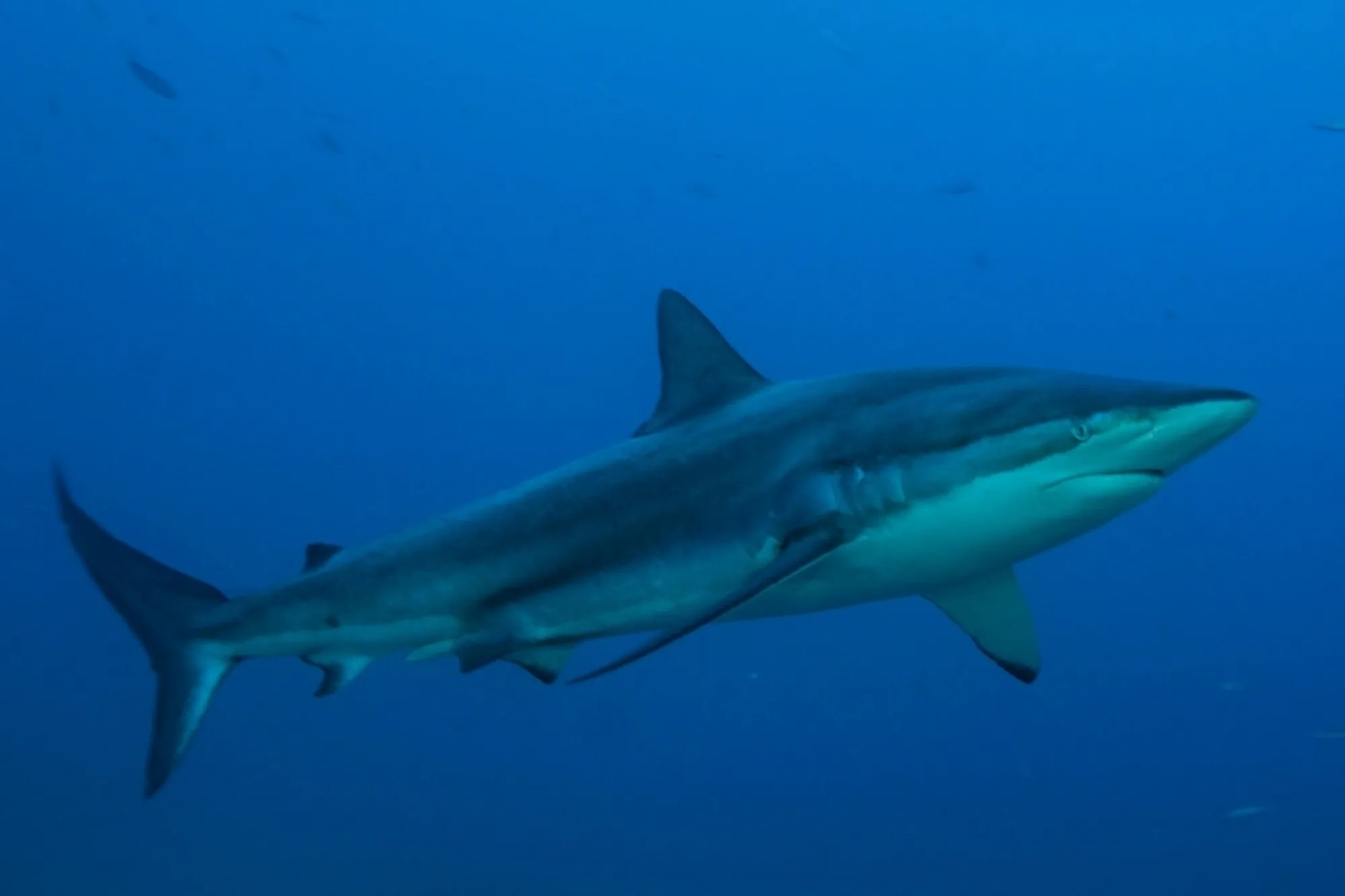
Bronze Whaler
Carcharhinus brachyurus
Bronze above and white below, the Bronze Whaler has a streamlined body and can reach 3.3 m in length. Its upper surface may have an olive-grey or metallic sheen, with darker fin tips and edges. Other large requiem sharks look similar, especially the dusky shark.
This shark favours temperate waters, with separate populations in the Atlantic and Pacific, off southern Africa, and around Australia and New Zealand. It occurs commonly in some waters near New Zealand, Australia, South Africa and Argentina, but is rare elsewhere. Its habitats range from estuaries and shallow bays to offshore waters 100 m deep or more. Young sharks stay in inshore waters year round, while adults generally venture farther offshore and approach the coast in spring and summer. At those times, large gatherings can be seen in shallow water. The sharks migrate seasonally and return to the same areas year after year.
A fast swimmer, the Bronze Whaler is usually solitary, although it can gather in large groups to hunt. Its varied diet includes squid, fish, sharks and rays, with feeding often taking place nearer the seabed than the surface. Off South Africa, groups follow the winter pilchard run and have been seen herding small fish into tight balls before feeding. Females give birth to 7 to 24 pups every other year, using shallow coastal waters as nurseries. Commercial and recreational fishing take these sharks, and they are also caught accidentally in other fisheries. Slow growth and reproduction make them susceptible to overfishing, while coastal development, pollution and aquaculture can damage their nursery grounds. Sharks also die in beach protection nets and face persecution from fish farmers in southern Australia.
Written from the English Wikipedia article Copper shark (CC BY-SA 4.0).
- Records
- 8,915
- Countries
- 6
- Atlas places
- 1
These are open occurrence records, so they show where people looked for and recorded the Bronze Whaler as much as where it lives. Cells are up to 25 km across, and every location is generalised to its cell.
Generalised encounter areas, not exact locations. Each shape is a grid cell coloured by how likely the species is there.
- Very likelyAustralia25 km zone · medium confidence · 8823 records · updated 80 days ago
- Very likelyNew Zealand25 km zone · medium confidence · 75 records · updated 80 days ago
- Very likelySouth Africa25 km zone · medium confidence · 10 records · updated 80 days ago
- LikelyMexico25 km zone · medium confidence · 4 records · updated 80 days ago
- LikelyChina25 km zone · medium confidence · 3 records · updated 80 days ago
- LikelyUnited States25 km zone · low confidence · 0 records · updated 80 days ago
Conservation status not assessed here yet, so every location is generalised to its grid cell.