Grey Reef Shark
Carcharhinus amblyrhynchos
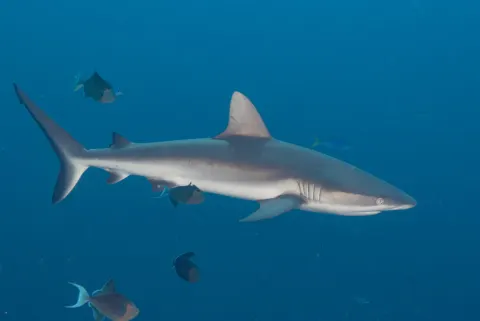
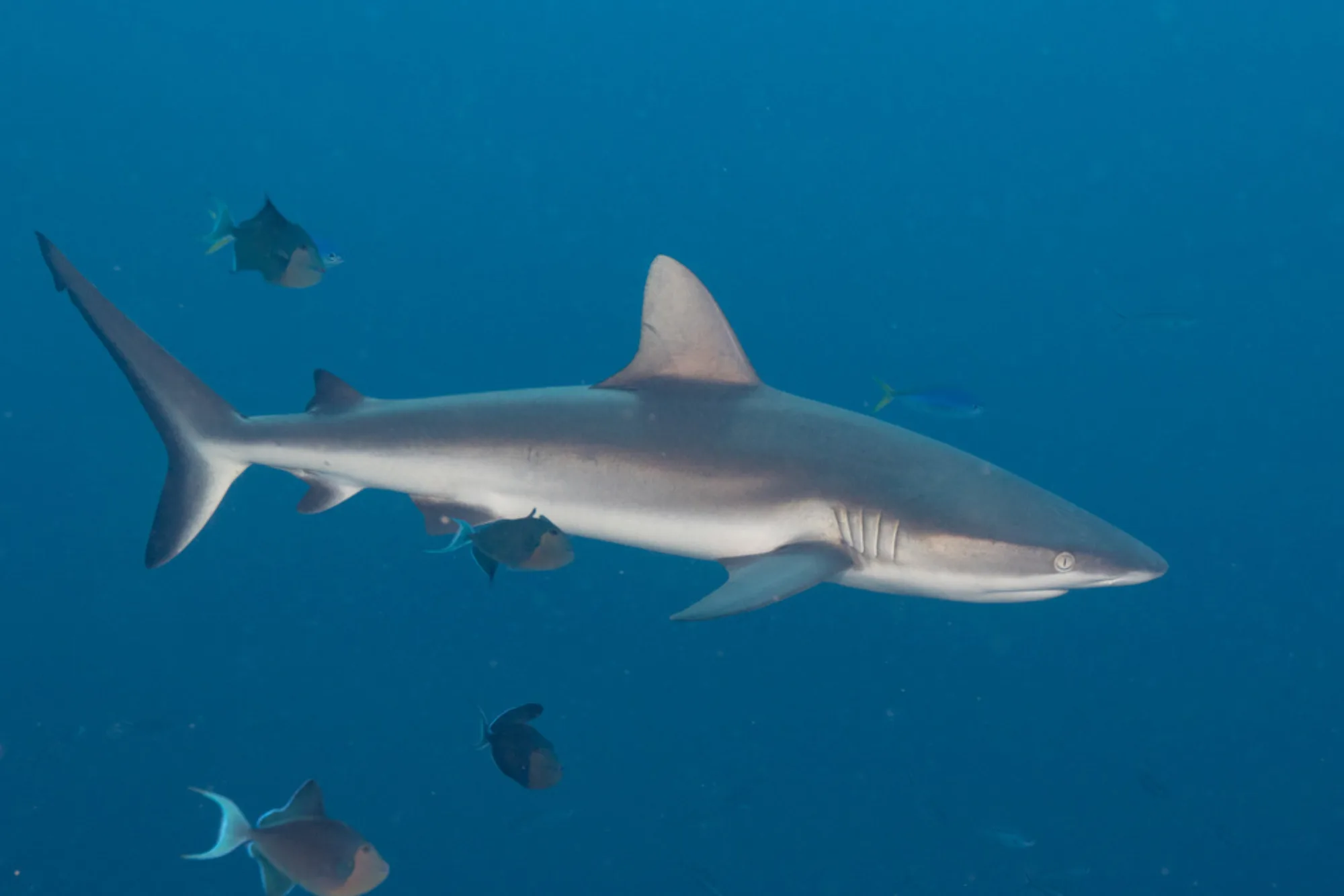
With a broad, rounded snout and large eyes, the Grey Reef Shark has the familiar streamlined shape of a reef shark. It is grey above and white below, sometimes with a bronze sheen, and has a broad black band along the rear edge of its tail. Most are less than 1.88 m long. The first dorsal fin is plain or white-tipped, while the other fins have dark tips. Found across the Indian and Pacific Oceans, it ranges from South Africa to Easter Island, with records from the Maldives, Indonesia and many Pacific islands. It favours clear water around coral reefs, often near outer drop-offs and channels with strong currents, and is usually found at depths of less than 60 m.
Grey reef sharks are social and often gather near reef drop-offs during the day, then disperse as they begin to hunt in the evening. They feed mainly on bony fish, as well as squid, octopuses and crustaceans, hunting alone or in groups. Females give birth to one to six pups every other year. Divers may see a shark approach closely, but should treat it with caution: a shark that feels threatened may drop its side fins, arch its back and swim with an exaggerated motion from side to side. Fisheries catch these sharks across much of their range, while human development continues to degrade their coral reef habitat. Slow reproduction and a tendency to remain in one area make local populations susceptible to depletion.
Written from the English Wikipedia article Grey reef shark (CC BY-SA 4.0).
- Records
- 193,759
- Countries
- 22
- Atlas places
- 1
These are open occurrence records, so they show where people looked for and recorded the Grey Reef Shark as much as where it lives. Cells are up to 25 km across, and every location is generalised to its cell.
Generalised encounter areas, not exact locations. Each shape is a grid cell coloured by how likely the species is there.
- Very likelyAustralia25 km zone · high confidence · 191411 records · updated 80 days ago
- Very likelyU.S. Outlying Islands25 km zone · high confidence · 1568 records · updated 80 days ago
- Very likelyNorthern Mariana Islands25 km zone · medium confidence · 146 records · updated 80 days ago
- Very likelyFrench Polynesia25 km zone · medium confidence · 142 records · updated 80 days ago
- Very likelyAmerican Samoa25 km zone · medium confidence · 60 records · updated 80 days ago
- Very likelyMicronesia25 km zone · medium confidence · 43 records · updated 80 days ago
- LikelyUnited States25 km zone · medium confidence · 149 records · updated 80 days ago
- LikelyNew Caledonia25 km zone · medium confidence · 50 records · updated 80 days ago
- LikelyPalau25 km zone · medium confidence · 49 records · updated 80 days ago
- LikelyMaldives25 km zone · medium confidence · 45 records · updated 80 days ago
Conservation status not assessed here yet, so every location is generalised to its grid cell.