Crucian Carp
Carassius carassius
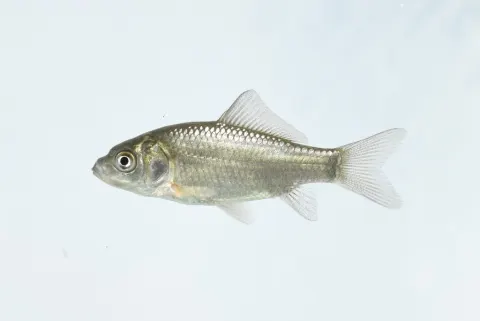
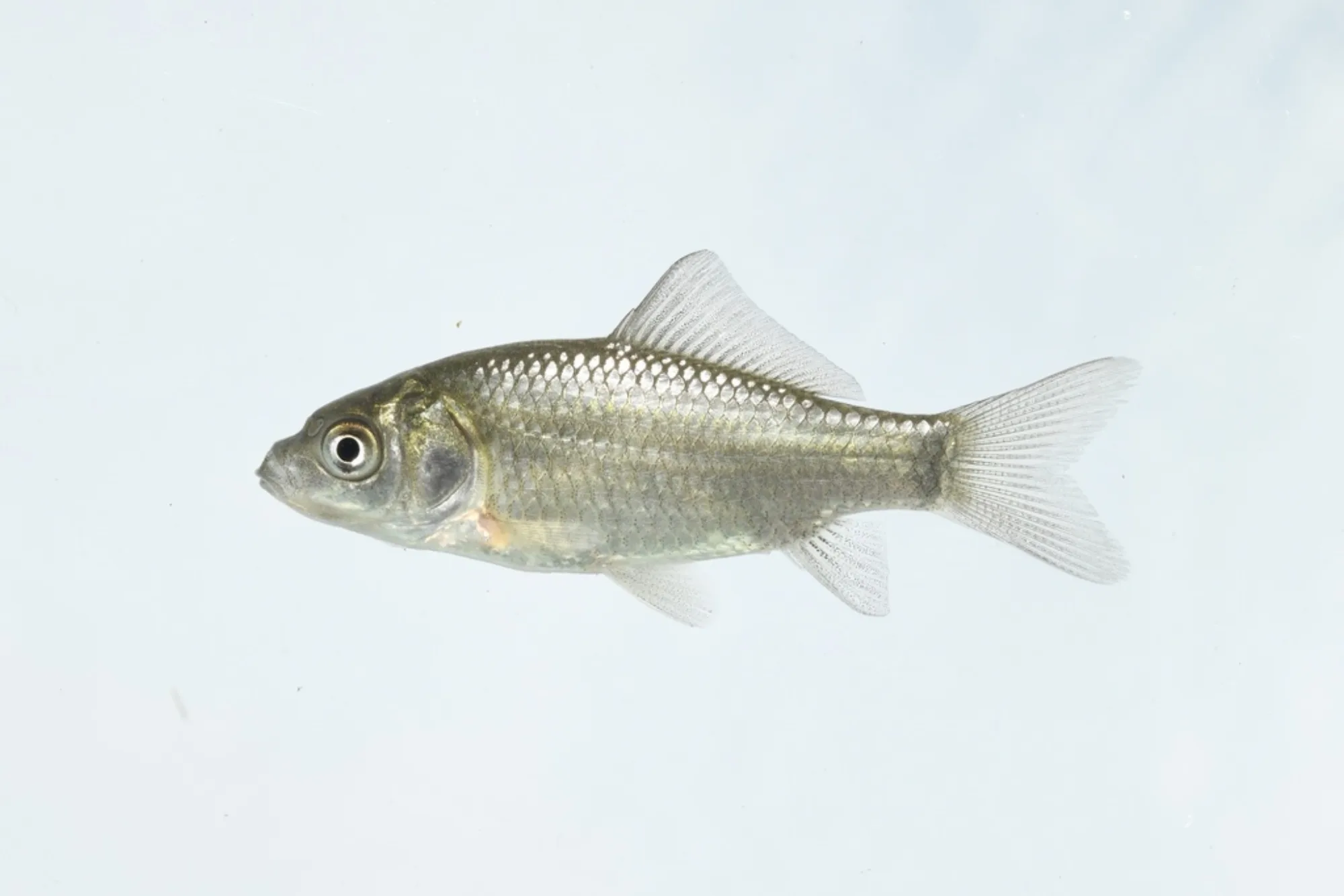
Golden-bronze when young, the Crucian Carp darkens as it matures, developing a dark green back, deep bronze upper sides and gold lower sides and belly. Its fins can be reddish or orange, though other colour variations occur. This medium-sized member of the carp family is typically 15 centimetres long and rarely weighs more than 2 kilograms. A male has been reported at 64 centimetres, while the heaviest published fish weighed 3 kilograms. A rounded fin helps distinguish it from hybrids with goldfish or C. gibelio, which have inward-curving fins.
Its European range stretches from England to Russia, reaching the Arctic Circle in Scandinavia and extending south to central France and the Black Sea region. Look for it in lakes, ponds and slow-moving rivers. In waters shared with predatory fish, crucian carp can develop deeper bodies, making them harder for a predator to fit into its jaws. That shape is associated with slower growth and reduced immune function, and it is not permanent.
In winter, crucian carp can survive for weeks in water without oxygen, including beneath ice that seals a pond or lake off from the air. They do so by producing alcohol, most of which passes out into the water. Cold water allows them to tolerate these conditions for longer; fish have been kept without oxygen for 140 days in experiments. Hybridisation with domestic or feral goldfish has been reported, raising concern about genetic contamination of native populations. Even when hybrids cannot reproduce, they may pose a threat because they are better than either parent at finding food and escaping predators.
Written from the English Wikipedia article Crucian carp (CC BY-SA 4.0).
- Records
- 20,585
- Countries
- 9
No atlas park has a record of the Crucian Carp in or around it yet.
These are open occurrence records, so they show where people looked for and recorded the Crucian Carp as much as where it lives. Cells are up to 25 km across, and every location is generalised to its cell.
Generalised encounter areas, not exact locations. Each shape is a grid cell coloured by how likely the species is there.
- Very likelySweden25 km zone · high confidence · 12689 records · updated 80 days ago
- Very likelyFrance25 km zone · high confidence · 7226 records · updated 80 days ago
- Very likelyDenmark25 km zone · high confidence · 129 records · updated 80 days ago
- LikelyUnited Kingdom25 km zone · medium confidence · 229 records · updated 80 days ago
- LikelyNetherlands25 km zone · medium confidence · 139 records · updated 80 days ago
- LikelyNorway25 km zone · medium confidence · 64 records · updated 80 days ago
- LikelySwitzerland25 km zone · medium confidence · 44 records · updated 80 days ago
- LikelyItaly25 km zone · medium confidence · 35 records · updated 80 days ago
- LikelyGermany25 km zone · medium confidence · 30 records · updated 80 days ago
Conservation status not assessed here yet, so every location is generalised to its grid cell.