Goldfish
Carassius auratus
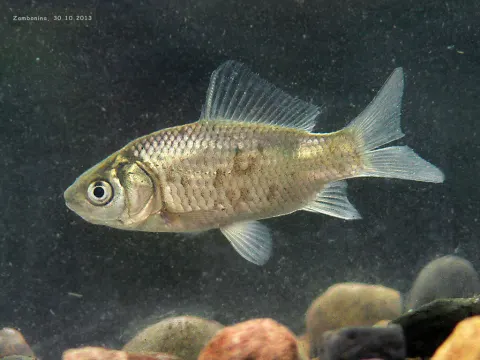
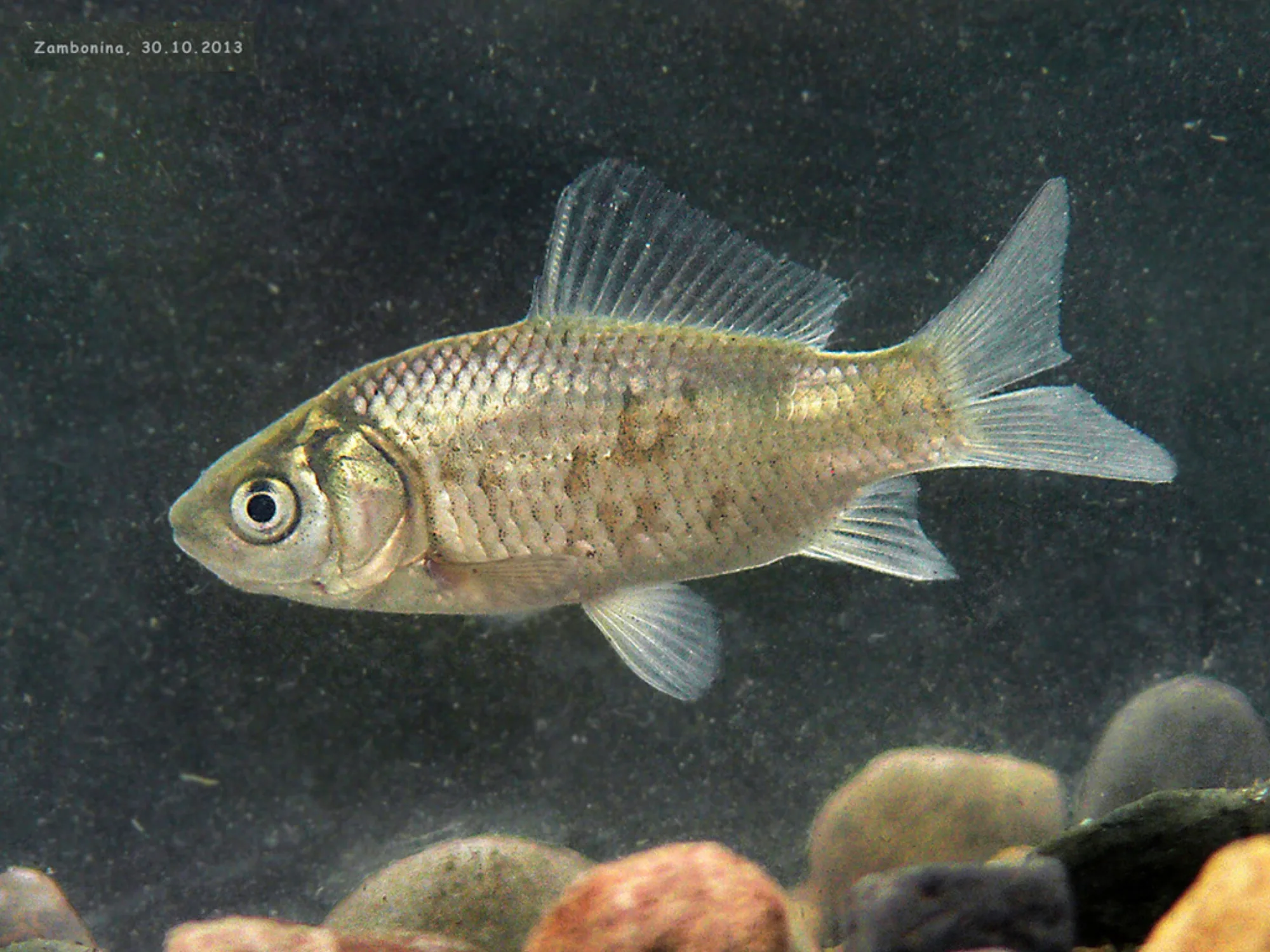
Native to China, the Goldfish is a freshwater fish that has also found its way into ponds, water gardens and aquariums around the world. Wild fish typically measure 12 to 22 cm, though they can reach 41 cm. Selective breeding has produced a range of body shapes, fins and colours, from black and brown to white, yellow, orange and red. Some familiar varieties are much closer to the wild form than the more extreme aquarium breeds.
Goldfish are sociable and swim in schools, with feeding habits that can be shared across a group. In the wild, they eat crustaceans, insects and plant material, taking advantage of food as they find it. In winter they can become sluggish, stop feeding and remain near the bottom of a pond, becoming active again in spring. Breeding often follows a marked change in temperature, frequently in spring. The eggs stick to aquatic vegetation and hatch within 48 to 72 hours. Young fish grow quickly in their first weeks, when they risk being eaten by adult goldfish, other fish and insects. They remain metallic brown at first and may take a year to develop adult colouring.
Released goldfish have become invasive in parts of North America and Australia, where their introduction can harm local ecosystems. The fish themselves face hazards, particularly in captivity: waste can build up to toxic levels, and sudden temperature changes can be fatal. Faster varieties may also consume the available food before slower fish can reach it, leaving the latter at risk of stunted growth or starvation.
Written from the English Wikipedia article Goldfish (CC BY-SA 4.0).
- Records
- 18,775
- Countries
- 10
- Atlas places
- 1
These are open occurrence records, so they show where people looked for and recorded the Goldfish as much as where it lives. Cells are up to 25 km across, and every location is generalised to its cell.
Generalised encounter areas, not exact locations. Each shape is a grid cell coloured by how likely the species is there.
- Very likelySouth Korea25 km zone · medium confidence · 7875 records · updated 80 days ago
- Very likelyAustralia25 km zone · medium confidence · 6936 records · updated 80 days ago
- Very likelyUnited States25 km zone · medium confidence · 2249 records · updated 80 days ago
- Very likelyJapan25 km zone · high confidence · 1005 records · updated 80 days ago
- Very likelyUkraine25 km zone · high confidence · 343 records · updated 80 days ago
- Very likelyCanada25 km zone · high confidence · 173 records · updated 80 days ago
- Very likelySpain25 km zone · medium confidence · 57 records · updated 80 days ago
- Very likelyGermany25 km zone · medium confidence · 48 records · updated 80 days ago
- Very likelySwitzerland25 km zone · medium confidence · 48 records · updated 80 days ago
- Very likelyTaiwan25 km zone · medium confidence · 41 records · updated 80 days ago
Conservation status not assessed here yet, so every location is generalised to its grid cell.