Giant Trevally
Caranx ignobilis
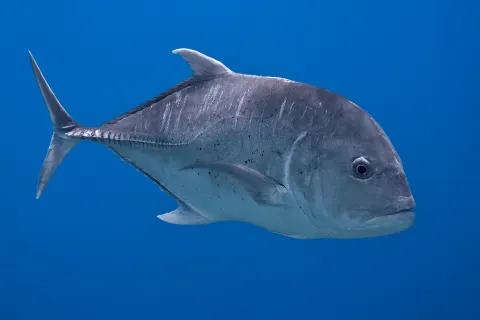
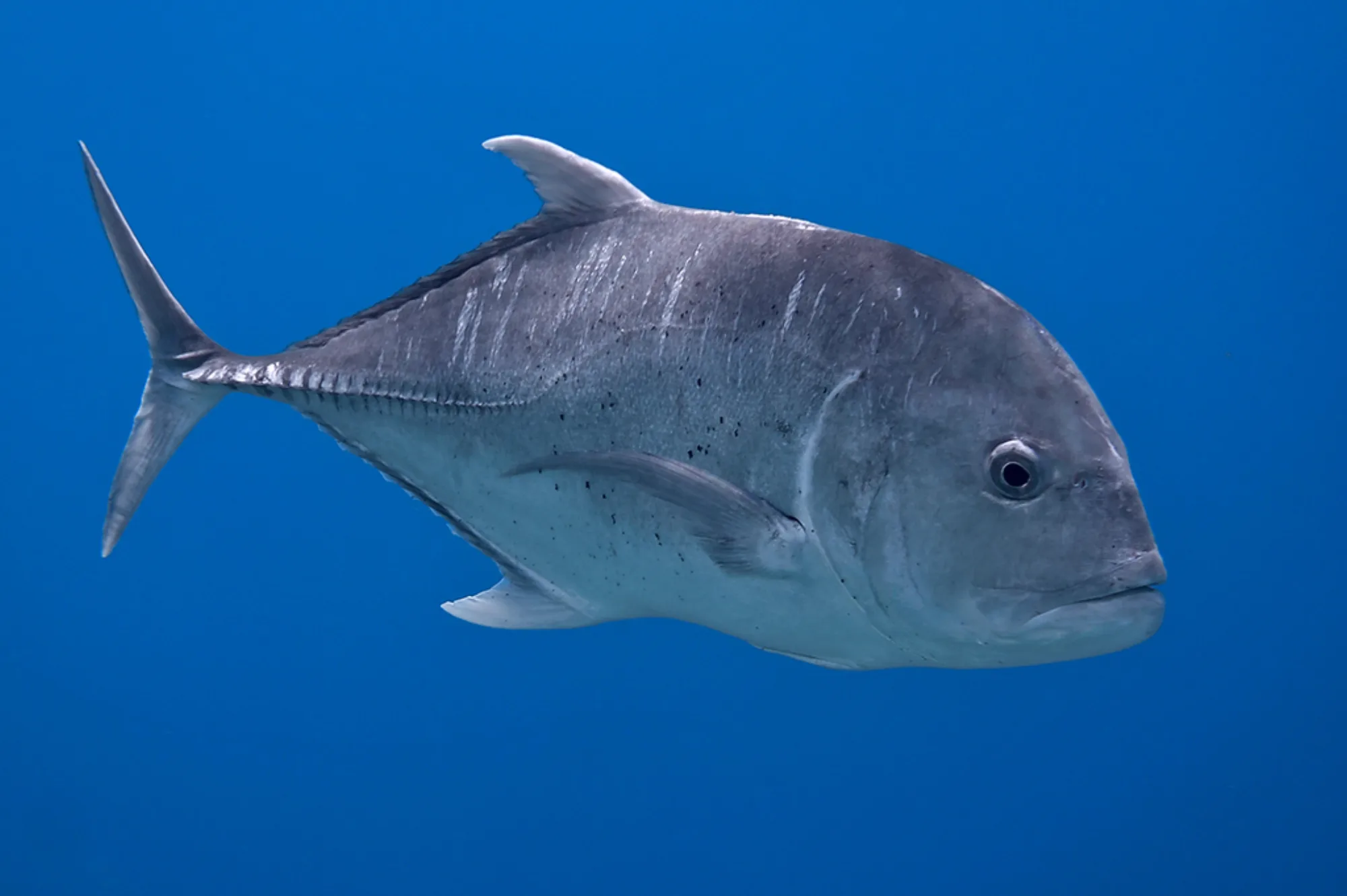
A steep head, strongly forked tail and silvery body give the Giant Trevally (Caranx ignobilis) a distinctive profile. Dark spots may scatter its flanks, while mature males can turn almost black. This large member of the jack family reaches a recorded 170 cm and 80 kg.
Its range spans tropical Indo-Pacific waters, from South Africa to Hawaii, with Japan and Australia marking its northern and southern reaches. Travellers may encounter it around coral and rocky reefs, lagoons, tidal flats and channels. Young fish also enter estuaries, rivers and coastal lakes, often favouring cloudy water. As they mature, they move towards reefs, and older fish tend to occupy deeper seaward reefs and drop-offs. Large individuals return to shallower water to hunt or reproduce.
Young giant trevally often gather in schools, while mature fish usually live alone, joining groups mainly to breed and occasionally to feed. They eat mostly fish, though crustaceans, squid and octopus also feature in their diet. Around Hawaii, some follow monk seals and seize prey disturbed by the seals; at Farquhar Atoll, they have been seen jumping to catch young sooty terns. Breeding takes place in warmer months, with timing varying by location, and large schools gather at particular phases of the moon. Fishing puts pressure on the species: commercial crews use nets and lines, while anglers catch it with bait and lures. Numbers have fallen around the main Hawaiian Islands, and commercial pressure has also reduced the fishery around Oman's Hallaniyat Islands, where large fish are becoming rarer.
Written from the English Wikipedia article Giant trevally (CC BY-SA 4.0).
- Records
- 8,253
- Countries
- 32
- Atlas places
- 3
These are open occurrence records, so they show where people looked for and recorded the Giant Trevally as much as where it lives. Cells are up to 25 km across, and every location is generalised to its cell.
Generalised encounter areas, not exact locations. Each shape is a grid cell coloured by how likely the species is there.
- Very likelyAustralia25 km zone · high confidence · 4246 records · updated 80 days ago
- Very likelyUnited States25 km zone · medium confidence · 2937 records · updated 80 days ago
- Very likelyU.S. Outlying Islands25 km zone · medium confidence · 210 records · updated 80 days ago
- Very likelyJapan25 km zone · medium confidence · 163 records · updated 80 days ago
- Very likelyTaiwan25 km zone · high confidence · 148 records · updated 80 days ago
- Very likelySeychelles25 km zone · high confidence · 146 records · updated 80 days ago
- Very likelyMozambique25 km zone · high confidence · 107 records · updated 80 days ago
- Very likelySaudi Arabia25 km zone · medium confidence · 31 records · updated 80 days ago
- LikelySouth Africa25 km zone · medium confidence · 45 records · updated 80 days ago
- LikelyIndonesia25 km zone · medium confidence · 27 records · updated 80 days ago
Conservation status not assessed here yet, so every location is generalised to its grid cell.