Common Jack
Caranx hippos
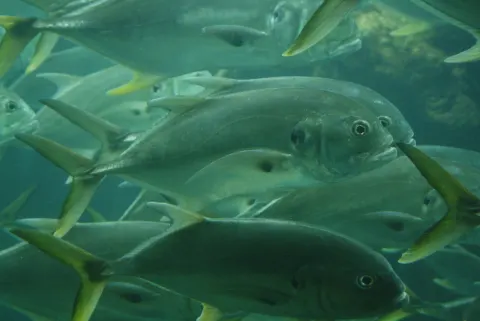
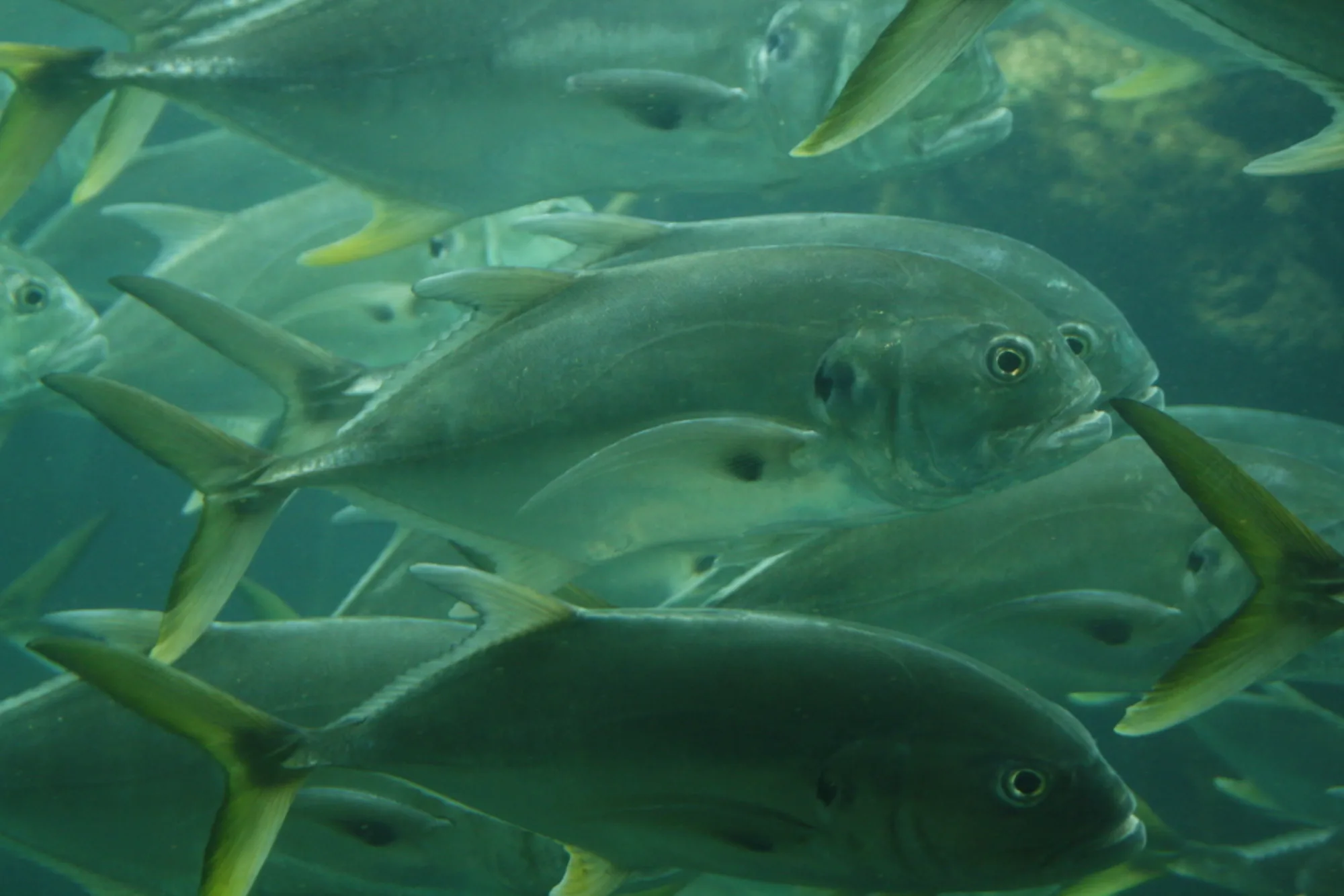
A deep body, a strongly forked tail and a dark spot on the pectoral fin help identify the Common Jack, a large marine fish also known as the crevalle jack. Its back can be brassy green, blue or bluish-black, contrasting with a silvery-white or golden underside. Young fish have about five dark bands down their sides, which fade as they mature. The fish can reach 124 cm and 32 kg, although it is rarely longer than 60 cm.
The Common Jack ranges through tropical and temperate Atlantic waters, from Nova Scotia to Uruguay in the west and from Portugal to Angola in the east, with records in the Mediterranean. Some Mediterranean records may reflect confusion with similar species, however, and its presence north of Mauritania has been questioned. It uses both inshore and offshore waters, including shallow flats, sandy bays, seagrass beds, reefs and lagoons. Young fish use estuaries and seagrass beds as nurseries, while larger adults favour deeper water and may be found around offshore reefs.
For much of its life it travels in fast-moving schools, but larger fish tend to become more solitary. It is more active by day, feeding mainly on small fish alongside smaller amounts of prawns, shrimps, crabs, molluscs and other invertebrates. Spawning is thought to take place throughout the year in most areas, with seasonal peaks and large gatherings beforehand. Fishing takes the species commercially and recreationally, while sharks, billfish and seabirds also prey on it. Cold is another danger for young fish that reach northern waters: those that fail to move back towards warmer water before winter can die as temperatures fall.
Written from the English Wikipedia article Crevalle jack (CC BY-SA 4.0).
- Records
- 40,920
- Countries
- 17
- Atlas places
- 2
These are open occurrence records, so they show where people looked for and recorded the Common Jack as much as where it lives. Cells are up to 25 km across, and every location is generalised to its cell.
Generalised encounter areas, not exact locations. Each shape is a grid cell coloured by how likely the species is there.
- Very likelyColombia25 km zone · high confidence · 38615 records · updated 80 days ago
- Very likelyUnited States25 km zone · medium confidence · 1977 records · updated 80 days ago
- Very likelyPanama25 km zone · high confidence · 95 records · updated 80 days ago
- Very likelyCosta Rica25 km zone · medium confidence · 37 records · updated 80 days ago
- Very likelyPuerto Rico25 km zone · medium confidence · 25 records · updated 80 days ago
- LikelyMexico25 km zone · medium confidence · 111 records · updated 80 days ago
- LikelyBrazil25 km zone · medium confidence · 13 records · updated 80 days ago
- LikelyBelize25 km zone · medium confidence · 11 records · updated 80 days ago
- LikelyFrench Guiana25 km zone · medium confidence · 10 records · updated 80 days ago
- LikelyGuadeloupe25 km zone · medium confidence · 8 records · updated 80 days ago
Conservation status not assessed here yet, so every location is generalised to its grid cell.