Caracal
Caracal caracal
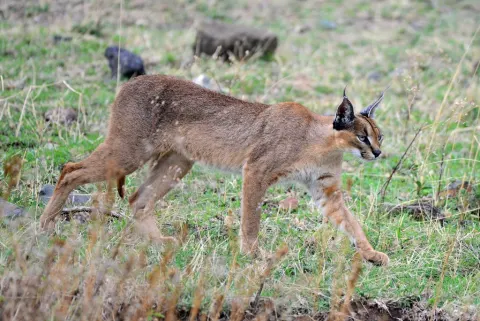
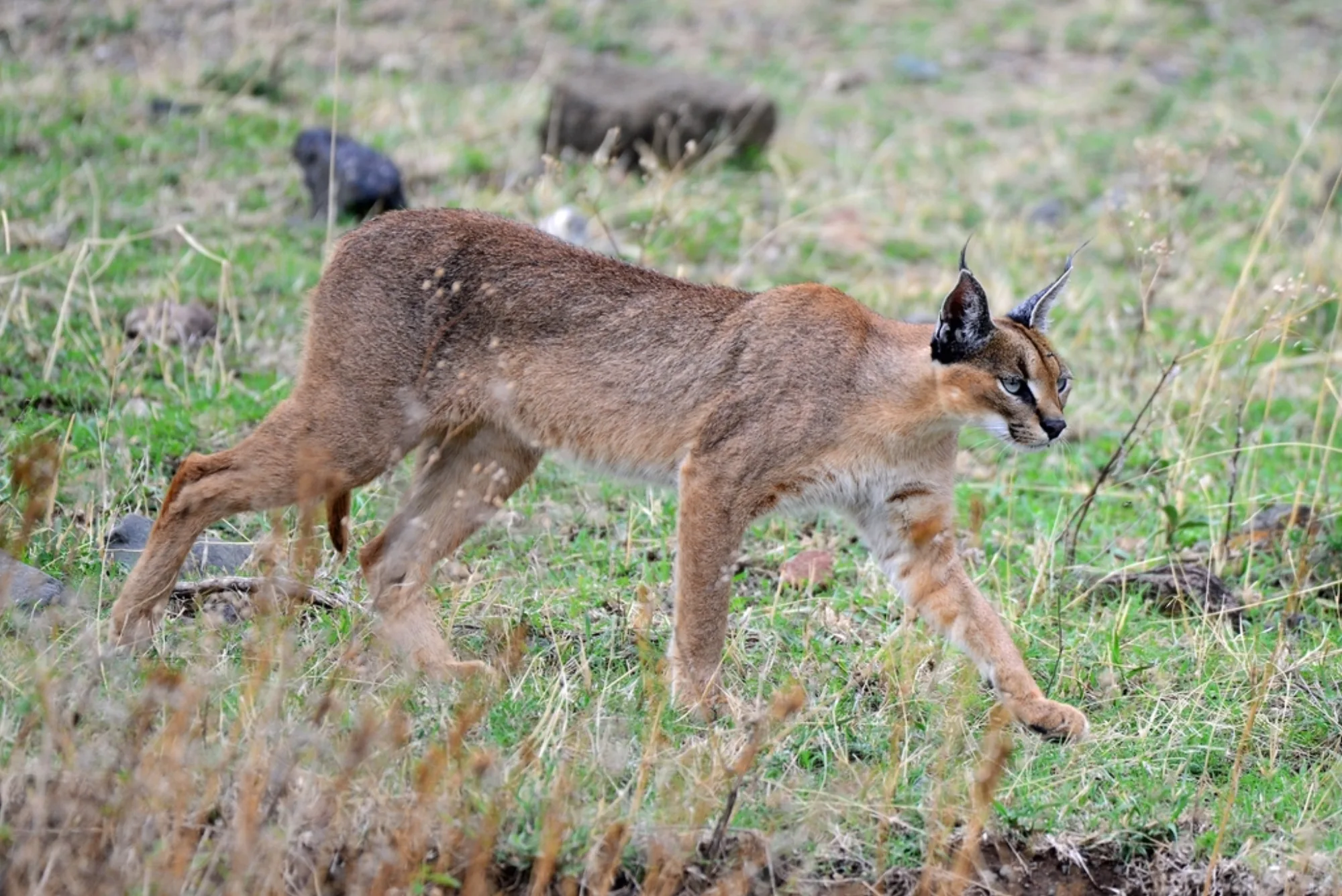
Long black ear tufts and a sandy or reddish-tan coat give the Caracal a distinctive outline. This wild cat has long legs, a sturdy build, a short face and a relatively short tail. Its underside and inner legs are paler, often marked with small reddish spots, while white patches frame the eyes and mouth.
Caracals range across Africa, the Middle East and Central Asia, reaching arid parts of Pakistan and northwestern India. They occur widely across sub-Saharan Africa, though sightings are rare in the north of the continent. Their habitats include savannas, forests, marshy lowlands, semideserts and scrub, although they favour dry places with cover and little rain. Secretive and usually active at night, they can be difficult to see, though they sometimes move about during the day. They are territorial and generally live alone or in pairs, with mothers and their young forming the only groups observed.
Small mammals make up much of the diet, alongside birds, reptiles and insects. A hunting caracal stalks close to its prey before sprinting, and can leap more than 3 m to catch a bird in flight. Breeding occurs throughout the year, with one to six kittens born after a pregnancy of about two to three months. Births generally peak from October to February, in dense vegetation or abandoned aardvark and porcupine burrows. Young caracals begin to leave their mothers at nine to ten months, although some females stay. Across its range, agriculture, roads and settlements destroy habitat, while some people kill caracals to protect livestock or in retaliation for losses. Road accidents threaten caracals in Turkey and Iran, while on the Arabian Peninsula they are hunted for sale as pets.
Written from the English Wikipedia article Caracal (CC BY-SA 4.0).
- Records
- 167
- Countries
- 5
- Atlas places
- 3
These are open occurrence records, so they show where people looked for and recorded the Caracal as much as where it lives. Cells are up to 25 km across, and every location is generalised to its cell.
Generalised encounter areas, not exact locations. Each shape is a grid cell coloured by how likely the species is there.
- Very likelyKenya25 km zone · high confidence · 148 records · updated 80 days ago
- Very likelySouth Africa25 km zone · medium confidence · 15 records · updated 80 days ago
- LikelyBenin25 km zone · medium confidence · 4 records · updated 80 days ago
- UncommonIsrael25 km zone · low confidence · 0 records · updated 80 days ago
- RareTanzania25 km zone · low confidence · 0 records · updated 80 days ago
Conservation status not assessed here yet, so every location is generalised to its grid cell.