European Nightjar
Caprimulgus europaeus
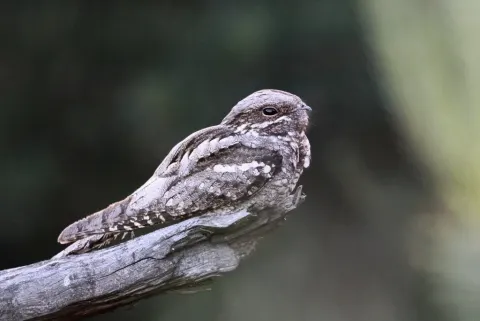
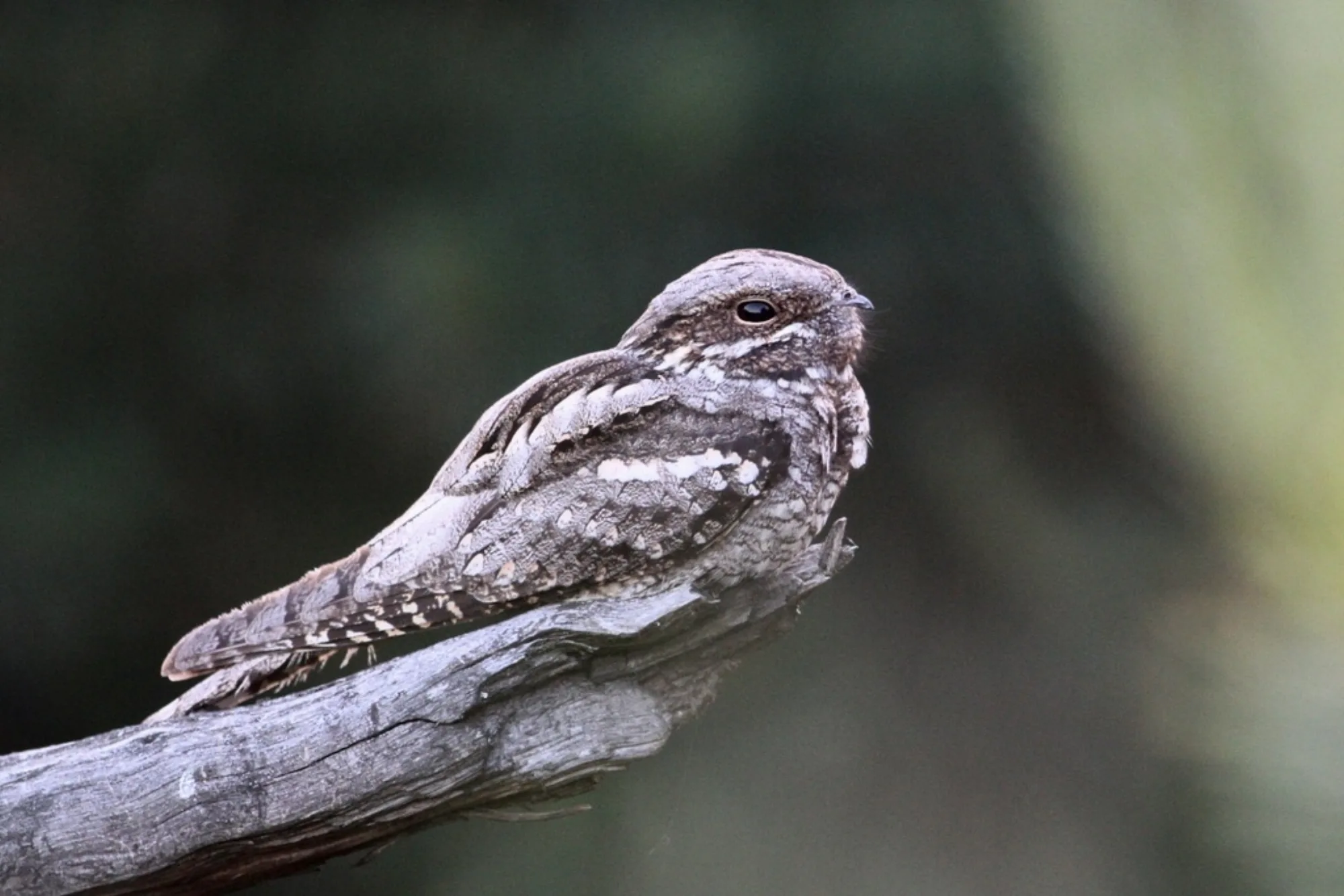
At dusk, a sustained churring trill may reveal a European Nightjar before its singer comes into view. This grey and brown bird is patterned so densely that it can be difficult to spot by day, when it rests on the ground or lies motionless along a branch. In flight, the male shows white patches on his wings and tail, while his long, pointed wings carry him silently. He sings from a perch, most often around first and last light.
European Nightjars breed across much of Europe and east through Asia to Mongolia and northwestern China, then migrate to spend the winter in sub-Saharan Africa. They favour dry, open places with scattered trees and small bushes, including heathland, forest clearings and newly planted woodland. At night they hunt flying insects by sight, sometimes making twisting pursuits and sometimes darting out from a perch. Their prey includes moths, beetles and dragonflies, and they may gather food around lights, farm animals or still ponds.
Breeding usually runs from late May to August, although it can begin earlier in northwestern Africa or western Pakistan. Instead of making a nest, the birds lay their usually one or two blotched eggs directly on the ground, sheltered by vegetation or tree roots. The chicks hatch after about 17 to 21 days and fledge another 16 to 17 days later. Habitat loss, disturbance, vehicle collisions and the loss of insects through pesticide use have contributed to population declines. Ground nests are vulnerable to predators and to disturbance by domestic dogs.
Written from the English Wikipedia article European nightjar (CC BY-SA 4.0).
- Records
- 53,158
- Countries
- 23
- Atlas places
- 4
These are open occurrence records, so they show where people looked for and recorded the European Nightjar as much as where it lives. Cells are up to 25 km across, and every location is generalised to its cell.
Generalised encounter areas, not exact locations. Each shape is a grid cell coloured by how likely the species is there.
- Very likelyNorway25 km zone · high confidence · 11988 records · updated 80 days ago
- Very likelyFinland25 km zone · high confidence · 8420 records · updated 80 days ago
- Very likelyFrance25 km zone · high confidence · 7697 records · updated 80 days ago
- Very likelyUnited Kingdom25 km zone · high confidence · 4711 records · updated 80 days ago
- Very likelyBelgium25 km zone · high confidence · 4253 records · updated 80 days ago
- Very likelySweden25 km zone · high confidence · 3514 records · updated 80 days ago
- Very likelySpain25 km zone · high confidence · 2784 records · updated 80 days ago
- Very likelyPortugal25 km zone · high confidence · 2611 records · updated 80 days ago
- Very likelyDenmark25 km zone · high confidence · 1823 records · updated 80 days ago
- Very likelyIsrael25 km zone · high confidence · 1377 records · updated 80 days ago
Conservation status not assessed here yet, so every location is generalised to its grid cell.