Japanese Serow
Capricornis crispus
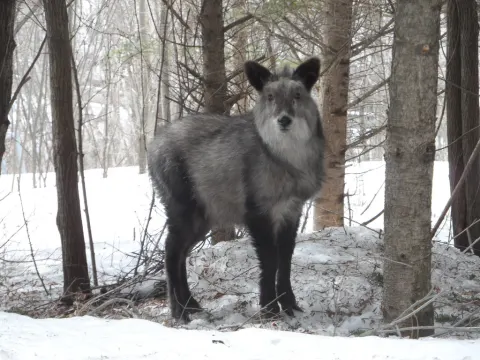
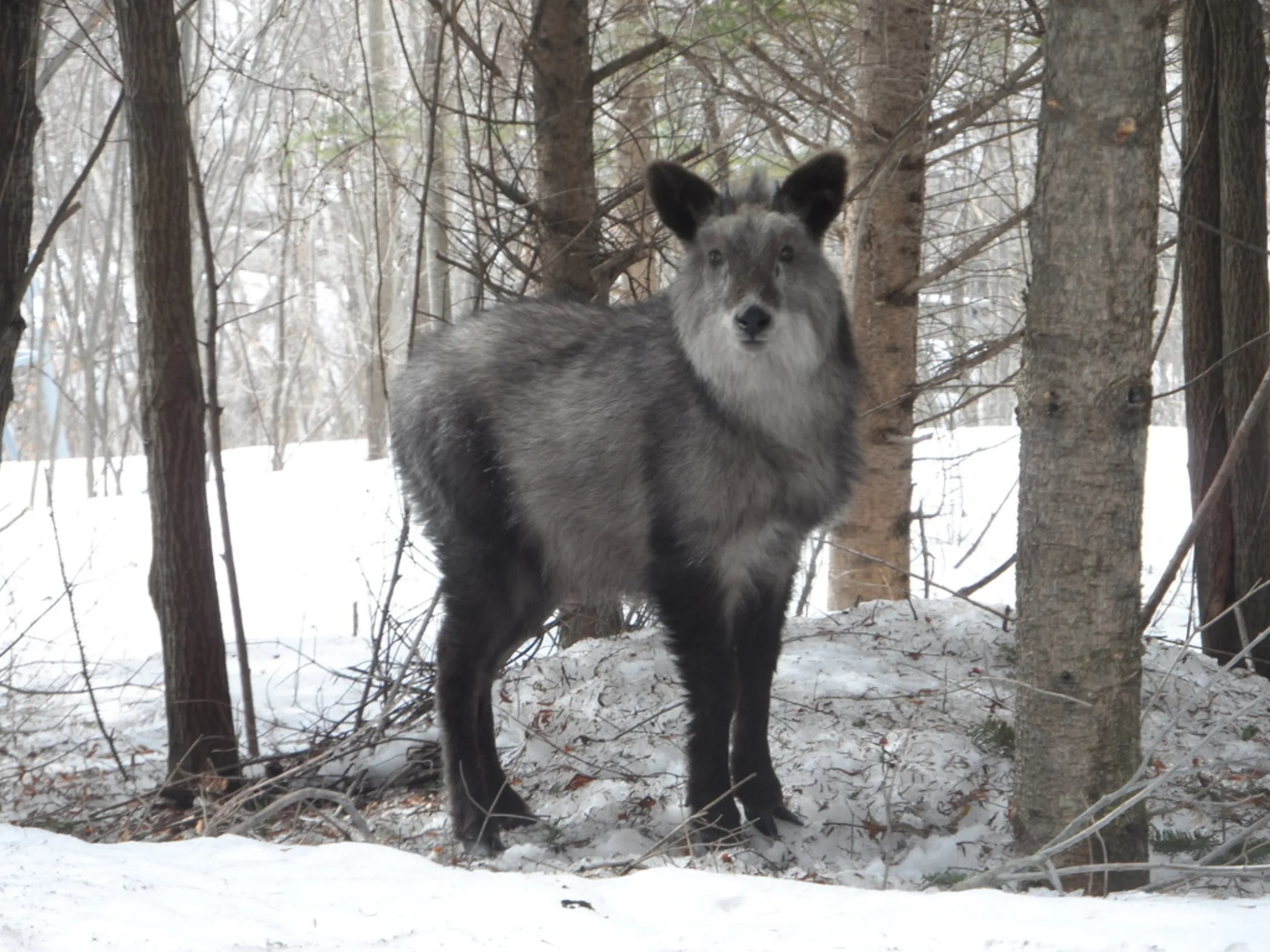
Shaggy and stocky, the Japanese Serow is a goat-antelope with a bushy tail and short horns that curve backwards. Its coat ranges from black or dark brown to whitish, often with a pale neck, and becomes lighter in summer. Males and females look much alike, making them difficult to tell apart by sight. An adult stands about 70 to 85 cm tall and weighs 30 to 50 kg.
Found only in Japan, it lives mainly in northern and central Honshu, with smaller populations in parts of Shikoku and Kyushu. Dense mountain forest is its home, particularly temperate deciduous woodland, although it also occupies other forests, open grassland and conifer plantations. It may rest in caves, and its sure-footedness allows it to move quickly up mountains and leap between cliffs when escaping danger. Active by day, it feeds chiefly in the early morning and late afternoon, browsing leaves, shoots and acorns. Usually alone, it may also be seen in pairs or small family groups; males and females mark separate territories that can overlap. Breeding occurs once a year, and a single young is born between June and August, staying with its mother for 1 to 2 years.
Hunting brought the serow close to extinction in the mid-20th century, and poaching continued despite legal protection. Numbers later grew, but conflict with forestry and farming has led to culling outside protected areas. In Kyushu, competition for food from sika deer may be slowing the growth of serow populations. The Japanese black bear is its only remaining predator, following the extinction of the Japanese wolf.
Written from the English Wikipedia article Japanese serow (CC BY-SA 4.0).
- Records
- 1,251
- Countries
- 1
No atlas park has a record of the Japanese Serow in or around it yet.
These are open occurrence records, so they show where people looked for and recorded the Japanese Serow as much as where it lives. Cells are up to 25 km across, and every location is generalised to its cell.
Generalised encounter areas, not exact locations. Each shape is a grid cell coloured by how likely the species is there.
- Very likelyJapan25 km zone · high confidence · 1251 records · updated 80 days ago
Conservation status not assessed here yet, so every location is generalised to its grid cell.