Eastern Roe Deer
Capreolus pygargus
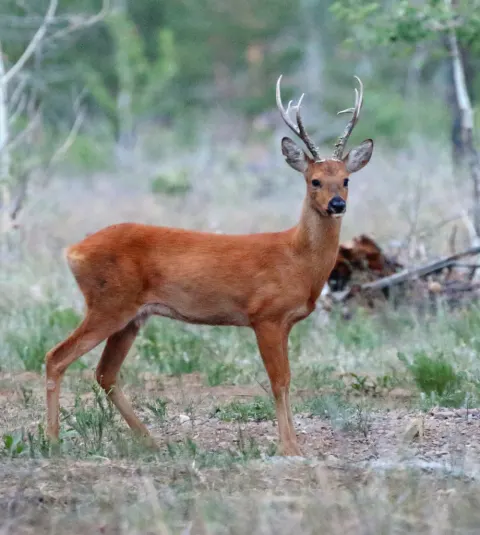
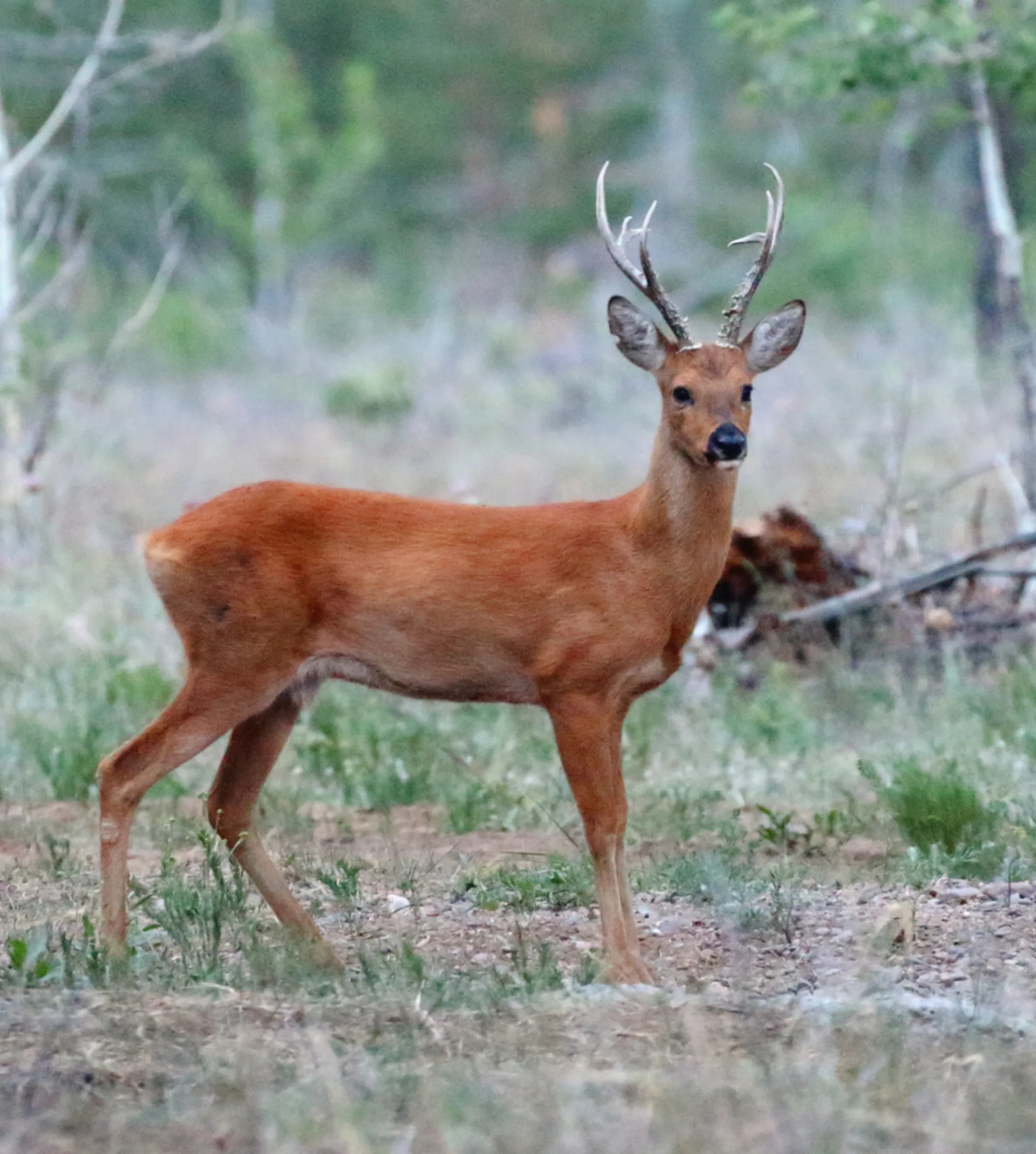
Long ears, a slender build and a white rump patch help distinguish the Eastern Roe Deer, a medium-sized deer of northeastern Asia. Its coat changes with the seasons: reddish in summer, it turns light grey in northern populations in winter, while southern animals become greyish brown and ochre. Young deer have spotted coats. Males are larger than females and carry widely spaced, three-tined antlers that slope upwards; they shed them in autumn or early winter, and regrowth begins soon afterwards. The body can reach 146 cm in length and 59 kg in weight.
Its range stretches from Siberia and Mongolia to Kazakhstan and Kyrgyzstan's Tian Shan Mountains, as well as eastern Tibet, the Korean Peninsula and wooded parts of northern China. It lives in forest and steppe, with particularly dense populations on floodplains and in meadows of tall grass. Its light frame suits tall, dense grass, and it is adapted to severe extremes of weather. Some deer make mass migrations, while males mark territories by rubbing vegetation or fraying trees with their antlers. They also communicate through vocal signals, including barks, whistles and screams.
The deer eats a wide variety of plants, including herbaceous and woody species. In summer it visits natural salt licks to meet its need for sodium, and it usually gets water from moisture-rich food. Mating takes place in August and September, and a female typically gives birth to two young. The young are weaned after 4 to 5 months. Amur leopards, Siberian lynx, snow leopards, Himalayan wolves and Siberian tigers prey on these deer. Around the turn of the 20th century, overhunting reduced their range in parts of Eastern Europe and Asia.
Written from the English Wikipedia article Siberian roe deer (CC BY-SA 4.0).
- Records
- 1,849
- Countries
- 4
No atlas park has a record of the Eastern Roe Deer in or around it yet.
These are open occurrence records, so they show where people looked for and recorded the Eastern Roe Deer as much as where it lives. Cells are up to 25 km across, and every location is generalised to its cell.
Generalised encounter areas, not exact locations. Each shape is a grid cell coloured by how likely the species is there.
- Very likelySouth Korea25 km zone · medium confidence · 1216 records · updated 80 days ago
- Very likelyRussia25 km zone · medium confidence · 618 records · updated 80 days ago
- Very likelyKazakhstan25 km zone · medium confidence · 14 records · updated 80 days ago
- LikelyChina25 km zone · medium confidence · 1 record · updated 80 days ago
Conservation status not assessed here yet, so every location is generalised to its grid cell.