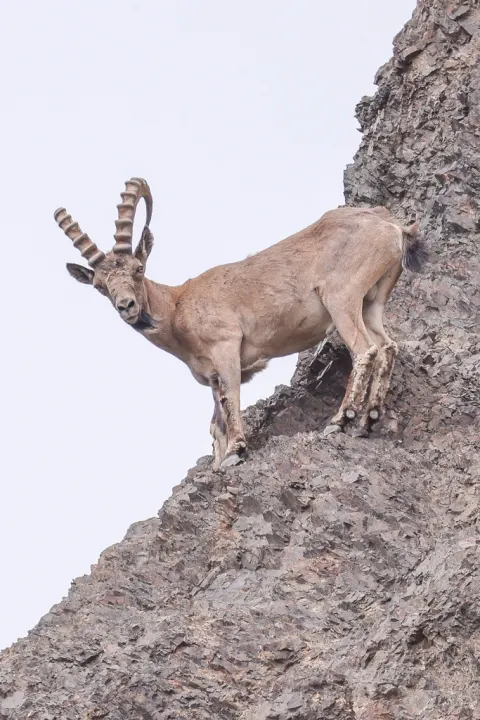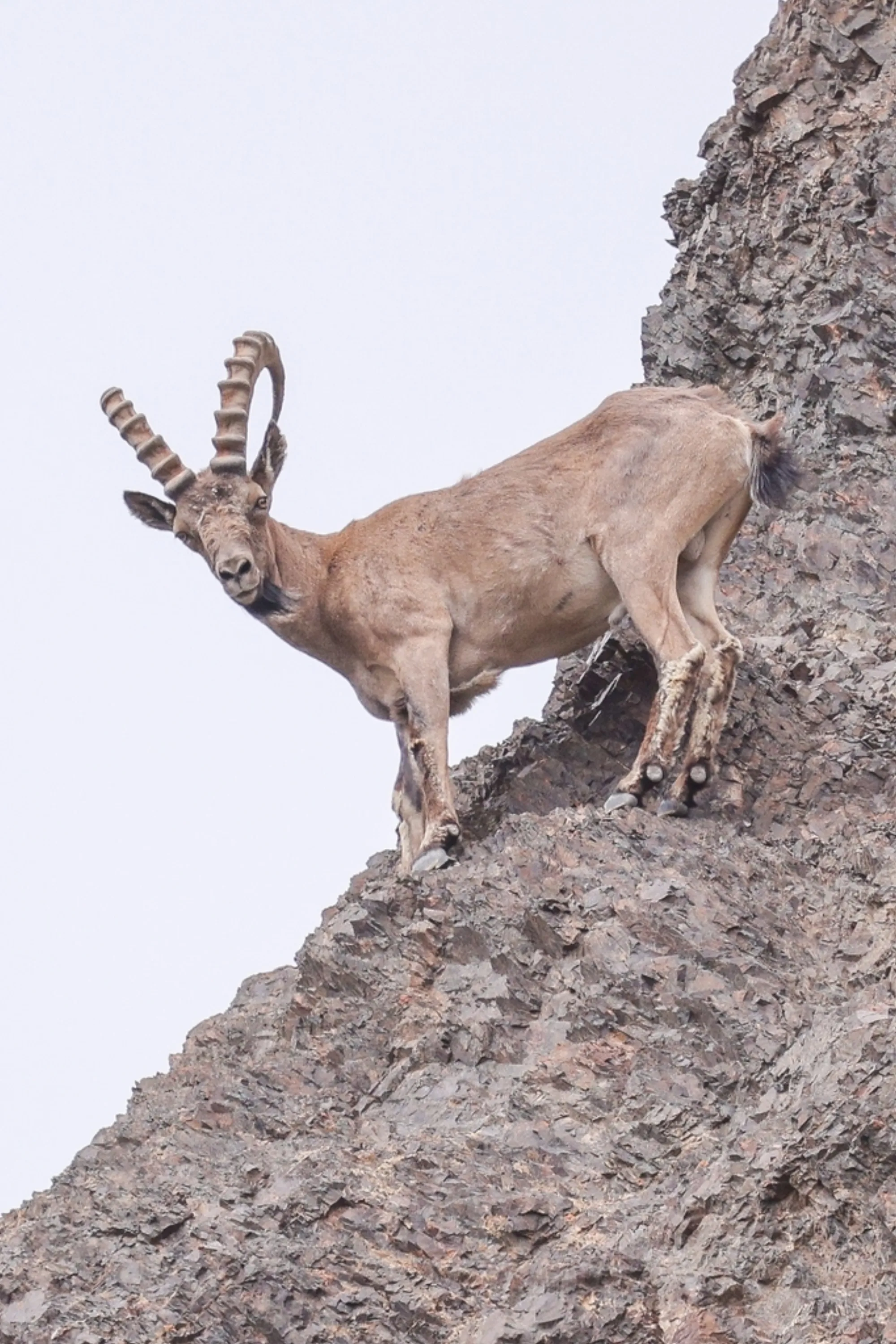
Siberian Ibex
Capra sibirica
Built for mountain country, the Siberian Ibex is a large, heavily built wild relative of goats and sheep. Males are noticeably larger than females, standing 88 to 110 cm at the shoulder and weighing 60 to 130 kg. Both sexes carry horns: mature males have black horns typically about 115 cm long, while female horns average 27 cm. Coats range from dark brown to light tan, sometimes with a reddish colour, and a darker stripe usually runs along the back and onto the tail. In winter, mature males become much darker and develop white patches.
Across central and northern Asia, these ibex live mainly above the tree line, among steep slopes and rocky scree. Their habitat includes high-altitude steppe, alpine meadows and semidesert, with most summer sightings at elevations of roughly 2,000 to 5,000 metres. In winter they descend to lower slopes for food, sometimes pawing through deep snow to reach vegetation. Alpine grasses and herbs form the main diet, supplemented in winter by taller herbs, twigs and needles. Herds commonly number about 5 to 30 and spend much of the day grazing, moving on after an hour or more at a feeding site. Outside the breeding season, most herds consist of one sex, although some remain mixed throughout the year. The rut runs from late October until early January, and females usually give birth to a single kid. Wolves, dholes, snow leopards and brown bears prey on ibex, while young animals may also be taken by lynxes, foxes and eagles. In Pakistan, human pressures and climate change have contributed to a contraction of the species' historical range.
Written from the English Wikipedia article Siberian ibex (CC BY-SA 4.0).
- Records
- 57
- Countries
- 7
- Atlas places
- 1
These are open occurrence records, so they show where people looked for and recorded the Siberian Ibex as much as where it lives. Cells are up to 25 km across, and every location is generalised to its cell.
Generalised encounter areas, not exact locations. Each shape is a grid cell coloured by how likely the species is there.
- Very likelyMongolia25 km zone · medium confidence · 22 records · updated 80 days ago
- Very likelyRussia25 km zone · medium confidence · 13 records · updated 80 days ago
- Very likelyPakistan25 km zone · medium confidence · 9 records · updated 80 days ago
- LikelyKyrgyzstan25 km zone · medium confidence · 4 records · updated 80 days ago
- LikelyChina25 km zone · medium confidence · 3 records · updated 80 days ago
- LikelyKazakhstan25 km zone · medium confidence · 3 records · updated 80 days ago
- PossibleIndia25 km zone · medium confidence · 3 records · updated 80 days ago
Conservation status not assessed here yet, so every location is generalised to its grid cell.