Spanish Ibex
Capra pyrenaica
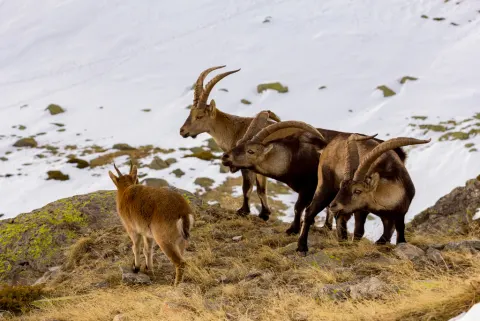
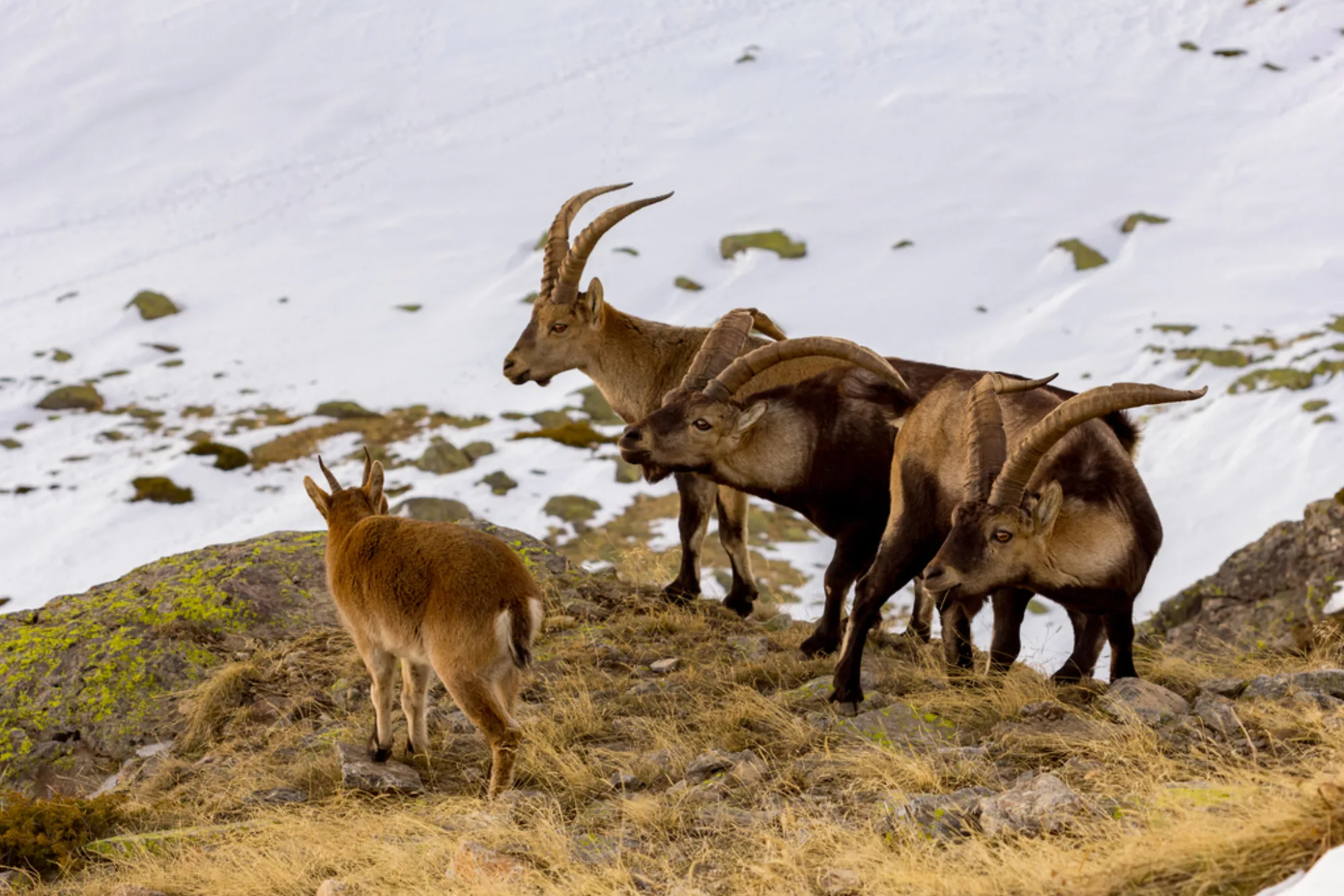
On steep, bare slopes, the Spanish Ibex moves with the help of short legs and large, flexible hooves, running and leaping across ground that predators may struggle to reach. Its horns curve outwards and upwards before sweeping back and in, with the final direction varying between subspecies. Males are larger and heavier than females and carry larger horns. This wild goat lives in Spain and northern Portugal, and a small population has been reintroduced to the French Pyrenees.
Ibex feed on a mix of vegetation, browsing and grazing according to what is available in their home range. Their diet changes with altitude, location and season, and they move less while searching for food in winter than in the more plentiful spring. Males usually form their own groups, while females gather with young animals. During the November and December rut, males join females, and mixed groups remain common through the rest of winter. When new young are born, yearlings leave the female groups; young males return to male groups, while young females eventually rejoin their mothers. If an ibex spots a possible predator, it points its head and ears towards the danger and calls an alarm. The group then flees together, often towards a rocky slope, led by an experienced adult.
Hunting pressure, agricultural development and deteriorating habitat have probably contributed to long-term population declines. Disease, disturbance from tourism and hunting, and possible competition with livestock and other hoofed animals pose further threats. Sarcoptic mange, which can kill infected ibex, has become a major source of instability in many populations.
Written from the English Wikipedia article Iberian ibex (CC BY-SA 4.0).
- Records
- 23,259
- Countries
- 3
No atlas park has a record of the Spanish Ibex in or around it yet.
These are open occurrence records, so they show where people looked for and recorded the Spanish Ibex as much as where it lives. Cells are up to 25 km across, and every location is generalised to its cell.
Generalised encounter areas, not exact locations. Each shape is a grid cell coloured by how likely the species is there.
- Very likelySpain25 km zone · high confidence · 21071 records · updated 80 days ago
- Very likelyFrance25 km zone · high confidence · 2188 records · updated 80 days ago
Conservation status not assessed here yet, so every location is generalised to its grid cell.