Nubian Ibex
Capra nubiana
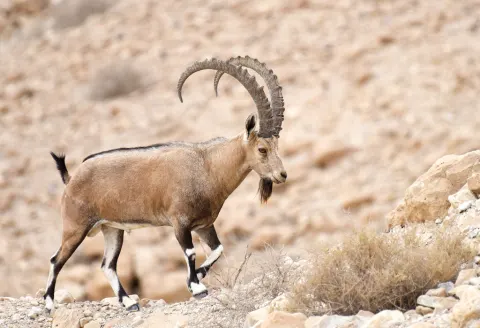
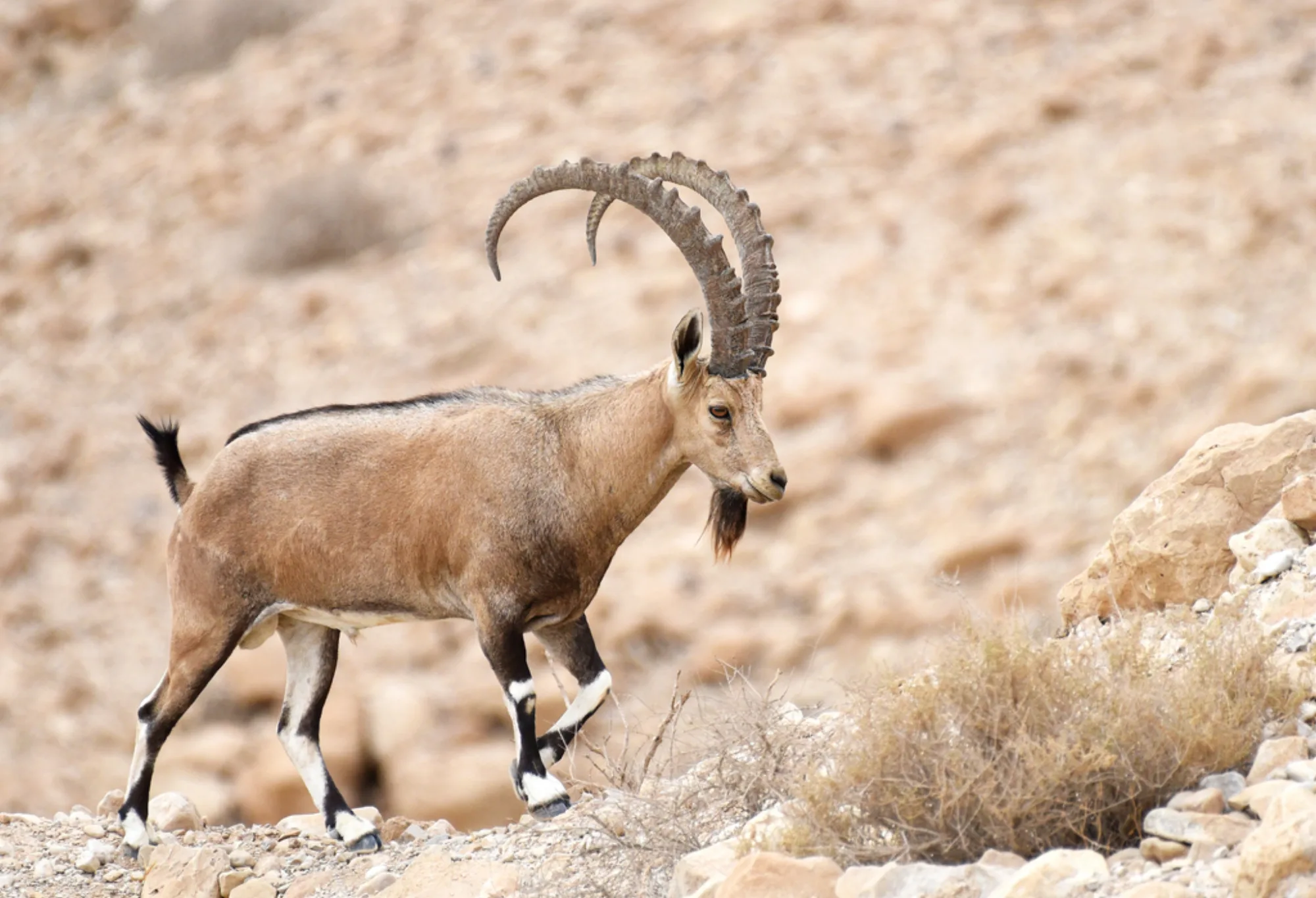
On dry mountain slopes, the Nubian Ibex is a light tan desert goat with a white belly, patterned black and white legs, and a pale rump set off by a dark brown tail. Its long, slender horns rise before curving backwards and down, reaching around 1 m in males and 30 cm in females. Males are larger, with a dark brown mane along the back, and older males grow a beard. It favours rough, dry mountain terrain, with a range that includes Sudan and Egypt in Africa, as well as Saudi Arabia, Oman, Jordan, Israel and Palestine.
Active by day, ibex move between feeding patches and spend much of their time near cliffs, where they can escape predators. They climb and leap readily, often crossing cliffs in single file and leaving well-worn trails over time. Their diet consists mainly of grasses and leaves, especially those of Acacia trees, which they may rear up or climb to reach. Female herds generally stay near permanent water, while males wander more and live alone or in temporary groups. During the autumn breeding season, males join the female herds, and large males clash horns. After a pregnancy of five months, females leave the herd to give birth to one or two kids in a secluded place; mothers and young return after a few days.
Hunting, competition with livestock for water and fodder, habitat destruction and fragmentation, chemical pollution and climate change all threaten the ibex. Recreation can disturb them too, prompting them to avoid people and leave good feeding patches more readily. Some become accustomed to settlements, where they may eat harmful rubbish and lose some of their wariness of predators.
Written from the English Wikipedia article Nubian ibex (CC BY-SA 4.0).
- Records
- 305
- Countries
- 5
No atlas park has a record of the Nubian Ibex in or around it yet.
These are open occurrence records, so they show where people looked for and recorded the Nubian Ibex as much as where it lives. Cells are up to 25 km across, and every location is generalised to its cell.
Generalised encounter areas, not exact locations. Each shape is a grid cell coloured by how likely the species is there.
- Very likelyIsrael25 km zone · high confidence · 286 records · updated 80 days ago
- Very likelyPalestinian Territories25 km zone · medium confidence · 17 records · updated 80 days ago
- PossibleJordan25 km zone · medium confidence · 2 records · updated 80 days ago
Conservation status not assessed here yet, so every location is generalised to its grid cell.