Alpine Ibex
Capra ibex
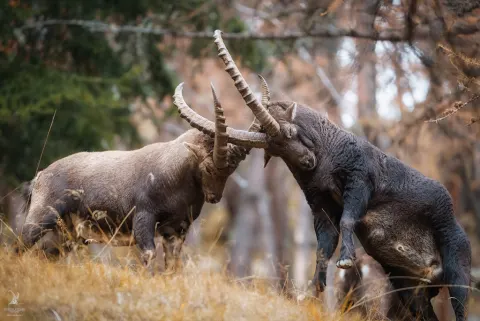
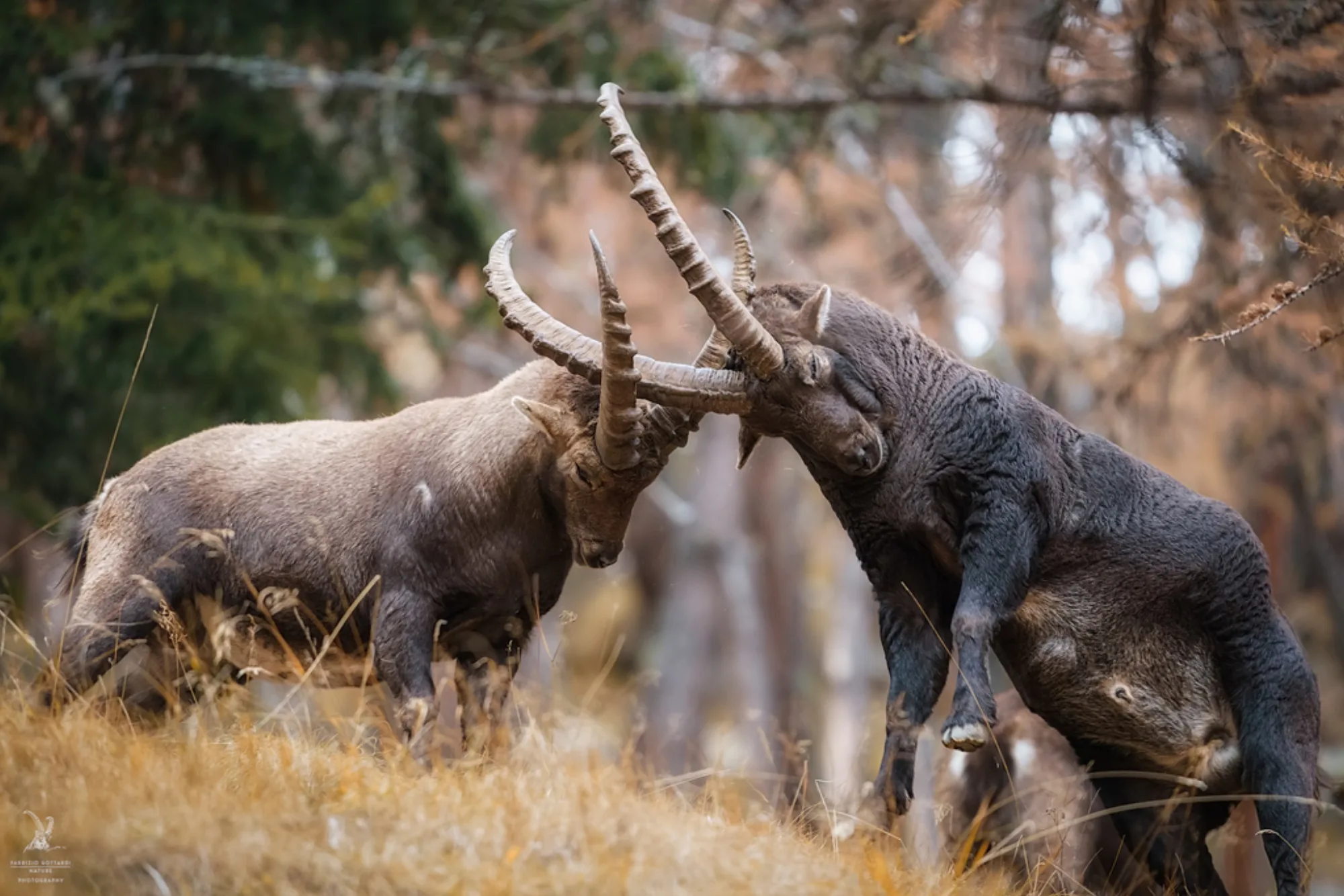
On steep Alpine slopes, the Alpine Ibex is a stocky wild goat with a brownish-grey coat, a pale belly and dark markings on its chin and throat. Both sexes have ridged horns that curve backwards, but males are much larger than females and carry substantially longer horns. A thick winter coat gives way to shorter, thinner hair in spring, before growing back in autumn.
Native to the Alps of central Europe, ibexes live across France, Switzerland, Liechtenstein, Italy, Germany and Austria, and have also been introduced to Slovenia and Bulgaria. They favour open, rough terrain and alpine meadows, climbing slopes and cliffs with the help of their sharp hooves. Males move from lowland meadows in spring to alpine meadows in summer, while both sexes seek steep, rocky slopes in early winter. Active all year, they find shelter during cold winter nights and warm themselves in the morning sun. Grass is their main food, supplemented by herbs in summer and by dwarf shrubs and conifer shoots in autumn and winter.
Ibexes are social, though adult males and females spend most of the year in separate groups. They gather during the December and January breeding season, when males fight rivals using their horns. Females usually give birth to one kid, sometimes two, on rocky slopes away from their groups; mothers and young later gather in nursery groups. Hunting once drove the species close to extinction, but reintroductions have returned it to parts of its former range. Today, disease, parasites and avalanches can kill ibexes, while low genetic diversity leaves them at risk of inbreeding and may make them more vulnerable to infectious disease.
Written from the English Wikipedia article Alpine ibex (CC BY-SA 4.0).
- Records
- 166,211
- Countries
- 8
No atlas park has a record of the Alpine Ibex in or around it yet.
These are open occurrence records, so they show where people looked for and recorded the Alpine Ibex as much as where it lives. Cells are up to 25 km across, and every location is generalised to its cell.
Generalised encounter areas, not exact locations. Each shape is a grid cell coloured by how likely the species is there.
- Very likelyFrance25 km zone · high confidence · 65379 records · updated 86 days ago
- Very likelySwitzerland25 km zone · high confidence · 53248 records · updated 86 days ago
- Very likelyItaly25 km zone · high confidence · 45852 records · updated 86 days ago
- LikelyAustria25 km zone · high confidence · 1691 records · updated 86 days ago
- PossibleSlovenia25 km zone · medium confidence · 26 records · updated 86 days ago
- PossibleGermany25 km zone · medium confidence · 12 records · updated 86 days ago
- UncommonIsrael25 km zone · medium confidence · 3 records · updated 86 days ago
- RareEgypt25 km zone · low confidence · 0 records · updated 86 days ago
Conservation status not assessed here yet, so every location is generalised to its grid cell.