Markhor
Capra falconeri
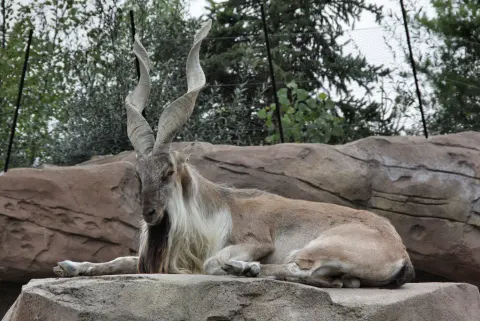
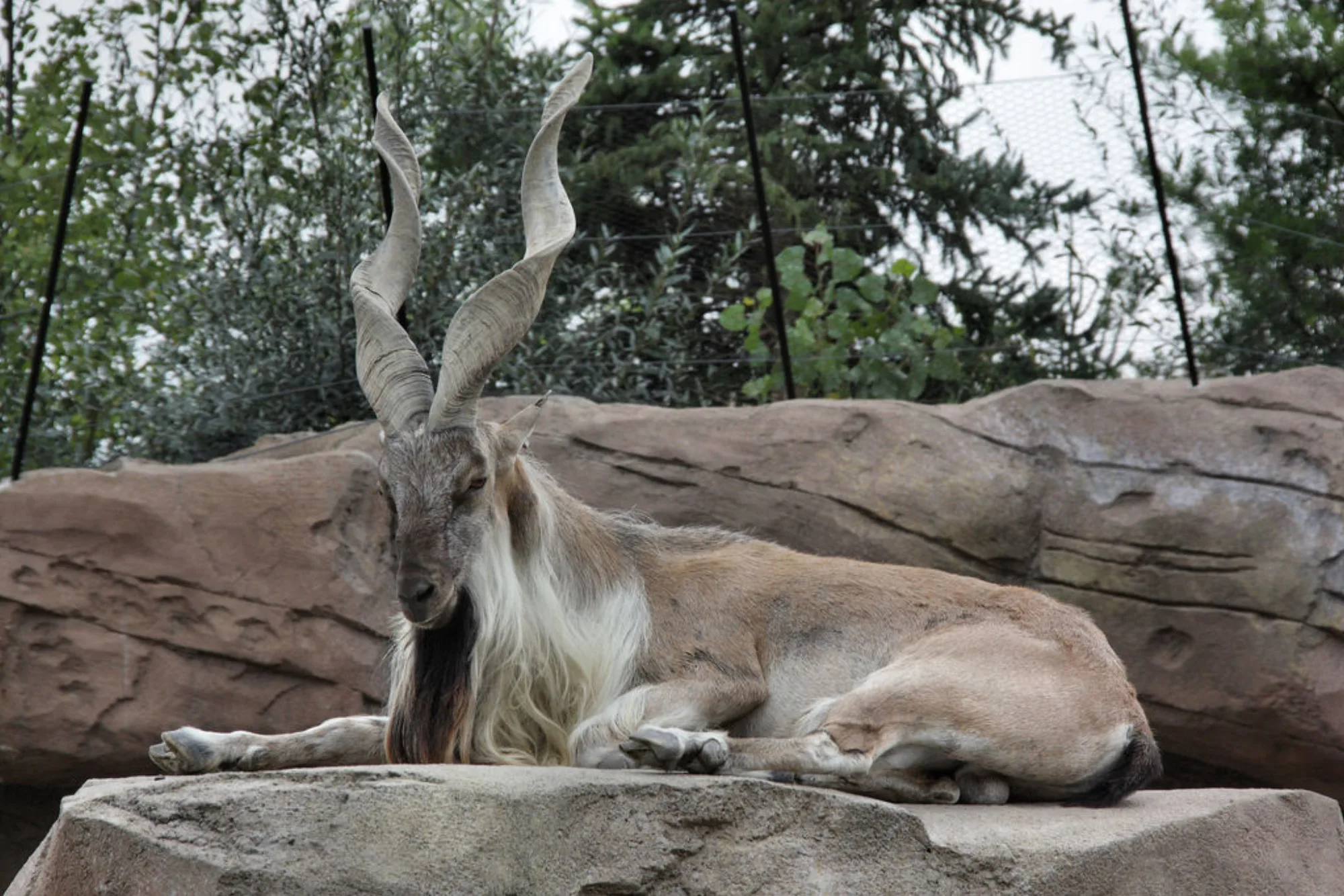
Corkscrew horns give the Markhor (Capra falconeri) a distinctive silhouette in the mountains of Central and South Asia. Both sexes have horns that rise apart towards their tips, although those of males can reach 160 cm, compared with 25 cm in females. Adults stand 65 to 115 cm at the shoulder and have grizzled coats ranging from light brown to black. Their coats are short and smooth in summer, becoming longer and thicker in winter; males also have longer hair around the chin and throat, across the chest and down the lower legs.
Markhor range across parts of Central and South Asia, from Turkmenistan and Uzbekistan to Tajikistan, Afghanistan, Pakistan and India, including the Karakoram and Himalayas. In mountainous terrain between 600 and 3,600 m above sea level, they inhabit shrub forests dominated by oak, pine and juniper. They are most active early in the morning and again towards late afternoon, grazing in spring and summer and browsing in winter, sometimes rising on their hind legs to reach branches. Females and their young usually form herds of nine, while adult males are largely solitary. In summer, males stay in the forest while females generally move up to the highest rocky ridges. Breeding takes place in winter, and females usually give birth to one or two kids after 135 to 170 days.
Poaching is a major threat, disturbing animals and breaking populations into small, isolated groups. Competition with domestic livestock also reduces available forage, and dense livestock herds can push wild herbivores out of the best grazing areas. Lynx, snow leopards, Himalayan wolves and brown bears prey on markhor, while golden eagles have been reported taking young.
Written from the English Wikipedia article Markhor (CC BY-SA 4.0).
- Records
- 40
- Countries
- 1
No atlas park has a record of the Markhor in or around it yet.
These are open occurrence records, so they show where people looked for and recorded the Markhor as much as where it lives. Cells are up to 25 km across, and every location is generalised to its cell.
Generalised encounter areas, not exact locations. Each shape is a grid cell coloured by how likely the species is there.
- Very likelyUzbekistan25 km zone · medium confidence · 40 records · updated 80 days ago
Conservation status not assessed here yet, so every location is generalised to its grid cell.