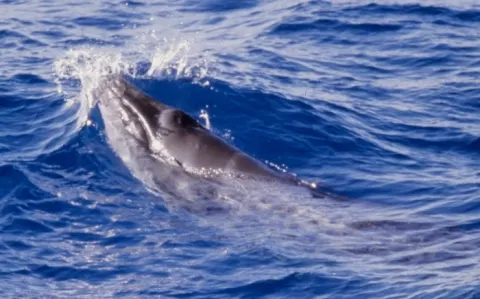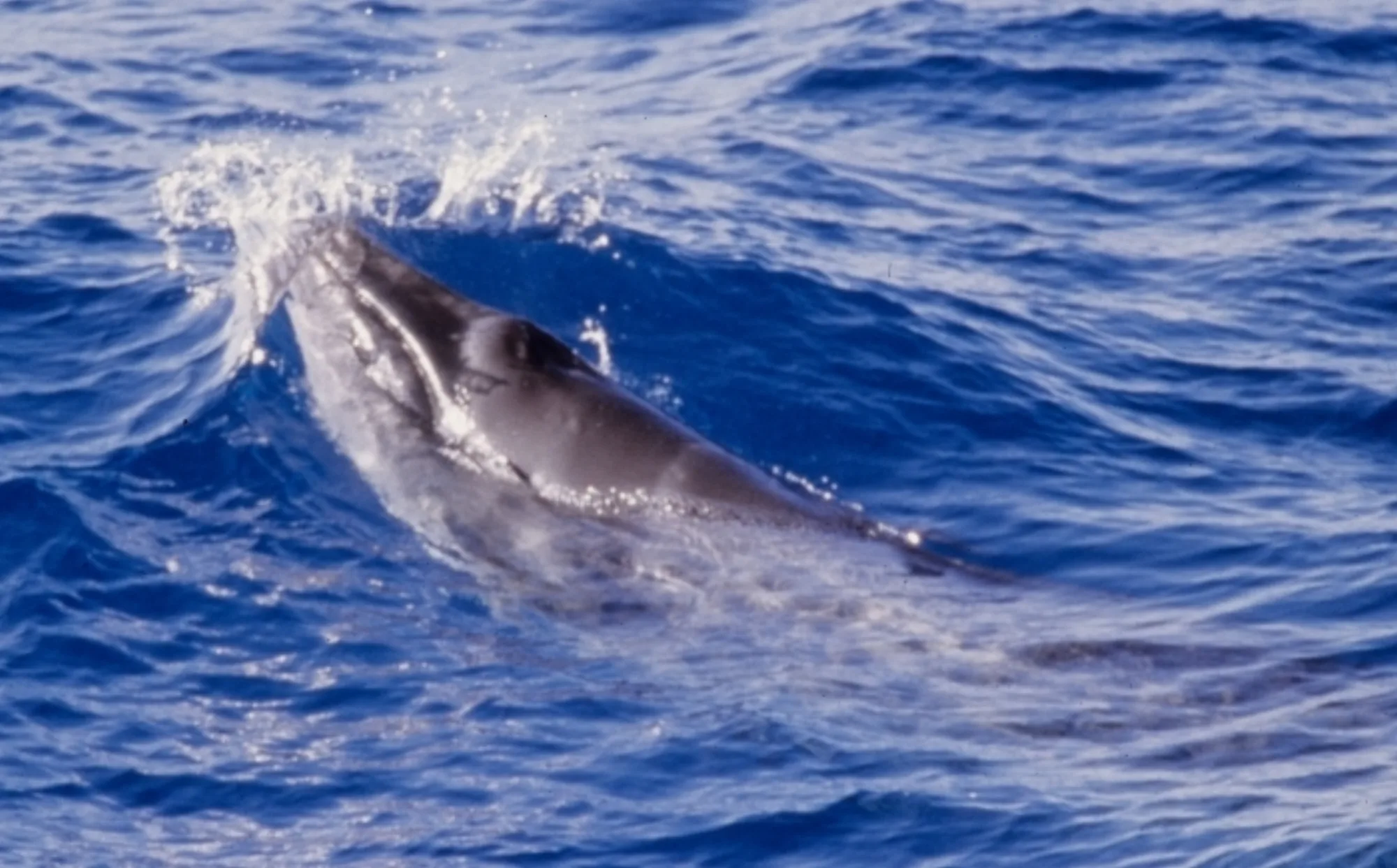
Pygmy Right Whale
Caperea marginata
Small and elusive, the Pygmy Right Whale (Caperea marginata) is the smallest baleen whale, reaching between 6 and 6.5 metres in length. It is dark grey above and lighter underneath, often with two pale, chevron-shaped patches behind the eyes. Its crescent-shaped dorsal fin sits far back, though it may not appear when the whale surfaces. Its faint, modest blow can be hard to see; it generally swims with a slow, rolling motion, although it can accelerate suddenly. It does not lift its tail flukes when diving. At sea it can be confused with dwarf and Antarctic minke whales; its cream-coloured baleen and white gumline are useful distinguishing features.
This whale lives in temperate Southern Hemisphere waters, probably in a band encircling the globe between about 30°S and 55°S. There, surface water temperatures range from 5 to 20 °C. Strandings have been recorded in New Zealand and Australia, as well as in South Africa, Namibia, Tierra del Fuego and Chile; at least one group may live off Tasmania year-round. Sightings at sea are rare, and the species is not the main target of whale watching cruises. It is usually seen alone or in pairs, sometimes alongside other cetaceans, although larger groups have occasionally been recorded.
Stomach contents show that it eats copepods and krill. Calves are estimated to measure about 1.6 to 2.2 metres at birth and may be weaned at 5 months, but gestation and lactation periods remain unknown. Some individuals have been caught in fishing nets, and strandings have been recorded. A calf's remains were also found in a killer whale caught off South Africa. Whaling has rarely targeted the species, and its total population is unknown.
Written from the English Wikipedia article Pygmy right whale (CC BY-SA 4.0).
- Records
- 201
- Countries
- 1
- Atlas places
- 1
These are open occurrence records, so they show where people looked for and recorded the Pygmy Right Whale as much as where it lives. Cells are up to 25 km across, and every location is generalised to its cell.
Generalised encounter areas, not exact locations. Each shape is a grid cell coloured by how likely the species is there.
- Very likelyAustralia25 km zone · medium confidence · 201 records · updated 80 days ago
Conservation status not assessed here yet, so every location is generalised to its grid cell.