Ethiopian Wolf
Canis simensis
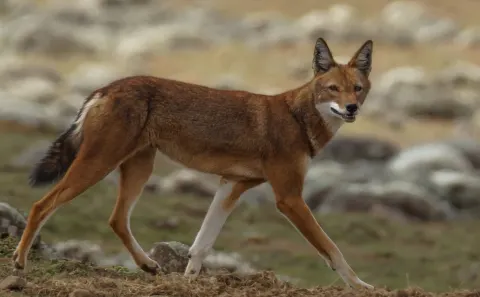
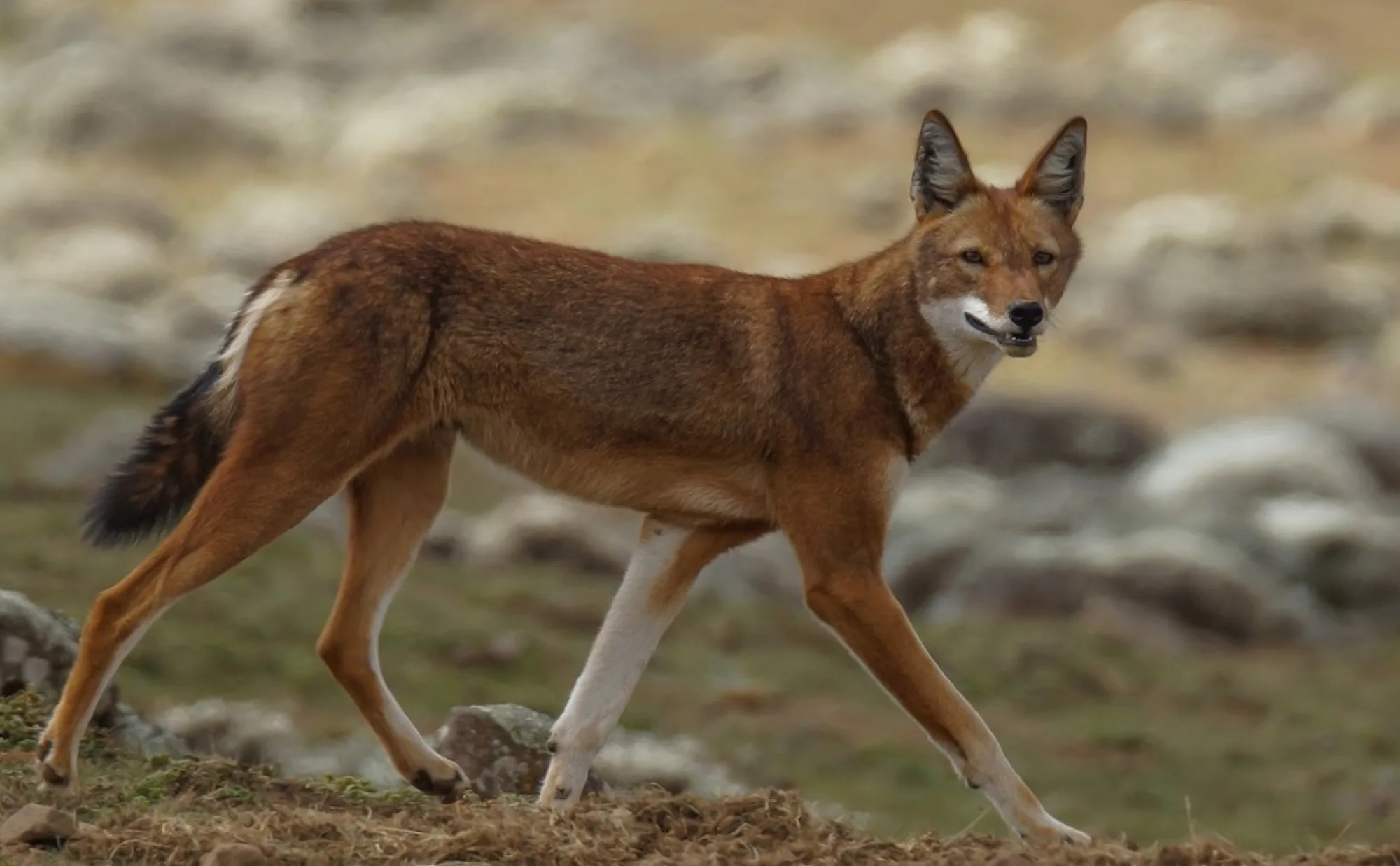
With its rusty red coat, white throat and chest, and black-tipped tail, the Ethiopian Wolf is a distinctive sight in the highlands of Ethiopia. It has long legs, broad pointed ears and a slender build similar in size to a coyote. White markings extend around the sides of its neck and beneath its eyes. It lives in isolated pockets of Afroalpine grassland and heathland, including the Bale and Simien mountains. Its preferred ground is open, with short vegetation and plenty of rodents; in Bale, some wolves inhabit montane grasslands at 3,000 m.
Ethiopian wolves live in family packs, commonly of six, sharing territories and gathering for greetings and patrols. They rest together in the open at night, sometimes sheltering from rain behind boulders or under overhanging rocks. Although social, they usually hunt small prey alone and are most active during the day. In Bale, their main prey is the big-headed African mole-rat, but they also take other rodents and highland hares. Wolves have been seen hunting among grazing geladas, where they catch rodents more successfully than usual. Pups are born between October and December, and all pack members help feed and protect them.
Farming, livestock grazing and roads take up or divide the highland habitat on which the wolves depend. Disease is another serious threat: rabies outbreaks originating in infected dogs have killed many wolves, and canine distemper has also caused outbreaks. Free-ranging dogs can also interbreed with wolves, while road collisions and retaliatory killing pose further dangers.
Written from the English Wikipedia article Ethiopian wolf (CC BY-SA 4.0).
- Records
- 7
- Countries
- 1
No atlas park has a record of the Ethiopian Wolf in or around it yet.
These are open occurrence records, so they show where people looked for and recorded the Ethiopian Wolf as much as where it lives. Cells are up to 25 km across, and every location is generalised to its cell.
Generalised encounter areas, not exact locations. Each shape is a grid cell coloured by how likely the species is there.
- Very likelyEthiopia25 km zone · medium confidence · 7 records · updated 80 days ago
Conservation status not assessed here yet, so every location is generalised to its grid cell.