Wolf
Canis lupus
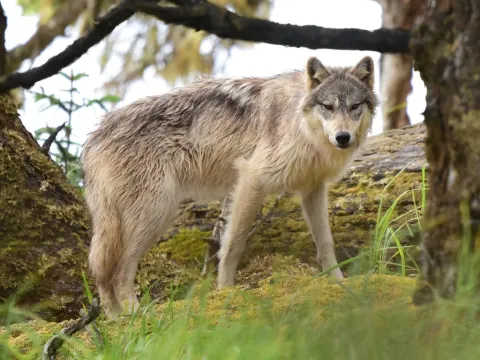
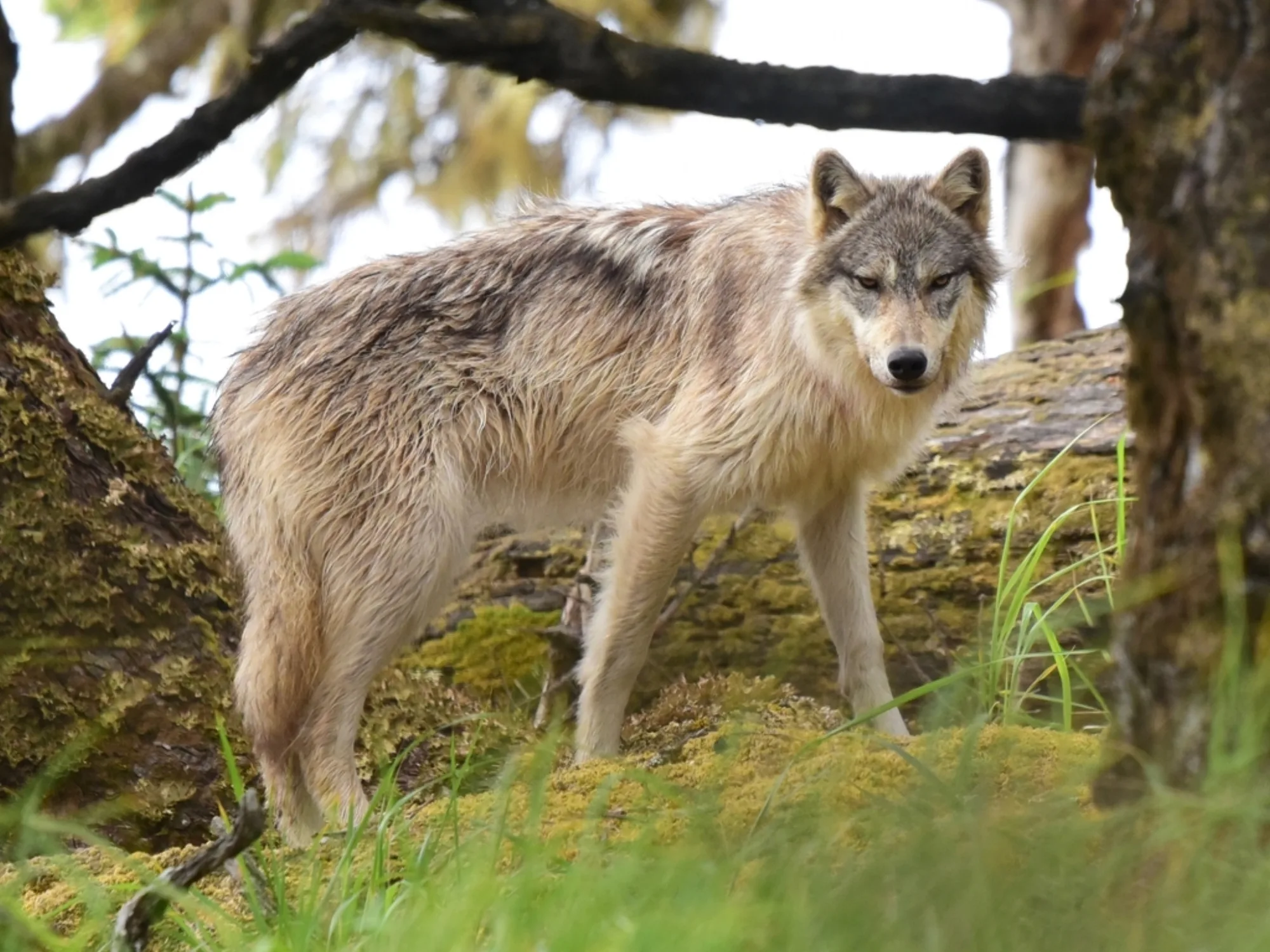
Across Eurasia and North America, the Wolf (Canis lupus) is the largest wild member of the dog family. Slender and powerfully built, it has relatively small triangular ears, a broad snout and a long tail. Its coat is usually a mottled mix of white, brown, grey and black, though Arctic wolves may be almost entirely white. Adults measure 105 to 160 cm in length and stand 80 to 85 cm at the shoulder. Wolves now live mostly in wilderness and remote areas, from forests and wetlands to grasslands, deserts and rocky mountain peaks. They occur from sea level to 3,000 m, with their choice of habitat influenced by prey, snow, roads and human presence.
Wolves are social and territorial, travelling in family groups built around a mated pair and their offspring. They howl to bring the pack together, raise an alarm or keep in contact across long distances. Large wild hoofed mammals are central to their diet, but they also eat smaller animals, livestock, carrion and garbage. They generally hunt alone in summer, while winter packs may hunt through the night. Pups are usually born in spring, or in early summer in very cold places, and by autumn they can join adults hunting large prey. Young wolves may eventually leave their family to form a pack of their own, sometimes because of competition for food. Deliberate persecution linked to livestock losses and fear of attacks has greatly reduced the Wolf's range. Conflict over game and livestock, concern about danger to people and habitat fragmentation remain threats, while territorial fights and diseases also kill wolves.
Written from the English Wikipedia article Wolf (CC BY-SA 4.0).
- Records
- 26,475
- Countries
- 14
- Atlas places
- 1
These are open occurrence records, so they show where people looked for and recorded the Wolf as much as where it lives. Cells are up to 25 km across, and every location is generalised to its cell.
Generalised encounter areas, not exact locations. Each shape is a grid cell coloured by how likely the species is there.
- Very likelySwitzerland25 km zone · high confidence · 14106 records · updated 80 days ago
- Very likelyNorway25 km zone · medium confidence · 8188 records · updated 80 days ago
- Very likelyFrance25 km zone · high confidence · 1585 records · updated 80 days ago
- Very likelyItaly25 km zone · high confidence · 1564 records · updated 80 days ago
- Very likelySweden25 km zone · medium confidence · 341 records · updated 80 days ago
- Very likelyUkraine25 km zone · medium confidence · 252 records · updated 80 days ago
- Very likelyEstonia25 km zone · medium confidence · 75 records · updated 80 days ago
- Very likelyUnited States25 km zone · medium confidence · 65 records · updated 80 days ago
- Very likelyArmenia25 km zone · medium confidence · 42 records · updated 80 days ago
- Very likelyIsrael25 km zone · medium confidence · 38 records · updated 80 days ago
Conservation status not assessed here yet, so every location is generalised to its grid cell.