Golden Jackal
Canis aureus
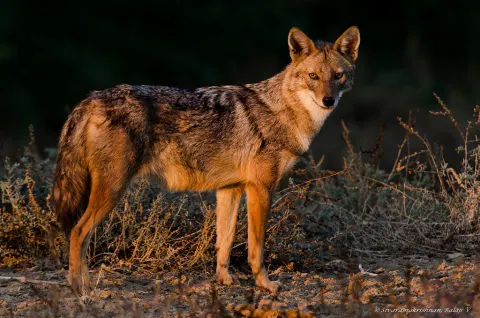
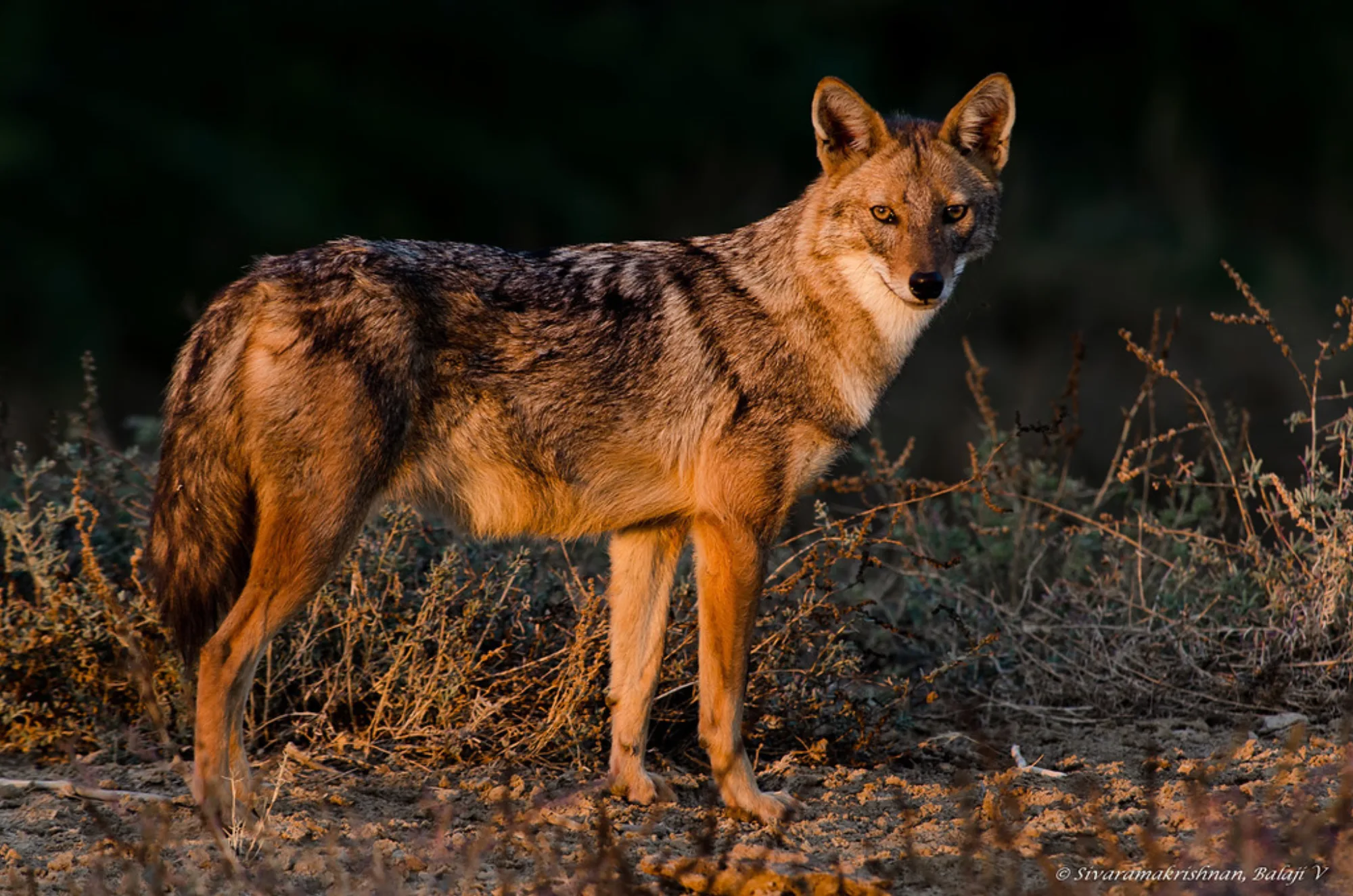
With its pointed muzzle and bushy tail, the Golden Jackal is a wolf-like canid native to Eurasia. Its coarse, relatively short coat ranges from pale creamy yellow in summer to darker tawny beige in winter, with black, brown and white hairs along the back. The underparts are pale ginger to cream, and the tail can have a tan or black tip. Smaller than a grey wolf, it has shorter legs and a shorter tail, as well as a more elongated body.
Golden jackals inhabit Europe and much of Asia, from the southwest and centre to the south and southeast. They are abundant in valleys and beside rivers, canals, lakes and seashores, and also live among prickly bushes, in reed floodlands and in forests. Their tolerance of dry conditions helps them use varied habitats: in India they live in the Thar Desert, while in Central Asia they are found at desert edges and in oases.
A breeding pair forms the core of jackal society, sometimes accompanied by their pups. Jackals often hunt alone, listening for rodents in grass before leaping and pouncing, though they sometimes hunt in pairs. Their varied diet includes birds, insects, fruit and carrion, and they may bury surplus food. Group howling is common, particularly at dawn and in the evening. Breeding pairs use dens, and males help dig and raise the pups. Wolves can kill jackals or displace them from their territories, while Eurasian lynxes and striped hyenas also hunt them. People hunt golden jackals in several European countries, and an anti-rabies campaign reduced their populations in Israel and Lebanon.
Written from the English Wikipedia article Golden jackal (CC BY-SA 4.0).
- Records
- 4,436
- Countries
- 31
- Atlas places
- 7
These are open occurrence records, so they show where people looked for and recorded the Golden Jackal as much as where it lives. Cells are up to 25 km across, and every location is generalised to its cell.
Generalised encounter areas, not exact locations. Each shape is a grid cell coloured by how likely the species is there.
- Very likelyIsrael25 km zone · medium confidence · 3553 records · updated 80 days ago
- Very likelyPalestinian Territories25 km zone · high confidence · 384 records · updated 80 days ago
- Very likelySwitzerland25 km zone · medium confidence · 104 records · updated 80 days ago
- Very likelyNorway25 km zone · high confidence · 76 records · updated 80 days ago
- Very likelyIndia25 km zone · medium confidence · 64 records · updated 80 days ago
- Very likelyLebanon25 km zone · high confidence · 62 records · updated 80 days ago
- Very likelyArmenia25 km zone · medium confidence · 47 records · updated 80 days ago
- Very likelyBulgaria25 km zone · medium confidence · 31 records · updated 80 days ago
- Very likelySyria25 km zone · medium confidence · 24 records · updated 80 days ago
- Very likelyMontenegro25 km zone · medium confidence · 19 records · updated 80 days ago
Conservation status not assessed here yet, so every location is generalised to its grid cell.