Bactrian Camel
Camelus bactrianus
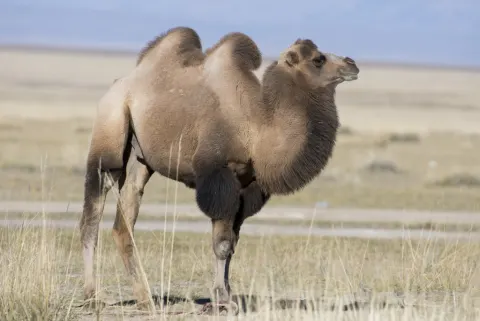
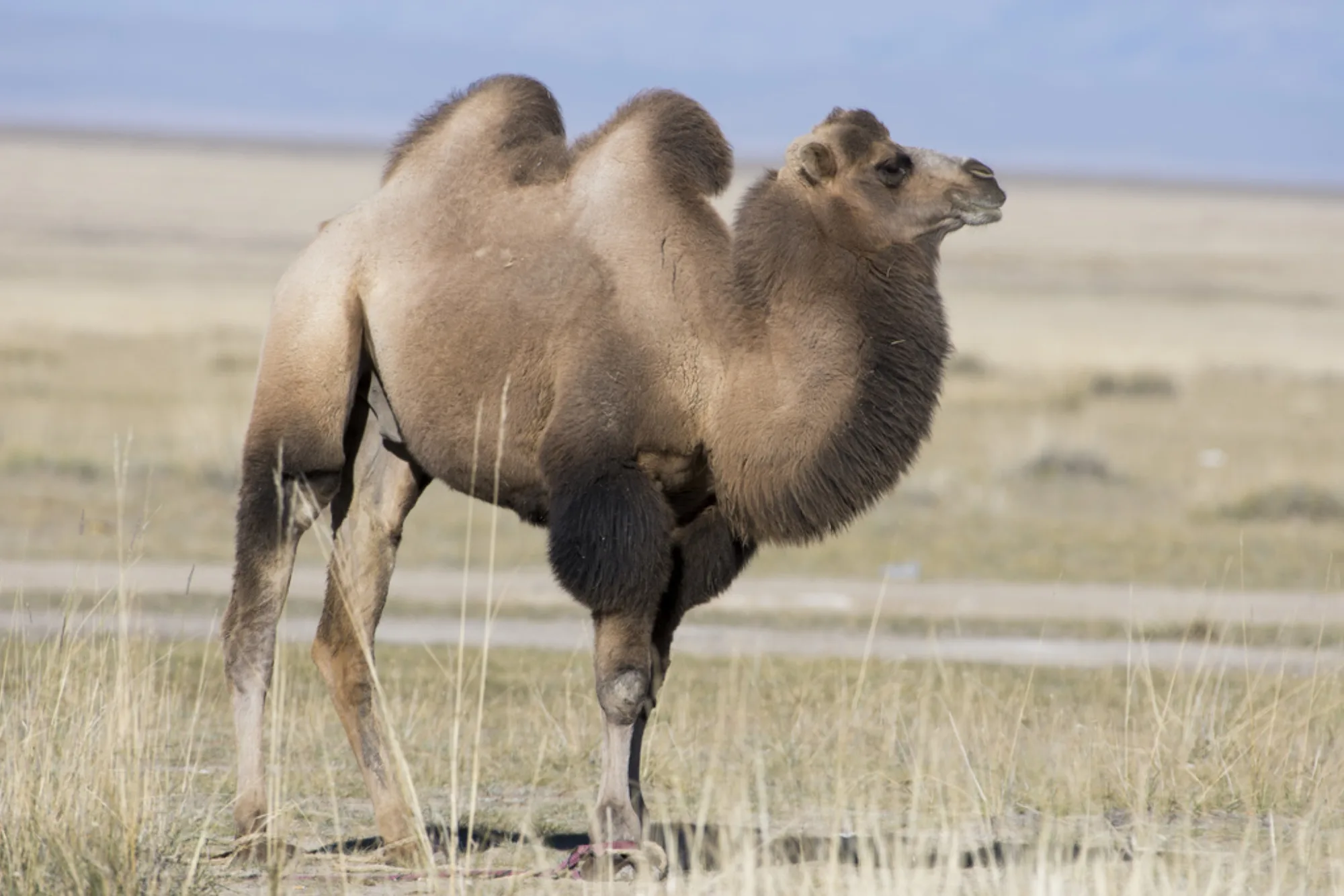
Two humps and a long, woolly coat make the Bactrian Camel a distinctive sight on the steppes of Central Asia, where it is native. Its coat ranges from dark brown to sandy beige, with longer hair forming a mane and beard. In warmer weather, the shaggy coat sheds in large sections. The humps contain fat and can shrink and lean sideways when food is scarce. Long eyelashes and nostrils that can close help keep out dust during sandstorms. Most of the population is domesticated, with camels bred by farming and herding communities in Central Asia, the Middle East, and areas of Mongolia and China.
Bactrian camels migrate through landscapes ranging from rocky mountains and flat steppe to desert, stony plains and sand dunes, mainly in the Gobi Desert. These habitats have sparse vegetation, limited water and extreme temperatures. After rain, large groups gather near rivers, while mountain springs provide water in summer and snow does so in winter. Active by day, the camels graze mainly on grasses but can also eat dry, prickly, salty or bitter plants. Salt-loving plants are a necessary part of their diet, and they may turn to fish or carcasses when other food is unavailable. They can go for months without water and also eat snow to meet their water needs.
Females usually reach maturity at three to five years, and pregnancy lasts around 13 months. A mother normally has one calf, occasionally two, and can give birth every other year. Calves can stand and run shortly after birth and stay with their mothers for three to five years.
Written from the English Wikipedia article Bactrian camel (CC BY-SA 4.0).
- Records
- 11
- Countries
- 7
No atlas park has a record of the Bactrian Camel in or around it yet.
These are open occurrence records, so they show where people looked for and recorded the Bactrian Camel as much as where it lives. Cells are up to 25 km across, and every location is generalised to its cell.
Generalised encounter areas, not exact locations. Each shape is a grid cell coloured by how likely the species is there.
- Very likelyRussia25 km zone · medium confidence · 10 records · updated 80 days ago
- LikelyTajikistan25 km zone · medium confidence · 1 record · updated 80 days ago
- LikelyUnited States25 km zone · low confidence · 0 records · updated 80 days ago
- PossibleMongolia25 km zone · low confidence · 0 records · updated 80 days ago
- UncommonChina25 km zone · low confidence · 0 records · updated 80 days ago
- UncommonIndia25 km zone · low confidence · 0 records · updated 80 days ago
Conservation status not assessed here yet, so every location is generalised to its grid cell.